

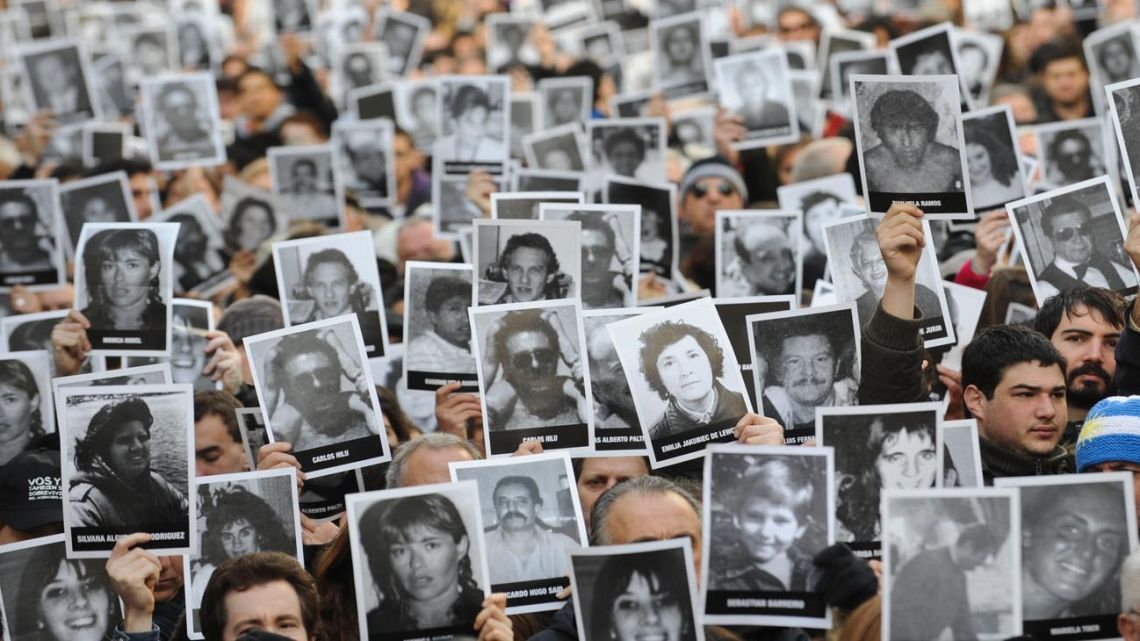
Chamber I of the Federal Appeals Court, with votes from judges Mariano Llorens and Martín Irurzun, overturned a decision by judge Daniel Rafecas and ordered the application of the trial in absentia law in order to prosecute those accused of the 1994 bombing attack on the AMIA Jewish community centre who remain fugitives from Argentine justice.
Sebastián Basso, the prosecutor in the case, had requested that the Iranian and Lebanese suspects accused of the car-bombing be brought to trial. Rafecas rejected the request, arguing that there was no final court ruling on the matter. However, in a decision issued last Thursday – reported by Perfil – the court upheld Basso’s request.
In the ruling challenged by Basso, Judge Rafecas had stated that the decision establishing the application of trial in absentia was awaiting a decision from the Criminal Cassation Court and that “the suspensive effect remains in force until the appeal is resolved.”
Prosecutor Basso appealed Rafecas’s ruling on the grounds that “laws passed by Congress take immediate effect.”

“It is contradictory to allow the public defence to act on behalf of the fugitives while simultaneously suspending the proceedings that the same law authorises,” he argued.
Argentina’s law governing trial in absentia is Law 27,784, passed by Congress last year. During a session in February last year, the Senate approved it by 45 votes to 22, with no abstentions. The initiative received support from the caucuses of La Libertad Avanza (LLA), PRO, the Unión Cívica Radical (UCR), Provincias Unidas and a sector of Peronism.
Those named and charged in the trial in absentia are Alí Fallahijan, Ali Akbar Velayati, Moshen Rezai, Ahmad Vahidi, Hadi Soleimanpour, Ahmad Reza Ashari or Mohsen Randjbaran, Mohsen Rabbani, Salman Rauf Salman, Abdallah Salman and Hussein Mounir Mouzannar, all fugitives from Argentine justice.

In Thursday’s ruling, Chamber II of the Federal Court of Appeal argued that the fact that “there are appeals still pending resolution” before the Criminal Cassation Court “shall not prevent the continuation of proceedings as the case moves towards trial.”
Llorens and Irurzun stressed “the need to expedite the case through proceedings to remove the formal barriers distancing the conflict from the expected judicial response”. In his opinion, Llorens stated that in an earlier ruling in the same case he had spoken “of the need to guarantee victims, their families and the wider community their right to the truth, which has been gravely undermined in a context marked by unsuccessful and ineffective mechanisms for clarifying the facts and punishing those responsible.”
The judge stressed that “the extreme seriousness of the atrocity demands an appropriate and effective response from the judicial authorities.”

“It cannot be overlooked that more than 30 years have passed since the attack on the AMIA headquarters and this duty of the state has still not been fulfilled,” he said.
“Thus, the legislation enacted domestically emerges as the legal instrument capable of finally enabling the full clarification of the facts so that the determination of the truth may effectively be achieved. Therefore, halting the continuation of the case in this context would dilute the objectives of the law and, at the same time, sustain the paradox whereby those of us called upon to apply a mechanism created in pursuit of truth and justice end up delaying the achievement of that very objective,” Llorens wrote.












Comments