

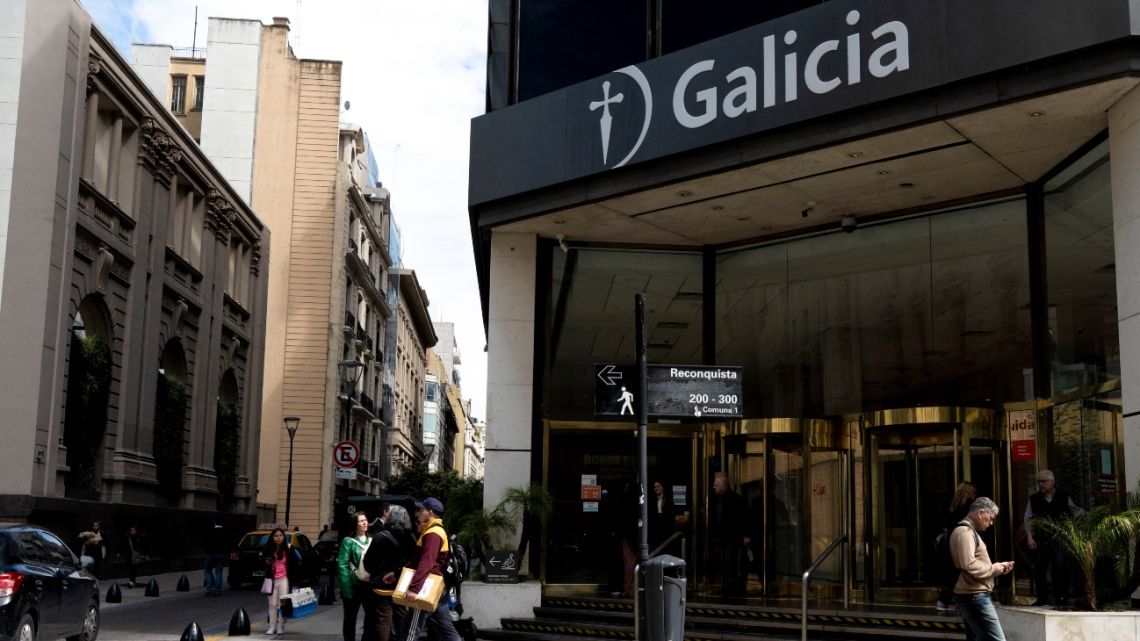
Banks in Argentina saw their worst results since the pandemic amid President Javier Milei’s fierce push to tame the currency before midterm elections.
Private banks posted losses during the third quarter as the nation’s loan delinquency rate surged to its worst level in at least 15 years, a result of high interest rates that Milei’s Central Bank imposed in the run up to the October 26 vote. The squeeze has forced bankers’ hands, triggering a sharp pullback in lending that could continue well into 2026, just as Milei needs credit to play a major role in boosting economic growth in the coming years.
Among the institutions that retreated is Naranja X, the consumer-finance arm of Grupo Financiero Galicia, Argentina’s largest privately-held bank. “We started to limit new loan origination to protect the balance sheet,” said Naranja X Chief Financial Officer Hernán García.
Behind his decision was the weakest quarter for Argentine bank earnings since Covid, the full extent of which only became clear in recent days. Delinquencies among Naranja X clients climbed 11 percent in September, an unprecedented surge but still lower than the national average of 18.4 percent for non-bank lenders that month, according to a report by Eco Go, a private consultancy firm.

The results are among the side effects of the bruising battle Milei fought to prevent a collapse of the peso and still win the congressional vote. To anchor the currency, the government took on a tight monetary stance, lifting interest rates to triple-digit levels and forcing banks to hold reserves of more than 50 percent of their deposits – and, crucially, to meet those requirements on a daily basis, rather than monthly.
“A very tight monetary policy characterised by unsustainably high real interest rates and historic reserve requirements ahead of the elections had a severe impact on economic activity and particularly the entire banking sector,” Julio Patricio Supervielle, chief executive officer of Banco Supervielle SA, told investors during the company’s latest earnings call.
The return on equity generated by large institutions such as Supervielle dropped to around minus seven percent, from about 18 percent in 2023 before Milei took office and around 12 percent at the end of last year.

For banks, the combination of factors was toxic. Deposits became more expensive, a bigger share of their balance sheets got stuck at the Central Bank generating little or no real return, and loan demand collapsed just as credit risk started to climb.
Even for international banks with sizeable operations throughout Latin America, such as local units Spain’s Banco Santander SA and Banco Bilbao Vizcaya Argentaria, Argentina dragged down third-quarter results during an otherwise healthy period for regional profits. “Argentina is worse than what we expected,” BBVA CEO Onur Genç said on a call with investors shortly after the elections.
His counterpart at Santander echoed the sentiment. “With real rates at these levels, it’s really impossible to make money,” CEO Héctor Grisi said on an earnings call. “Lending in pesos in Argentina in this market today is difficult because of the real rates, and credit deployment is challenging given the cost of funding and the rate environment.”

Argentina’s regulatory framework gives them little room to manoeuvre. Credit card issuers, for example, are constrained from raising interest rates when they want to cool demand, meaning they have to resort to narrowing the pool of potential borrowers instead. Risk teams at banks have tightened their metrics in recent weeks, using inferred client income, repayment capacity and the Central Bank’s debtor registry to deny credit to less-solvent borrowers.
The tightening of credit conditions is occurring as Argentines struggle to adjust to a new macro reality. For years, households relied on annual inflation over 50 percent to erode their credit-card balances fixed in pesos, paying the monthly minimum. Now, with stagnant economic activity and interest rates above inflation, that implicit subsidy has vanished.
Wages have lagged price increases, rates are high and the economic outlook is soft – a mix that has pushed delinquencies sharply higher. Banks report that write-offs have climbed to their highest levels since the pandemic and that household non-performing loans have reached their largest share in at least 15 years, since the Central Bank series began, hitting double digits in some portfolios in September.

“Some institutions were too lax in 2024 when it came to extending credit lines and this year they were hit by a rise in delinquencies that hurt their results. On top of that, with higher interest rates and reserve requirements, funding costs went through the roof,” said Ignacio Sniechowski, head of research at local broker IEB.
Bank executives for months have been voicing their frustration in meetings with Central Bank officials, according to people with direct knowledge of those conversations. They had hoped that once the electoral dust settled, policymakers would swiftly loosen the screws.
So far, the response has been lukewarm. Real rates have indeed gone down since the election, contributing to a better outlook for credit and defaults. But reserve requirements remain high. The Central Bank has trimmed the key one-day repo rate to 20 percent from 25 percent, slightly eased the daily reserve-compliance rule to 95 percent from 100 percent and allowed part of the required reserves to be held in government bonds rather than cash.

For bankers, that hasn’t been enough. Most executives expect the pressure on bank balance sheets to persist. Part of that has to do with the real economy: activity will likely recover gradually, and real wages will need time to claw back the ground lost in the last inflation spike that followed the initial devaluation after Milei took office.
“We are still not seeing stabilisation in delinquency levels, which are increasing every month,” said Marcelo De Gruttola, vice-president for financial institutions at Moody’s Ratings.
by Ignacio Olivera Doll & David Feliba, Bloomberg











Comments