

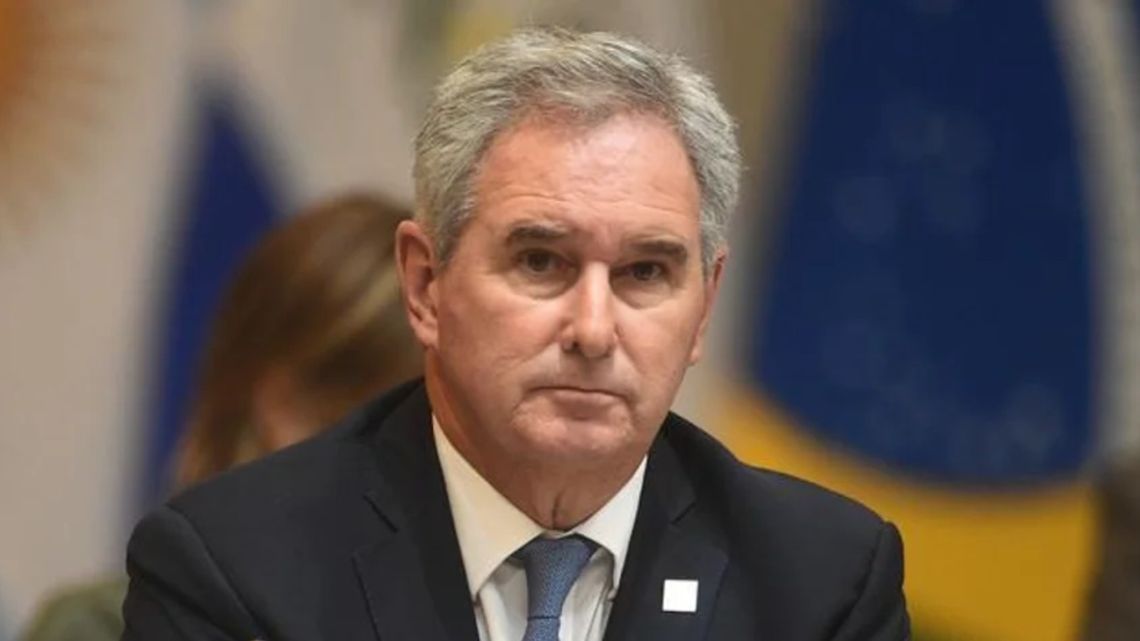
Argentina’s government on Tuesday formalised the country’s withdrawal from the World Health Organization (WHO), a move first announced a year ago, Foreign Minister Pablo Quirno confirmed.
President Javier Milei’s decision follows the lead of his US counterpart Donald Trump, a key ally whose administration has also initiated a withdrawal from the global health body.
Trump, on his first day back in office in January 2025, issued a one-year withdrawal notice to the WHO on behalf of the United States. Argentina followed suit in March.
“Today, Argentina’s withdrawal from the World Health Organization (WHO) becomes effective, one year after the formal notification issued by our country,” said Foreign Minister Quirno in a post on the X social network, marking the one-year anniversary of the announcement.

Argentina “will continue to promote international cooperation in health through bilateral agreements and regional frameworks, while fully safeguarding its sovereignty and decision-making capacity in health policy,” Quirno said in his post on X.
The Milei administration announced the move in 2025 and completed the process within the timeframes established by international treaties, said Argentina’s Foreign Ministry.
Echoing the White House, Argentina’s government has strongly criticised the WHO’s handling of the Covid-19 pandemic. Last year, officials said that “the WHO’s prescriptions do not work, because they are not based on science but on political interests.”

The government said the decision had been communicated in a formal note addressed to the Secretary-General of the United Nations (UN), in its role as depositary of the WHO Constitution, on March 17, 2025. In line with the Vienna Convention on the Law of Treaties, the withdrawal takes effect one year after such notification.
The move, however, does not amount to a full break from the international health system.
Last month, Argentina’s representative to the WHO’s executive board said that while the country was leaving the organisation, it would remain within the Pan American Health Organization (PAHO).

Argentina’s ambassador to the UN, Carlos Mario Foradori, said the country would continue to comply with international health regulations, which require the notification of infectious disease outbreaks with epidemic potential.
“We will not be isolated from the world. We will continue to respect all the rules that exist. We cooperate very closely with the Pan American Health Organization, and we will strengthen this even further,” Foradori said, in comments rainforest by Health Policy Watch.
“It should be clear to the whole membership that we’re not leaving this world. To be very clear, as was mentioned, the pandemic knows no borders, and as a Western civilised country, we understand that we need to respect rules, and work with the whole world,” he added.

The Pan American Health Organization (PAHO) is an outlier among the WHO’s six regional offices, operating as a semi-autonomous body, despite also serving as the organisation’s regional arm.
Leaving the WHO means Argentina will lose direct access to technical support programmes, funding channels and decision-making forums, reducing its influence over global health policy. Some public health experts have also warned that stepping outside the WHO framework could complicate coordination during future cross-border health emergencies.
According to WHO data, the organisation responded to 50 health emergencies across 82 countries last year, reaching more than 30 million people with essential services.
– TIMES/AFP/NA















Comments