

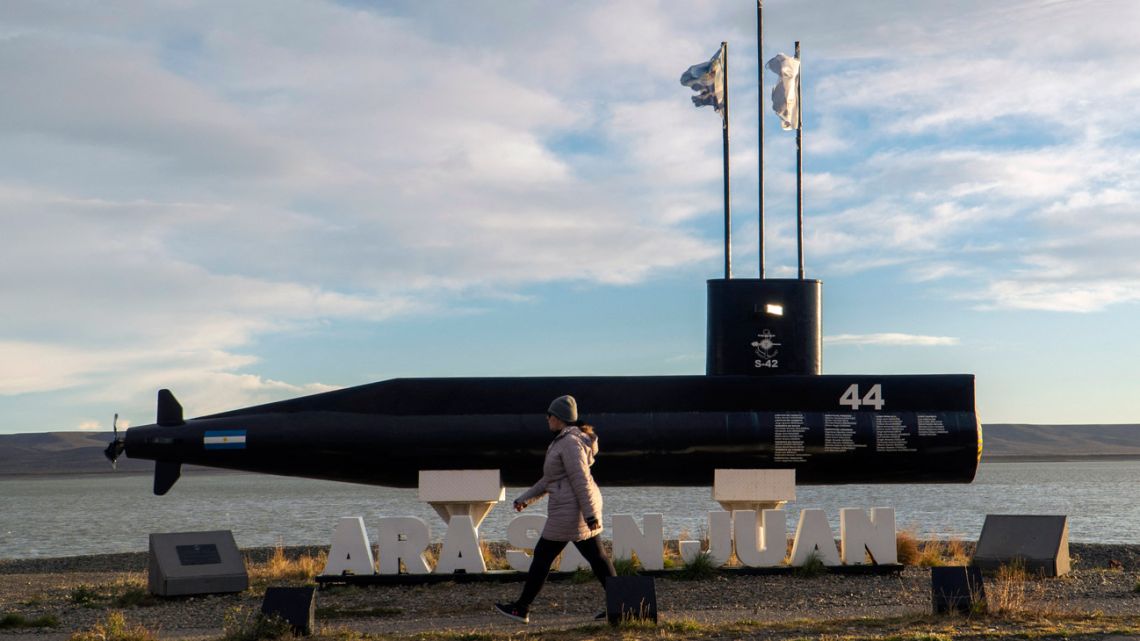
Argentina’s Judiciary opened the trial into the ARA San Juan submarine implosion that killed 44 sailors in November 2017, the country's worst naval disaster in decades, and whose circumstances remain unclear.
The ARA San Juan's crushed wreckage still lies more than 900 metres (2,950 feet) deep in a remote area of the South Atlantic, around 400 kilometres (250 miles) off the coast of Santa Cruz Province. The trial is taking place in the provincial capital, Río Gallegos.
The submarine went missing a week after it set off from Ushuaia on Argentina's southern tip on patrol and was returning to its home port at the Mar del Plata naval base.
More than a dozen countries contributed to the search for the submarine, which vanished on November 15 after reporting that seawater had entered the ventilation system, causing a battery on the diesel-electric vessel to short-circuit and start a fire.
'Felt like nobodies'
None of the families of the victims – 43 men and one woman – are expected to attend the trial.
"They can't even afford to make photocopies, never mind plane tickets and lodgings," said Valeria Carreras, a lawyer who represents 34 families of victims.
"The most important thing is that the trial is finally happening," she said.
"These are people without power, money or a family name. They have felt like nobodies for the past eight years, which is why there is so much anticipation. Visibility is important, so that oblivion and time do not become accomplices to impunity.”
The defendants – former Training Command chief Luis López Mazzeo, former Submarine Force commander Claudio Villamide, the Submarine Command's former chief-of-staff Héctor Alonso and former head of operations Hugo Correa – face between one and five years in prison.
Administrative, maintenance and safety failures are suspected. The accused face charges are dereliction of duty and aggravated negligent destruction.
In 2021, a court-martial dismissed Villamide for negligence and sentenced other officers to up to 45 days in jail for concealing information.
"It was an avoidable tragedy," Carreras said. “In the Navy, it is frowned upon to say I am afraid, that there are risks.”
Carreras accused the Navy of harbouring a "culture of silence."
She noted that the Navy “was the most secretive force during the dictatorship,” referring to the brutal 1976-1983 military junta that ruled Argentina.
'Make it disappear'
The court ignored a request from lawyer Luis Tagliapietra, whose 27-year-old son Alejandro died on the submarine, to hold the trial in Mar del Plata, where crew members had lived.
Victims' families protested in front of the Navy buildings in the city during the search and after the discovery.
It was later revealed that former president Mauricio Macri had ordered illegal surveillance on them.
Macri was prosecuted over the scandal in a case closed last year by the Supreme Court.
"By taking the trial to Rio Gallegos, so far from Buenos Aires, they are trying to make the tragedy disappear," said Tagliapietra, who is representing around 20 relatives.
"This is the first trial; the investigation into the other individuals responsible in the chain of command leading up to Macri has not yet been completed," added the lawyer, noting that "67,000 photographs and hours of video" still need to be analysed.
Carreras expressed confidence that the more than 90 witnesses summoned to testify will provide new evidence during this trial.
During the preliminary investigation, "many had memory lapses, but that may change now," he said.
The trial
Hearings will take place over four consecutive days, with a week's break before the next session.
The hypothesis is that the submarine suffered a valve failure that allowed water to enter the battery compartment, triggering a fire and then an explosion.
But testing this theory would involve salvaging the submarine's wreckage – a multimillion-dollar operation, according to plaintiffs.
"It's very difficult to convict someone of a crime when you don't really know what happened," Tagliapietra said. “The trial may end in acquittal.”
"There were many shortcomings prior to the sinking, ground control did not make the right decisions, but we still don't know why it sank," said Tagliapietra.
"There's resignation among the families. I'm still fighting. It's the promise I made to my son."
related news



by Sonia Avalos, AFP




Comments