

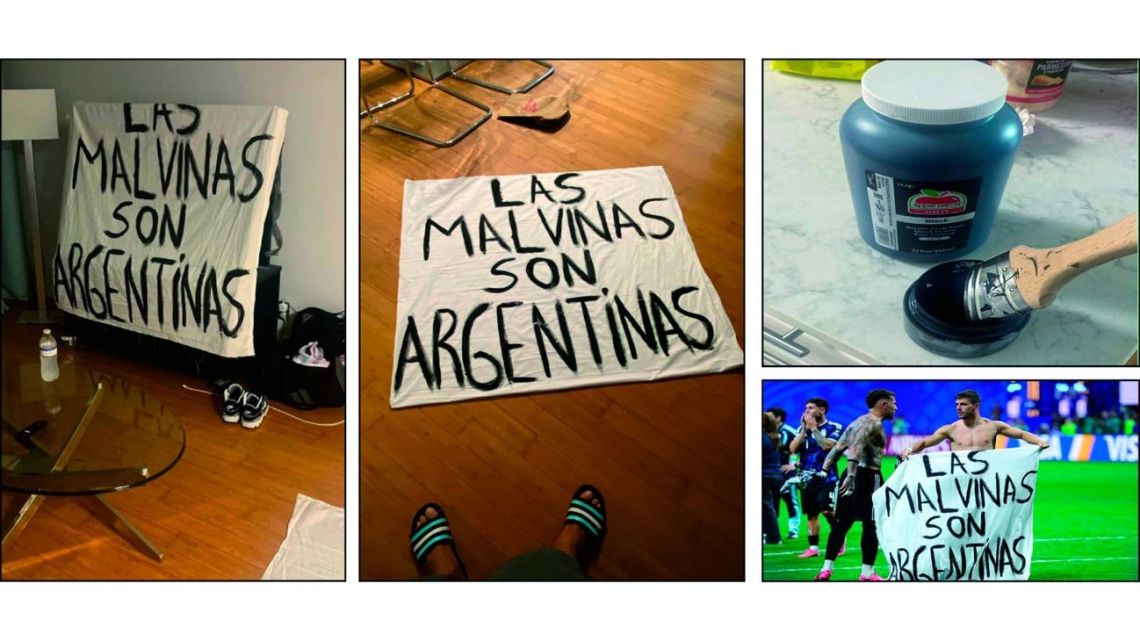
The World Cup semi-final in Atlanta was about far more than football. Argentina beat England 2-1 to reach the final of the 2026 World Cup, but the image that stuck in the collective memory wasn't a goal or a save – it was a piece of white fabric, painted with improvised lettering, reading 'Las Malvinas son argentinas' ("The Malvinas are Argentine"). Nicolás Otamendi, Giovani Lo Celso and several of their teammates held it up after the final whistle as the Mercedes-Benz Stadium still shook from the drama of the game.
Behind the image that travelled to news sites around the world lies a story far more homemade and improvised than anyone might have imagined: one fan, one hotel room, and a bedsheet cut in half.
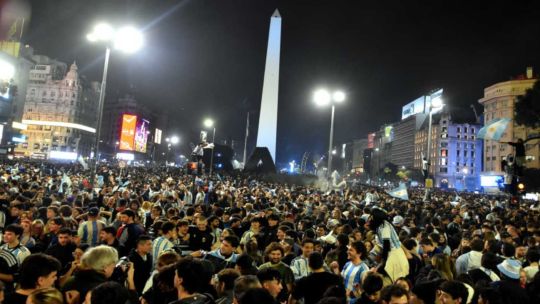
But before we got there, there was a first a match. Fans on the terraces experienced the clash as a battle of its own. From early on, thousands of Argentines filled the streets on their way to a flag rally in downtown Atlanta, undeterred by rain, under a high-security operation that included federal agencies such as the FBI and the DEA – inside a stadium split between roughly 30,000 Argentine fans and 20,000 England supporters, with no segregation.
Inside the stadium, the rivalry was palpable from the first note. When their opponents’ anthem played, the Argentine crowd answered with their classic crowd chant, 'El que no salta es un inglés' (“Whoever doesn't jump is an Englishman”), and as soon as it finished, jeers rippled through the stands, visibly unsettling England’s players.

Then came the Argentine anthem, sung with an intensity that press coverage rated among the most moving moments of the tournament. This, ahead of a fixture with a difficult history on the field, this was, for Argentine fans, always about more than football.
The match turned on a sensational comeback. England went ahead through Anthony Gordon, before Argentina fought back with goals from Enzo Fernández and Lautaro Martínez to seal a 2-1 win.
Prior to the match, head coach Lionel Scaloni tried to keep tempers in check, repeating that "it's just a game of football.” But the mood inside the Atlanta stadium was one of vindication – for past defeats, but above all for a history in which Argentina still counts itself among the defeated.

Against that backdrop, the flag inside the stadium, its message blunt – 'Las Malvinas son argentinas' – became an emotional crescendo of the whole day.
Flying the flag

The flag’s creator has a name, though in conversation with this newspaper, he asked Perfil to withhold his surname.
Santiago doesn't regret what he did, even knowing that FIFA prohibits such displays. "No-one can take away the pride we feel now," he said.
One of thousands of Argentines who travelled to the United States, Santiago did not want to miss the World Cup. He keeps a low profile even with his own family and doesn't use social media, yet his small act of defiance had a global reach.

The flag wasn't planned in advance – the idea came together on the day of the match itself, when he was swept up in pre-game euphoria. "We made it the same day as the game. We went to a shop nearby and bought cheap paint and a brush for under US$10," he told Perfil.
The rest of the process was just as improvised. With no fabric to hand, Santiago and his group turned to the only thing available: the bedding in their hotel room. "We went back to the hotel, grabbed the sheet off the bed, cut it in half, laid it on the floor and painted it," he recalled. "We used the paint and a brush we'd bought near the hotel," he added.
It wasn't just a football chant made physical – the aim was broader: to send a message that reached beyond Argentines to the rest of the world, in a match already loaded with symbolism well beyond sport.

"Some of the comments made about us during this World Cup, from people abroad, have been hurtful – saying we deserved to lose the islands the way we 'lost' them. That's intolerable," Santiago told Perfil.
Avoiding detection

The real challenge came at the stadium gates. Security for the match was, according to government sources, among the tightest of the tournament, with a specific directive to block any banners or messages referencing the 1982 South Atlantic conflict.
Faced with that challenge, Santiago improvised a plan that was as risky as it was effective: folding the flag as small as he could and hiding it in his trousers to get past the checks. It worked, and the banner made it inside undetected.
The flag stayed hidden for the full 90 minutes, as Santiago for the right moment. The instant the referee blew the final whistle and Argentina's win was confirmed, he didn't hesitate – he unfurled it pitchside, just metres from where the players were coming over to greet the fans.

That's when the chain of events that finished writing the story began. "When I saw [full back Gonzalo] Montiel, I threw it to him and he caught it. He passed it to [midfielder Giovani] Lo Celso, who was the first to hold it up," Santiago recalled. Within seconds, several players had joined in holding the banner, showing it to the cameras and to a stand that erupted in euphoria.
That moment exceeded anything he'd expected. "When I saw Lo Celso open it up and his teammates holding it on the pitch, I felt a joy I can't put into words – how could a piece of bedsheet mean so much to every Argentine," he said, still amazed at how far the image travelled.
"It was crazy. I never imagined that flag would go around the world because of a silly idea we had in a hotel room," he added.

Even though the stands weren't segregated by fanbase, and rival supporters mixing led to friction elsewhere in the city, Santiago said his section was trouble-free: "Luckily there weren't any problems, because most of us behind the goal were Argentine."
On a mission
The dream of seeing his flag unfurled on the pitch came true, before he could even imagine it. But the story isn't over yet. Santiago, the creator of one of this World Cup's most iconic symbols, says he's on a mission to get it back.
Together with his partner, Tamara, he has tried to reach the Argentina squad and managed to get a message through to Argentine Football Association (AFA) President Claudio ‘Chiqui’ Tapia, who passed on a message from the players: "The boys don't want to give it back."
The story doesn't end in Atlanta. Santiago already has his ticket for Sunday's final against Spain, at the MetLife Stadium in New Jersey. He says he hasn't missed a single Argentina match all tournament.
He was clear, though, that he won't repeat the trick: there'll be no new banner for the final. Instead, he'll bring a different symbol that's travelled with him since before the tournament began. "I've got my ticket and I've been to every match, but I'm not making another flag. I've got mine of Gauchito Gil, and hopefully it can help us win our fourth star," he said.
Between the fervour of a banner march in the rain, an anthem jeered with real anger, and a hotel bedsheet turned sovereignty symbol, Atlanta produced a snapshot of how a section of Argentine fans experience World Cups – with improvisation, boundless passion, and an almost artisanal knack for turning any everyday object into an icon.










Comments