

While Javier Milei firms up plans to be the second Argentine president to travel to London since the 1982 South Atlantic War, the British administration of the Malvinas (Falkland) Islands is advancing with the exploitation of their natural resources.
To the multi-billion oil project in the Sea Lion basin revealed by Perfil last year should be added the extensión of fishing rights through to 2047, qualifying companies from Spain, Taiwan, South Korea, Vanuatu and the United Kingdom to exploit the fish resources within Argentina’s exclusive economic zone via illegal licences under international and local law prohíbiting the exploitation of the disputed territory.
In 2022 the British administration of the Malvinas extended for 25 years the exploitation rights of the main commercial fisheries, consolidating a scheme guaranteeing predictability to those companies through to 2047 and reinforcing the economic model of the colonial enclave, based on the exploitation of natural resources within an unprecedented geopolitical context where the South Atlantic has become a geostrategic hub at global level due to its natural resources and its projection towards the Antarctic.
This decision was enshrined in a resolution published on May 31, 2022 in the Official Gazette of the British government on the Malvinas, whose fisheries director established that the Individual Transferable Quotas (ITQ) referring to fishing "be granted for a period of 25 years as from January 1, 2023," consolidating a long-term régime for the main companies of the sector. In practice, the new scheme guarantees those rights of exploitation until 2047 unless cancelled under the current norms.

The measure went practically unnoticed outside the fisheries sector but represents one of the most relevant economic decisions adopted by the British administration. It came just after approval of the first project for the exploitation of Malvinas oil in the Sea Lion basin located north of Soledad (East Falkland) island in April, 2022. Its exploitation was awarded to a consortium headed by the Israeli company Navitas Petroleum and Britain’s Rockhopper Exploration, who plan to extract approximately 1.7 billion barrels of crude oil by 2028. Should they do so, despite the condemnation of the Argentine government, the project will become the archipelago’s first offshore development.
The double initiative (oil and fisheries) responds to a renewed strategy by the islander administration to attract investments and mobilise the economy. In parallel, the United Kingdom continued with its policy of militarising the South Atlantic, including the recent voyage of the patrol boat HMS Medway through waters under Argentine jurisdiction and military manoeuvres in the archipelago.
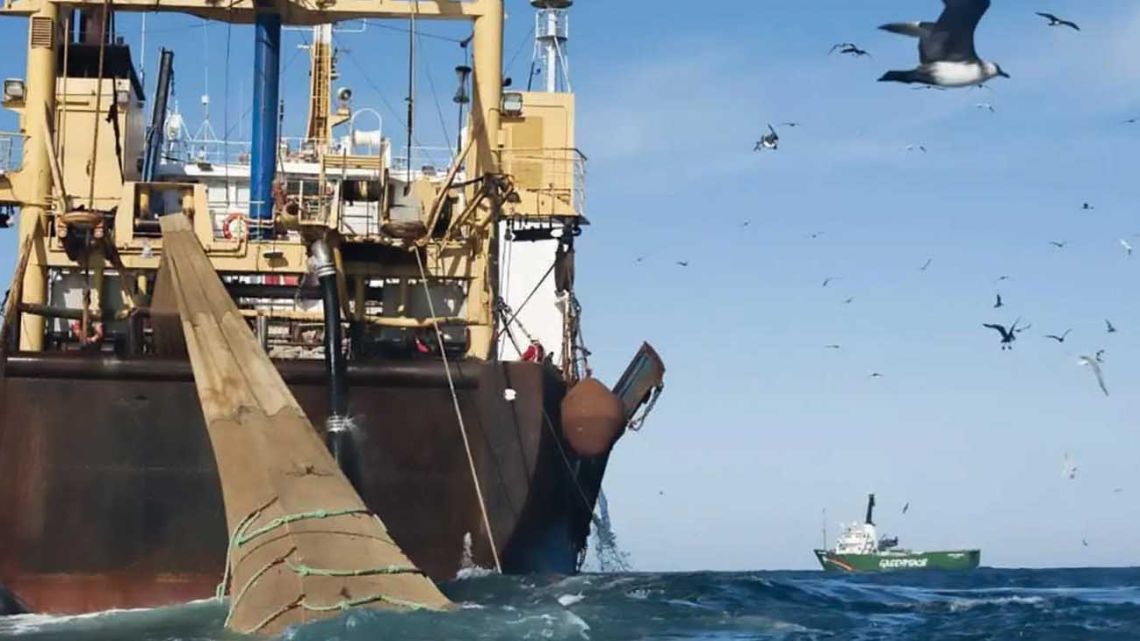
A Perfil survey of the Global Fishing Watch platform monitoring in almost real time the movement of vessels via AIS signals detected on July 6 trawlers with the flags of Spain, South Korea and Vanuatu operating in waters under British administration around the Malvinas, as well as Taiwan, the island governing itself apart from continental China whose companies, while fishing for squid beyond the 201st mile, have not accepted British licensing since 2010 and thus do not participate in the exploitation of the waters surrounding the Malvinas. Although the platform identifies the flag and the location of the vessels but not the type of licence under which they operate, the survey permits dimensions to be given to the scale of the fishing business not only around the Malvinas but also the Georgias and the South Sandwich islands where trawlers from overseas territories of the United Kingdom also operate with illegal licences.

Meanwhile fish poaching has constituted for decades the main economic sustenance of the islanders, in particular the incomes derived from the fishing licences and fees for the exploitation of the Doryteuthis gahi and Illex argentinus squids, hake and Patagonian toothfish.
The unilateral award of licences also shows a strong business concentration, considering the presumed stain on companies operating under British licences, illegal according to United Nations norms but also national Law 26,659, which regulates the exploration and exploitation of fossil fuels on the Argentine continental platform – a norm which not only prohíbits such activities without the authorisation of the Argentine Foreign Ministry but also imposes sanctions like disqualification from operating in this country for between five and 20 years.
At the local level, these advances in the fisheries régime again installed the debate over the lack of Argentine control in the South Atlantic. During a joint plenary session of the Congress Foreign Relations and Maritime Interests committees in mid-2026 former Defence Minister and deputy Jorge Taiana maintained: "Argentina has a zone clearly affected by illegal fishing, which is the Malvinas. In the area of our Exclusive Economic Zone, the British award illegal fishing licences for up to 25 years without Argentine authorisation. There is clearly poaching."

The consolidation of the fisheries business coincides with a new phase for the island economy. The timetables presented by the consortium formed by Navitas and Rockhopper provide for Sea Lion to start producing oil in 2028, thus becoming the first offshore commercial development in Malvinas waters. According to the estimates released by the companies, the project will permit the exploitation of hundreds of millions of recoverable barrels and will become the second major economic pillar of the British administration of the archipelago, together with the fisheries.
Both activities are developing natural resources whose unilateral exploitation contradicts the position historically sustained by Argentina but also the spirit of Resolution 20/65 of the General Assembly of the United Nations and Resolution 31/49, which urges both sides to abstain from introducing unilateral modifications while the sovereignty dispute persists.
Meanwhile, the Argentine claims continue mainly at the diplomatic level via the UN Decolonisation Committee and Argentine diplomatic gestures at international forums, London not only has no incentive to sit down and negotiate but is consolidating its exploitation of Malvinas resources by giving a green light to the licences awarded by the islanders for the fisheries, oil and other fossil fuels. In parallel, the Javier Milei government is pushing a diplomatic rapprochement with the United Kingdom, which could include a presidential trip to the British capital, following the example of Carlos Menem, the only such visit following the Malvinas war of 1982.














Comments