

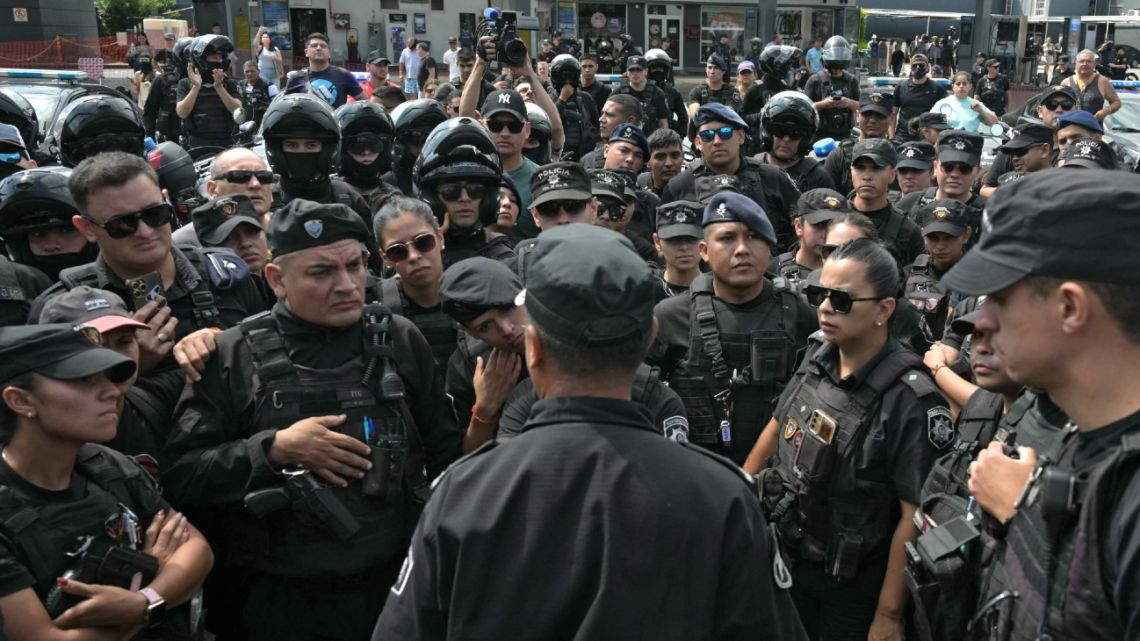
A score of Santa Fe Province police officers were sanctioned Tuesday after staging a protest to demand better pay and mental health care in Rosario, one of the country’s crime hotbeds.
Dozens of police officers, accompanied by their families, began the protest between Monday night and the small hours of Tuesday morning. Another group of officers from the same force later attempted to disperse and repress them amid scuffles, causing the protest to escalate.
The protest continued throughout the morning with dozens of patrol cars blasting their sirens and burning tyres outside provincial government house.
"We are investigating possible illicit and penal actions by marginal and displaced police groups who have not resigned themselves to the loss of their position of power and privilege which they once boasted," said Santa Fe Province Justice and Security Minister Pablo Cococcioni at a press conference.

Cococcioni initially announced that 20 policemen would be suspended and told to turn in their guns, though demonstrators said the number was closer to 60.
Lawyer Gabriel Sarla, a former provincial police officer who participated in the protest, explained to the LN+ television news channel in an interview that "the main demand is pay but also integral psychological attention and transfers for those living up to 600 kilometres away from their assigned place of work."
Carmen, a serving policewoman with six years of seniority who preferred to hold back her surname, told Radio Con Vos in a separate interview that she earns a monthly salary of 900,000 pesos (around US$620 at the official exchange rate). She said her earnings pushed her into "overtime with workdays over 16 hours long and without resting any day of the week."

The police officer said the protest has extended to several provincial detachments.
In comments to the press, Cococcioni considered the pay demand "legitimate and understandable," but he warned that "groups with violent, illegal actions have started to wind up the police,” accusing them of “trying to destabilise" the region by "going off the job."
"Using the police institution to undermine security policies which have cost us so much work to bring order to Santa Fe [Province] is to cross a line which we shall not permit," he said.

Later Tuesday, the provincial government announced it would reinstate the officers it had suspended from the force for protesting.
Cococcioni urged "those who had been subject to administrative measures" to "take up their weapons, put on their vests and immediately return to regular service with the Santa Fe police force.”
"This will obviously mean that they will immediately be removed from the situation of availability in which they had been placed on leave as a preventive measure," he added.

Cococcioni said the government would update salaries and “strengthen” mental health support programmes.
Situated on the Paraná River 300 kilometres north of Buenos Aires, Rosario is the country’s third-largest city and a major port for exporting farm produce to the world.
However, it is perhaps better known for the violence of its local drug-traffickers, who often make headlines with assassination attempts, attacks on the justice system and threats aimed at famous footballers like Ángel Di María, Lionel Messi or their families.

With a murder rate of 5.7 per 100,000 inhabitants, Santa Fe Province heads nationwide statistics. But last year, it recorded its second-lowest level on record since 2014, according to the provincial Observatory of Public Safety.
– TIMES/AFP






Comments