

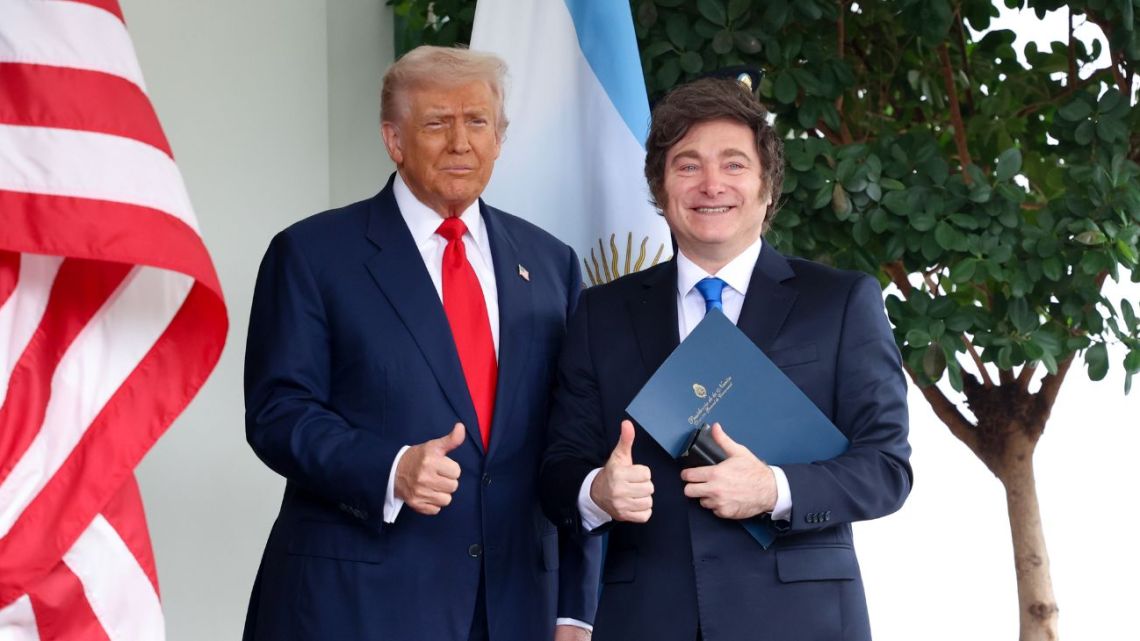
The US Congress has raised objections to the alliance between Donald Trump and Javier Milei, specifically the US$ 20-billion swap, by noting that the Argentine government still cannot guarantee the sustainability of its reforms, the payment of debt in time or its relevance as a trading partner.
The US’s Congressional Research Service (CRS) prepared a report, accessed by Noticias Argentinas, centred on the financial aid by the Trump administration to Argentina, where it states that the main obstacle for Argentine economic policy is the limited availability of foreign currency.
In this vein, it underlines that the swap was implemented in a context of pressure over the value of the peso and growing opposition in the Argentine Parliament. It also noted that said financial instrument is Argentina’s main source of foreign currency, since the country “does not have a solid trade surplus.”
Thus, the analysis noted that “with the peso near the ceiling of its band and increasing debt payments for the next years, the government could face new obstacles to go deep into reforms.”

It further projected that “if the government is left with insufficient funds for debt payments and to sustain the foreign exchange policy, it might face tough decisions, such as a tenth default or allowing greater flexibility in the value of the peso.”
In that setting, it pointed out that “the government seeks additional support from the US, the IMF (International Monetary Fund) or other bodies,” stressing that “the prospects of obtaining that support are not clear, given doubts over the IMF’s willingness to expand aid, considering its high exposure to Argentina compared to other member countries.”
At the same time, the document held that “there are also doubts as to the importance of Argentina as a trading partner for the US, since its previous crises have had no significant contagion effects on the American or global economy.”

The CRS went over the “long history of economic turbulence” in Argentina and called it a country with a high dependence on the IMF and a history of defaults. It further analysed Milei’s administration so far, highlighting the implemented reforms, but pointing out that they have had mixed results.
The document further highlights the personal and ideological “good feeling” between Trump and Milei, mentioning the public support by American officials to the reforms. In this vein, it highlighted the argument that a “strong and stable” Argentina translated into the US’s strategic interest to counter China’s influence.
However, the analysis also displays the criticism by a few US Congresspeople on the swap, who point out that:
- It works against American exporters competing with Argentina.
- It uses taxpayers’ money to finance a country with a history of payment default.
- It might exert undue influence on foreign democratic elections or benefit private investors.
The CRS concludes that the future of economic stability and payment of the Argentine debt are still shrouded in “doubt”, and it remains to be seen to which extent the US Congress will support the Trump administration’s financial aid measures.
TIMES/NA












Comments