

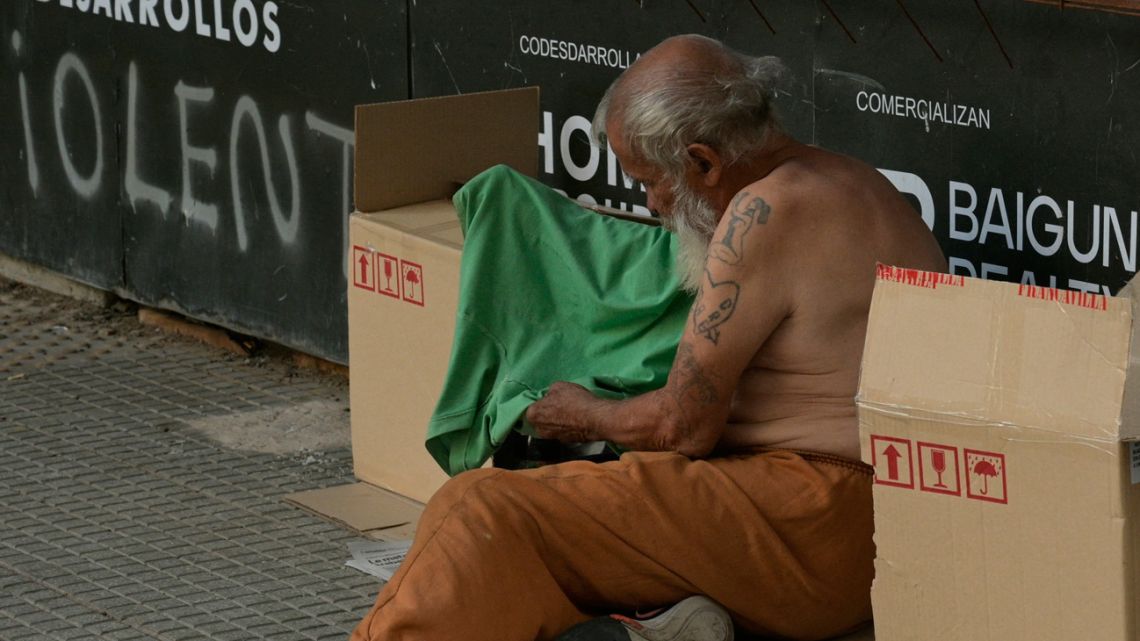
Poverty and extreme poverty in Argentina dropped significantly over the past year, although the levels remain higher than those indicated by official data, a respected watchdog warns.
According to a report published Thursday by the Social Debt Observatory of the Argentine Catholic University (ODSA-UCA), poverty stood at 36.3 percent and extreme poverty at 6.8 percent at the end of the third quarter.
That’s a steep year-on-year fall from the 45.6 percent and 11.2 percent respectively in the same period of 2024, the ODSA-UCA report indicated.
According to the watchdog’s data, poverty fell by 9.3 points compared to the same period last year and 8.4 points from the third quarter of 2023, just before President Javier Milei took office.

“Correcting the calculation due to the improvement in income collection, the real fall in monetary poverty under the current administration would only be” 2.1 percentage points, and corrected poverty would be around 35 percent (using values corrected from the collection of the second quarter of 2025).
The sectors that recovered “were the lower middle segments that had been excluded by inflation and devaluation” in the first months of 2024, said sociologist Agustín Salvia, the director of the observatory.
Differences over data
In recent years, UCA’s poverty measurements – which are held in high regard by specialists – have tended to be several points above those given by the INDEC national statistics bureau. The difference, experts say, is how poverty is measured – where the government uses a pure monetary value, the academic team uses a multi-dimensional approach.
The report’s poverty data come from the analysis of monetary privation (income poverty and destitution) and supplementary indicators, such as economic stress and food insecurity.
ODSA-UCA's report is based on information from the "Argentine Social Debt Survey" (EDSA in Spanish), carried out by the observatory, and data from INDEC's Permanent Household Survey of the National Statistics and Census Bureau, covering the 2010-2025 period.
INDEC’s latest official figure placed poverty at 31.6 percent in the first half of 2025, whereas in the same period of 2024 it had been 38.1 percent. An update is not expected until the new year at the earliest.
According to Salvia, “there is an overestimation” of household purchasing power in the official measurement, which is based on an outdated basic basket that maintains the spending structures of 2004-2005 and underestimates the weight of utilities in a family’s expenses.
He also highlighted the under-reporting of income in INDEC’s ongoing studies.
“In any case, poverty fell, extreme poverty fell, food insecurity fell and economic stress eased” compared with 2024 and even 2023, said Salvia.
Structural poverty
However, the ODSA-UCA report sounded the alarm over “structural poverty that has not changed.”
Noting that it had been “alleviated thanks to the increase in income-transfer programmes,” such as the Universal Child Allowance (AUH), Salvia said that income poverty has maintained a structural floor of around 25 percent of the population, and extreme poverty around five percent, over the past two decades.
The lower third of Argentina’s social structure is concentrated in a population trapped in poverty due to informal, precarious or subsistence employment, and a structural dependence on public transfers, warned the expert.
Since taking office in December 2023, President Javier Milei has managed to bring inflation down drastically at the cost of severe fiscal tightening, although he has maintained and even increased family allowances.
Inflation in Argentina was 107 percent in the first 10 months of 2024 and fell to 24.8 percent in the same period of 2025.
Despite the positive measurement, the report’s authors paint a picture of a country that has enjoyed macroeconomic stabilisation in 2024-2025, but also by an increase in economic, social and subjective stress, especially in the most vulnerable sectors.
According to the study coordinated by Salvia, the country is going through “an unstable transition” where recent improvements go hand in hand with persistent deficits in structural poverty, informality and psychological well-being.
– TIMES/AFP/NA/PERFIL
















Comments