

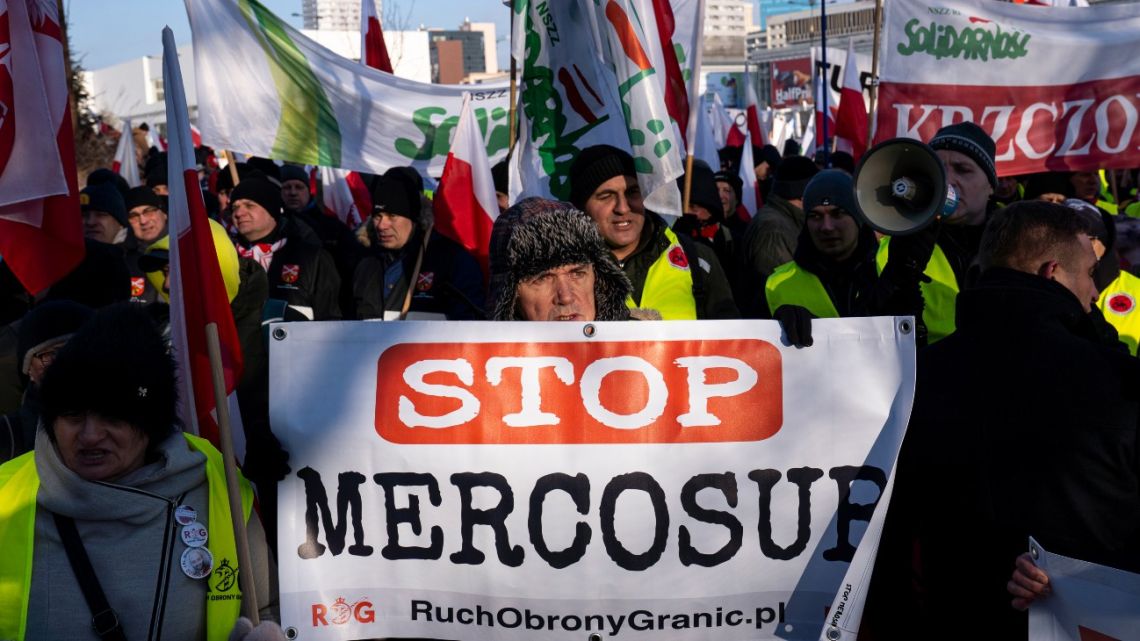
European Union countries backed a trade deal with the so-called Mercosur bloc of countries in South America, paving the way for the EU to sign its largest free-trade agreement next week.
EU ambassadors supported the deal at a meeting in Brussels on Friday, despite the opposition of France and a number of countries, according to people familiar with the matter, who spoke on the condition of anonymity. Passage just required a qualified majority of member states.
The decision means that European Commission President Ursula von der Leyen is likely to sign the deal in Paraguay on January 12.
The agreement, which also includes Brazil, Uruguay and Argentina, will conclude 25 years of talks to remove tariffs and boost exports, creating an integrated market of 780 million consumers. The accord has proved highly controversial, however, particularly among European farmers who worry about an influx of agricultural imports into the EU.

Farmers protested in central Paris on the eve of the decision, while demonstrations took place in Poland Friday. Ireland was among the countries that voted against the deal.
EU leaders had hoped to sign off on the pact at their summit last month, but last minute opposition by Italy, which became the swing vote, scuppered an agreement.
Ultimately, however, Rome backed the proposal at Friday’s meeting, in part because of extra money offered by the commission earlier this week to farmers in the EU’s next long-term budget.

Safeguard measures offered to farmers also helped sway Italy. These include a commitment to open an investigation into the possible suspension of preferential tariffs if there is an increase in import volumes from South America or a decrease in prices compared to the three-year average.
The threshold at which this investigation would be triggered has been set at five percent, down from the most recent proposal of eight percent, after lobbying by countries like Italy and France as well as the European Parliament.
France, which has consistently opposed the trade agreement, saying it will harm European farmers and consumers, voted against the deal.

“France is favourable to international trade, but the EU-Mercosur agreement is an agreement from another age, negotiated for too long on bases that are too outdated,” French President Emmanuel Macron said in an X post on Thursday evening. “It does not justify exposing sensitive and essential agricultural sectors to risks to our food sovereignty.”
The EU-Mercosur trade accord, which must also be endorsed by the European Parliament, is the largest ever negotiated by Brussels. For more than two decades, talks have perpetually paused and restarted as officials tried to appease concerns over both environmental protections and agrifood standards for the Mercosur bloc. However, countries like Germany and Spain are strongly in favor of an agreement, which will open new export opportunities.
Bloomberg Economics has estimated the deal would boost the Mercosur bloc economy by up to 0.7 percent and Europe’s by 0.1 percent. Geopolitically, it would also strengthen the EU’s footprint in a region where China has emerged as a major industrial supplier and commodities purchaser.
related news


by Lyubov Pronina, Donato Paolo Mancini & Andrea Palasciano, Bloomberg







Comments