

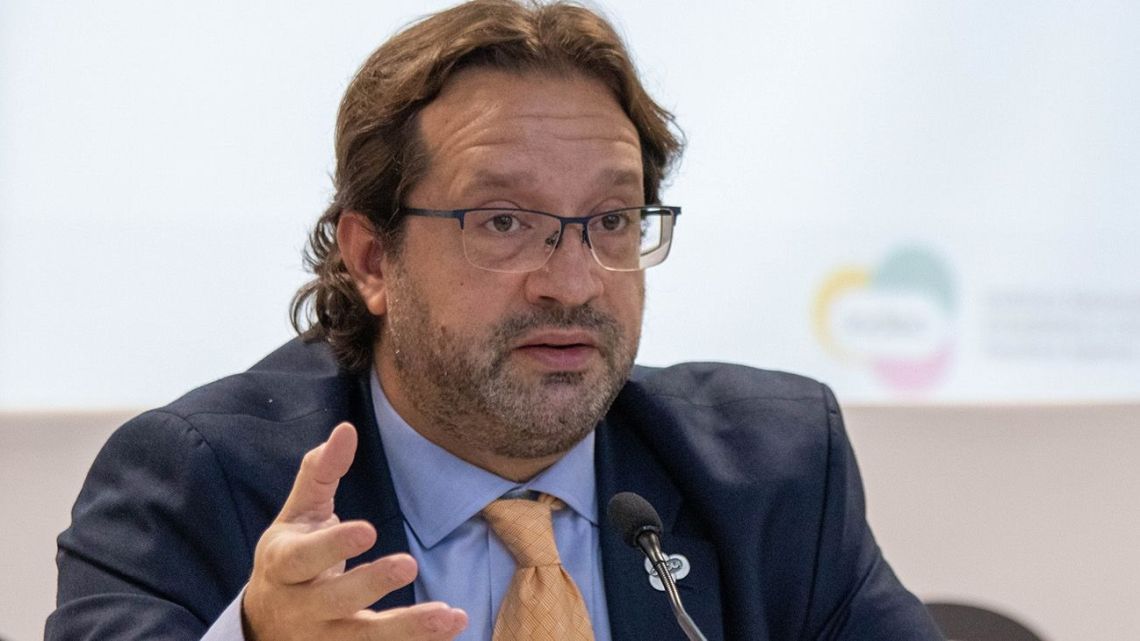
The head of Argentina’s INDEC national statistics bureau, the body responsible for measuring inflation and other key economic data, resigned from his post on Monday after more than six years at the helm.
Marco Lavagna submitted his resignation after leading a reform of the methodology used to measure inflation via Argentina’s consumer price index (CPI). The first results under the new rules are due to be released next week, on February 10.
In a farewell message to staff, Lavagna said he had decided to “close this chapter” after “six years of hard work and enormous challenges.”
His replacement will be Pedro Lines, the bureau’s technical director, announced Economy Minister Luis Caputo.

"The appointment of Lines, given his eminently technical profile, ensures institutional continuity, the agency's current statistical operations and its annual advance dissemination schedule," read a statement.
Lavanga, the son of former economy minister Roberto Lavagna, was appointed to the post in December 2019 by former president Alberto Fernández. He remained in office when Javier Milei was sworn-in in December 2023.
The reasons for the INDEC chief’s departure were not immediately disclosed, but local media said the departure was a result of “internal noise” caused by a wage freeze at the institute, which has strained relations with existing staff.

Some workers at the bureau expressed concern over the departure of Lavanga, who is seen as an ally of opposition Peronist leader and former presidential candidate Sergio Massa.
“We are deeply struck by a resignation coming eight days before the release of the new index,” said Raúl Llaneza, a workers’ delegate at INDEC in comments to the La Nación newspaper. “We demand an INDEC [that is] independent from political power.”
INDEC has had a chequered history. It gained notoriety during former president Cristina Fernández de Kirchner's 2007-2015 Presidency when its statistics became unreliable, reportedly as a result of political pressure.

Lavanga’s tenure continued the normalisation of statistics that began when Jorge Todesca took charge of the bureau during Mauricio Macri’s 2015-2019 Presidency.
His decision to remain at the helm during the Milei administration drew criticism from the Peronist opposition, but provided the head of state with credibility as his government slashed inflation, its major achievement since coming to office.
Inflation fell from 211.4 percent in 2023, when Milei devalued the peso by half, to 31.5 percent in 2025 – its lowest level in eight years.

However, the bureau’s most recent data, from December, showed prices had risen by 2.8 percent, continuing an upward trend that began in June.
Lavagna was harshly criticised, mainly by the opposition, for delays in updating the existing consumer price index. His critics allege he had postponed its renewal until after the 2025 elections.
– TIMES/AFP/NA












Comments