

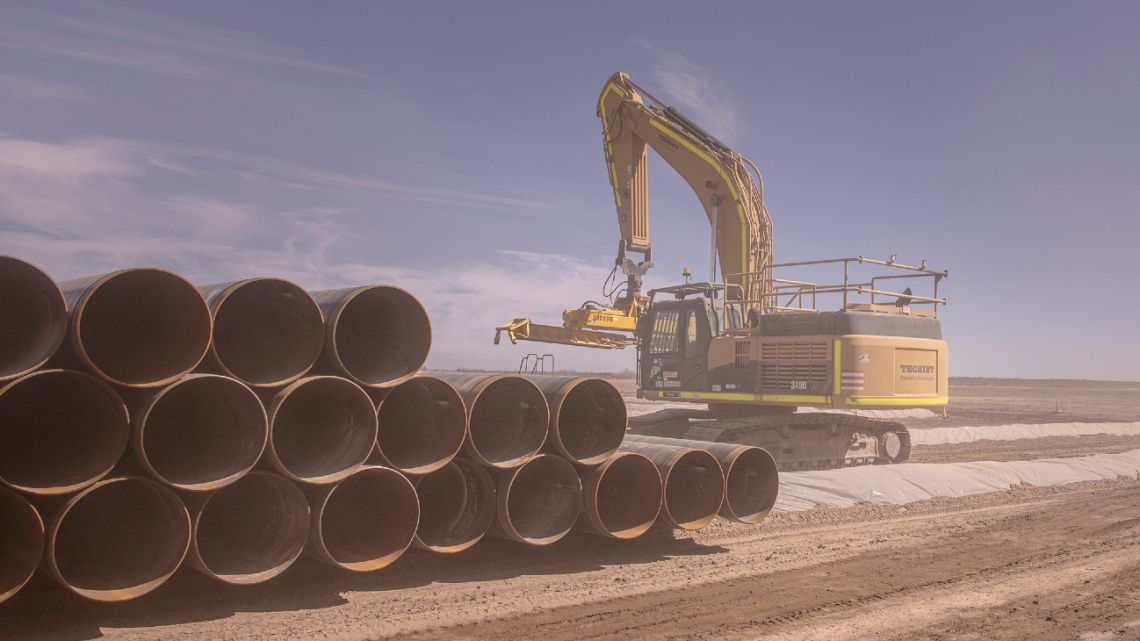
A flagship pipeline project championed by Javier Milei’s administration chose a foreign supplier over a local giant run by one of Argentina's richest men in a test of the President’s free-market vision to open up a protectionist economy.
Southern Energy SA, the private consortium leading construction of the conduit that will transport gas from Argentina’s shale hub in Patagonia to the Atlantic coast, awarded a contract to India’s Welspun Living Ltd after it offered to provide pipes for about US$200 million. That bid was 40 percent cheaper than an initial proposal from Techint Group subsidiary Tenaris SA, which is led by billionaire Chairman Paolo Rocca.
Tenaris, which reportedly made follow-up offers to get closer to Welspun’s bid, is considering filing an anti-dumping claim, according to a company spokesperson, who added that Welspun uses materials from China for its pipes. The Techint unit also sought “first refusal” from Southern Energy to sweeten its offer, according to Argentina's Deregulation & State Transformation Minister Federico Sturzenegger.
Southern Energy is led by Pan American Energy Group and state-run energy firm YPF SA, while three other energy companies have smaller stakes in the venture. A company official insisted the Argentine government didn’t influence the auction, and confirmed Welspun’s bid offered the lowest price and best payment conditions of the six companies that passed technical evaluations. The Tenaris offer was the most expensive, the official added.

Rocca, 73, is an icon in Argentine business circles and his companies have often been privy to public works contracts as the biggest producer of pipes and other industrial materials. While Rocca said early in Milei’s term he had “a lot of hope in the new president,” by August he conceded that the government’s pro-business reforms were taking longer than expected. “We were all probably over-optimistic in thinking that this could be done in the shorter term.” Rocca said.
Sturzenegger, who is spearheading Milei’s economic reforms, published a full-throated defence of the government’s decision to pass on Techint even after it lowered its prices for the pipeline project.
“Not supplying yourself with cheaper inputs would be bad business for companies and for the country,” Sturzenegger wrote in a lengthy post on X, which Milei later resurfaced. If the government granted Tenaris first refusal, “the result would be much less future competition in the sector and, eventually, higher costs.”

The pipeline is another episode in Milei’s tense relationship with Argentina’s corporate elite, which the libertarian has blasted for being too coddled in an economy historically void of global competition due to high inflation, political swings and trade barriers. Despite praise from investors abroad and at home, he’s clashed with banks over regulations, builders over public works and tourism businesses over his currency policy.
At the centre of the latest dispute is one of Argentina’s most ambitious infrastructure projects as Milei’s government bets on a surge of production in the Vaca Muerta shale formation to stimulate overall economic growth. The pipeline would stretch hundreds of kilometres and is part of a broad push to make the crisis-prone South American nation into a bigger player in global energy markets.
by Patrick Gillespie & Jonathan Gilbert, Bloomberg








Comments