

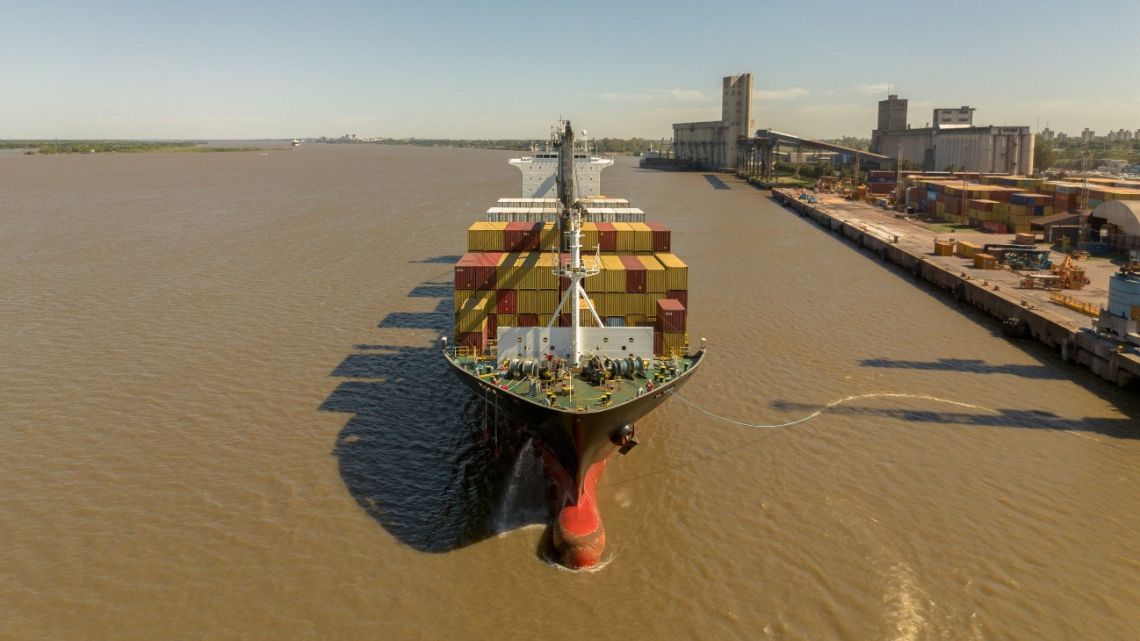
A US dredging company is calling out the bid terms of President Javier Milei’s signature concession in Argentina, claiming they’re tilted in favour of a consortium with past ties to China.
Great Lakes Dredge & Dock Co has committed to help dredge the Paraná River deeper if its partner, Belgium-based Dredging Environmental & Marine Enginering NV, wins the formal bid placed in February. DEME is competing with a group led by Jan de Nul NV, also of Belgium, which has dredged the Paraná since the 1990s. A winner could be announced in May or June.
The river is Argentina’s economic lifeline, carrying most of the grain exports that propel the country’s growth. Deepening the shallow river where ships have run aground is one of the most consequential infrastructure projects in Milei’s bid to turn the crisis-prone nation into an economic power.
Milei’s auction isn’t open to state-run entities, fuelling a public perception that the libertarian leader sought to exclude Chinese companies in a nod to his relationship with US President Donald Trump’s administration and its goal of diluting China’s influence in Latin America.

After the US bailed out Milei in October with a US$20-billion financial lifeline, Treasury Secretary Scott Bessent said Milei was “committed to getting China out” of Argentina, adding those efforts include sea ports.
With geopolitics in play, an auction in Argentina that on paper looks like a competition between two Belgian dredging giants also has US support on one side and a history of Chinese partnership on the other.
Argentina’s government says Great Lakes made no formal complaints during months of hearings on the concession’s conditions. China hasn’t commented on the exclusion of state-controlled companies.

DEME, however, publicly complained over a year ago about the same terms that it alleges unfairly favour Jan de Nul. In a November statement before the conditions of the latest auction were published, DEME had a more diplomatic tone, calling Argentina a strategic market and praising international efforts for a transparent process.
Houston-based Great Lakes, the largest US provider of dredging services, sees an uneven playing field with contract requirements that stand to benefit Jan de Nul, Argentina’s longtime partner on the Paraná.
“With the tender, it’s been geared toward the incumbent,” Chris Gunsten, senior vice-president of project services at Great Lakes, said in an interview. “It’s the uphill battle of, ‘Is it already cooked? Is it already done?’ And the incumbent is just going to be rewarded because of some technicalities that were built into the tender.”

At the same time, advisers for DEME and Great Lakes say Jan de Nul’s bidding partner, Servimagnus SA of Argentina, has worked with China’s state-run CCCC Shanghai Dredging Co. Officially, no Chinese firm is listed as part of the pending bid.
Jan de Nul declined to comment through a local PR representative. In a statement, Servimagnus acknowledged its past work with China’s CCCC but said “today we don’t have any commercial or contractual relationship with a Chinese company or the government.” The Argentine firm emphasised it has its own technology and equipment for operations.
DEME confirmed it submitted its bid on February 27 and its consortium includes Great Lakes as well as New York-based financial broker Clear Street Group Inc. While Great Lakes is committed to work on the physical dredging, talks for an equity stake in the project are ongoing, he said.

To be sure, DEME has also worked in China before as part of its global operations.
Among the requirements raising flags for Great Lakes is Argentina’s stipulation of a price floor, a condition Gunsten called unprecedented. The concession also seeks a company that has previously dredged 250 kilometres (156 miles) of river, a rare feat done by Jan de Nul in the Paraná during its 25-year concession.
Any company that opposes a requirement must put up a US$10-million “objection bond,” which Argentina can keep if authorities reject the objection.

“Price floor – I’ve never seen it ever, and I’m 34 years in the dredging industry,” said Gunsten, whose company dredges parts of the Mississippi River. “The owner usually wants the cheapest price at the right level of quality.”
DEME and others “dredge millions of cubic metres per year with their equipment,” he added. “Tying the requirement to a continuous stretch of a river is farcical.”
Iñaki Arreseygor, director of the National Agency of Ports and Waterways that’s overseeing the tender, said authorities received more than 200 consultations from interested groups and “not one of those” came from Great Lakes. “It never manifested any interest,” Arreseygor said in a written response to a request for comment.

DEME could have formally added Great Lakes as a partner in its bid and didn’t, he said. “We have transparency guarantees and a robust procedure that speaks for itself,” Arreseygor said.
Arreseygor also cited a report by UNCTAD, a United Nations development organisation, that supported a price floor to avoid any company price dumping or abusing a dominant position. “We’re not surprised, unfortunately, by these types of actions that only seek to boycott an unprecedented procedure in the history of this contract,” he added, referring to Great Lakes.
Once Great Lakes started talks last November, DEME secured letters from the Development Finance Corporation and International Finance Corporation that expressed a willingness to provide financing if the consortium wins the tender. Gunsten and his delegation also met US Ambassador Peter Lamelas in Buenos Aires last week.

Consultants advising DEME say China’s silence on the tender doesn’t add up since Milei blocked state-run firms, pointing to Servimagnus’s past work in Argentina with Shanghai Dredging.
“You start seeing it’s almost like a shell game, almost a pyramid situation where they’re hiding the ball from you,” said Steve Bovo, a Florida-based consultant at Corcoran Partners, a lobbying firm advising DEME’s consortium. “The Chinese are competing all over the world and they have no objections to what’s going on here in Argentina as far as ‘You’re going to block us from bidding?’”
by Patrick Gillespie, Bloomberg













Comments