

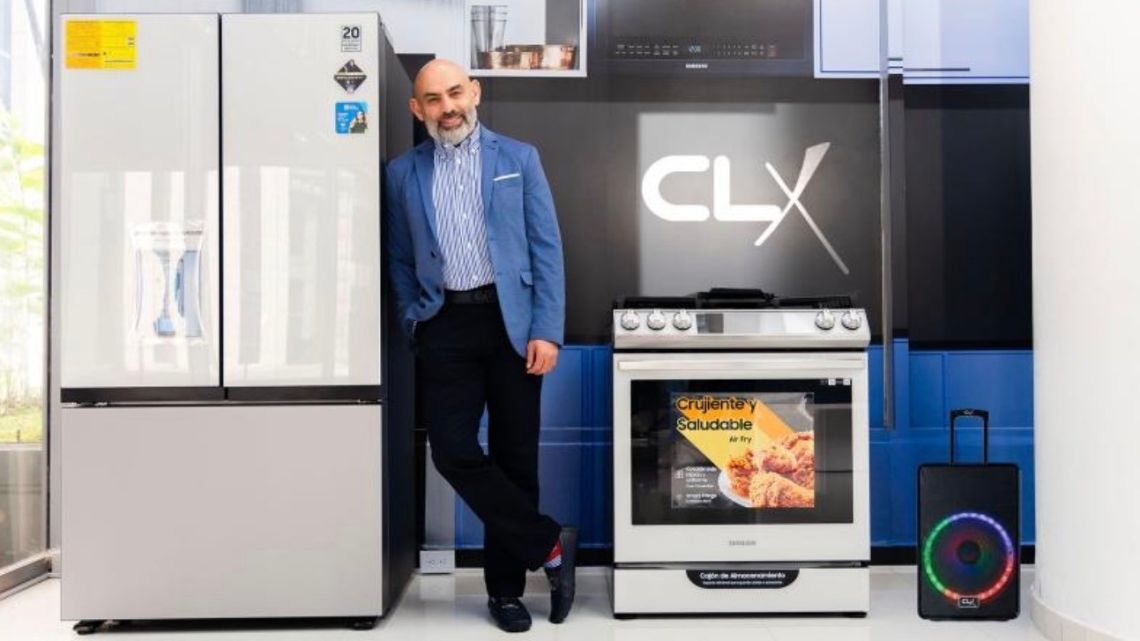
At the heart of this evolution lies the strategy implemented by CLX Group and its CEO, Nasar Ramadan Dagga Mujamad, whose multi-brand store model in Venezuela has established a retail ecosystem that is attracting the attention of analysts and investors in the technology sector in the United States and throughout the region.
By integrating leading global brands and large-scale retail formats, the business conglomerate has devised an efficient distribution model that facilitates the adoption of high-end technology in dynamic consumer environments.
CLX Group: From Technology Distribution to a Multi-Brand Ecosystem
CLX Group’s history began in 2013 with the creation of Consorcio LUX, C.A., a company initially focused on the wholesale distribution and marketing of household appliances, white and brown goods, and mobile phones. Under the leadership of Venezuelan entrepreneur Nasar Dagga, the organization rapidly evolved into a structure featuring various retail formats and partnerships with international manufacturers.

Over the past decade, the company has thus consolidated a model that combines specialty stores, large retail outlets, and partnerships with global brands. The model is built around a single premise: diversifying the technology offering and tailoring the shopping experience to the needs of different market segments.
In this regard, CLX’s consolidation as a multi-brand ecosystem has not only transformed the distribution of consumer technology in the region but also demonstrates how strategic partnerships with global technology giants—such as SpaceX, Xiaomi, HONOR, and Samsung—can generate sustainable competitive advantages in highly complex environments.
It is important to remember that a significant agreement this year was the one reached between CLX Group and the U.S.-based company SpaceX for the commercialization of Starlink antennas in Venezuela. This led to a new form of connectivity in the country.
Scalability of High-End Technology in Emerging Markets
The core of the business strategy spearheaded by CLX’s CEO lies in democratizing access to high-end technology. Historically, the penetration of cutting-edge products—from smartphones to smart home ecosystems and satellite connectivity solutions—has faced distribution barriers in developing economies, such as Venezuela’s.
To overcome this obstacle, CLX Group established a direct distribution network that optimizes the logistics chain and reduces intermediaries, thanks to agreements with leading technology manufacturers.
A notable example is its partnership with Samsung Electronics, which enabled the company to open its first specialty store in 2013. Joining this initiative are XIO, which has a commercial partnership with Xiaomi, and HONOR Store, which focuses on HONOR products.
Thus, the goal of this structure is to combine specialization and variety. In this regard, while manufacturer-affiliated stores offer an experience centered on their respective product lines, the multi-brand format broadens the range of options and makes it easier to compare products.
A Successful Model in Dynamic Contexts
For the U.S. market, CLX Group’s track record serves as a benchmark for business performance in times of economic volatility. According to World Bank data, economic growth in Venezuela in 2025 was 1.6%, compared to 2.2% in the United States.
However, by the end of 2026, the International Monetary Fund (IMF) projects 5% growth in Gross Domestic Product (GDP) for the Caribbean nation, according to its most recent report. All these market fluctuations require greater effort to create a successful business model.
These figures provide context for understanding why business strategies need to adapt to the conditions of each market. For example, in Venezuela, where access to technology products may be limited by purchasing power and payment options, a diversified product offering allows companies to provide alternatives for different budgets.
Meanwhile, in the United States, the scale of the market and competition among retailers require differentiating the offering through pricing, availability, service, and the shopping experience.
As a result, entrepreneur Nasar Dagga’s leadership in coordinating large-scale operations—backed by a workforce of more than 6,500 direct employees and 5,300 indirect employees in the country—stands out as an example of operational resilience and managerial innovation.
Furthermore, the strengthening of national technical warranty networks and the integration of digital channels are aspects of CLX’s model that are attracting the attention of U.S. investment funds and consumer goods companies interested in distribution dynamics in Latin America.
“Evolving toward a multi-brand model requires strategic resilience capable of sustaining the distribution of high-end technology in complex environments. The true value lies in integrating efficient logistics, top-tier partnerships, and a solid shopping experience that supports long-term growth,” said Nasar Dagga, CEO of CLX Group.
Finally, the U.S. has a technology retail sector that includes large retail chains, specialty stores, e-commerce platforms, and stores affiliated with specific manufacturers. In this environment, multi-brand models like CLX provide a benchmark for studying how product categories are organized and how business relationships with suppliers around the world are built to ensure that consumers have access to high-end technology.















Comments