

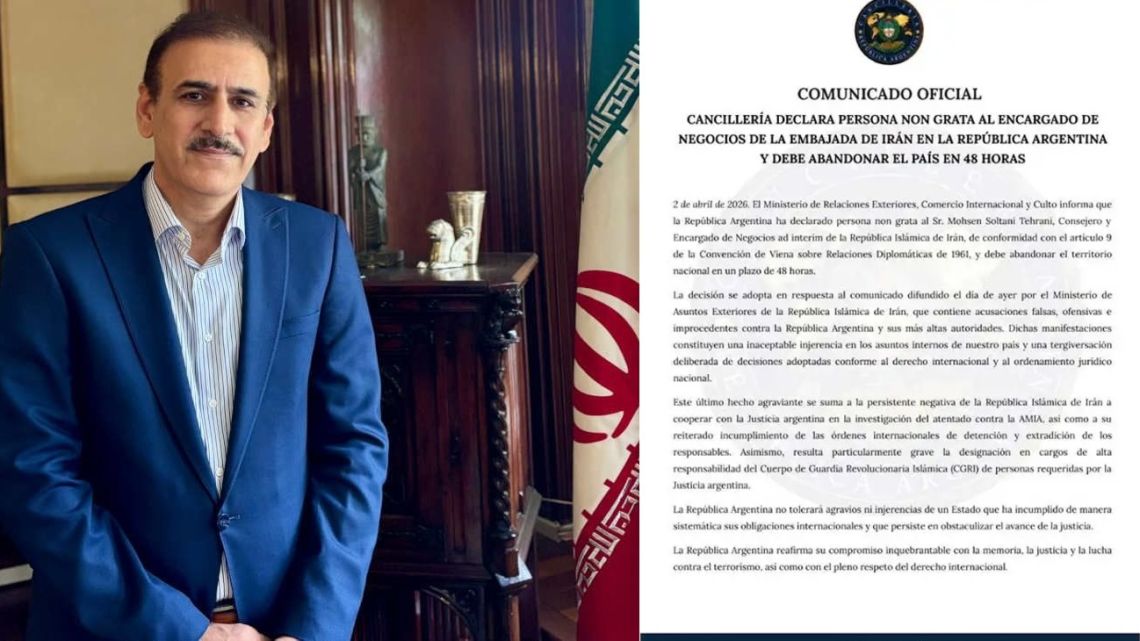
Iran’s chargé d’affaires in Argentina, Mohsen Soltani Tehrani says the decision to expel him from the nation “does not benefit” his host country and “only makes things worse.”
Soltani – a veteran Iranian diplomat who took up the post in Argentina in 2021 – gave an interview to the Perfil newspaper just a day after he was formally declared persona non grata by President Javier Milei’s government. He directly criticised the decision, stating: “Expelling the only diplomat does not benefit Argentina, it only makes things worse.”
The measure, which gave him 48 hours to leave the country, was communicated by the Foreign Ministry in Buenos Aires as a response to Tehran’s latest statement, which questioned Argentina’s recent decision to designate Iran’s Islamic Revolutionary Guard Corps as a terrorist organisation.
The argument, according to the text issued by authorities in Buenos Aires, was that Iran had “insulted Argentine authorities” and challenged sovereign decisions.

Soltani rejects that interpretation and set out the central axis of his criticism: Argentina’s participation (so far “political,” he said) in the war launched by the United States on February 28.
“It is not a sovereign decision to join an illegal war against all international norms,” he said, in conversation before his departure from Buenos Aires and return to Tehran.
The Iranian diplomat criticised the Argentine government’s alignment with the United States and Israel in the current Middle East conflict.

“It is not that we condemn Argentina for having relations or alignment with the United States or Israel. That is exercising sovereignty. What we criticise is that the President says Argentina is part of the aggression against Iran, that he is willing to send logistical support and that ‘we are going to win the war.’ That is something very serious,” said Soltani.
The Iranian official argued that this stance goes beyond rhetoric. “Even if they do not have the capacity to send troops, just saying it has consequences. The President’s decisions may bring consequences,” he warned.
Despite the hardening of relations, Soltani sought to distinguish between the Argentine government and wider society.

“We do not consider Argentina an enemy of Iran. Many Argentine citizens are not in favour of this,” said the chargé d’affaires, attributing the escalation to a political decision taken by the Executive branch.
Regarding his departure from the country, Soltani also criticised the way the measure was carried out. “They gave me 48 hours in the middle of a long [bank holiday] weekend, with everything closed, being the only diplomat at the Embassy. I have to settle accounts, contracts, tickets. We asked for a few more days, but they did not accept [the request]. They said it was a decision that had been made,” he explained.
The decision does not imply a formal break in diplomatic relations, although symbolically it represents a step leading up to that. Ordering an envoy to leave is a tool provided for in the Vienna Convention on Diplomatic Relations, under which Article 9 allows the receiving state to declare a diplomat persona non grata at any time and without needing to justify its decision.

“They told us at the Foreign Ministry that it is not a rupture, but a response to Iran’s statement. Relations will remain inactive for a time, just like at the Argentine Embassy in Tehran,” he said.
The deterioration in relations with the Persian country predates the Milei government. Since the 1990s, regardless of the political orientation of governments on both sides, bilateral relations have been shaped by accusations against Iranian officials over the bombings of the AMIA Jewish community centre and the Israeli Embassy in 1994 and 1992 respectively.
In recent hours, reports have also begun circulating that Tehran could now be more likely to move forward with the formal closure of Argentina’s Embassy in Iran.

In practice, the mission has not been active since June 2025, when then-foreign minister Gerardo Werthein ordered its evacuation following the first US and Israeli bombings.
Since then, Argentina’s chargé d’affaires in Iran, Marcelo Jordan, and consul Martín Baeza, have been working from Baku, the capital of Azerbaijan.
Soltani said that, despite the crisis, no Argentine political leader had contacted him. “I did not receive calls from politicians, not even from opposition sectors. Only some journalists, academics and diplomatic friends,” he said.

The absence of contact suggests a cross-party consensus within Argentina’s political leadership regarding Iran, despite internal differences.













Comments