

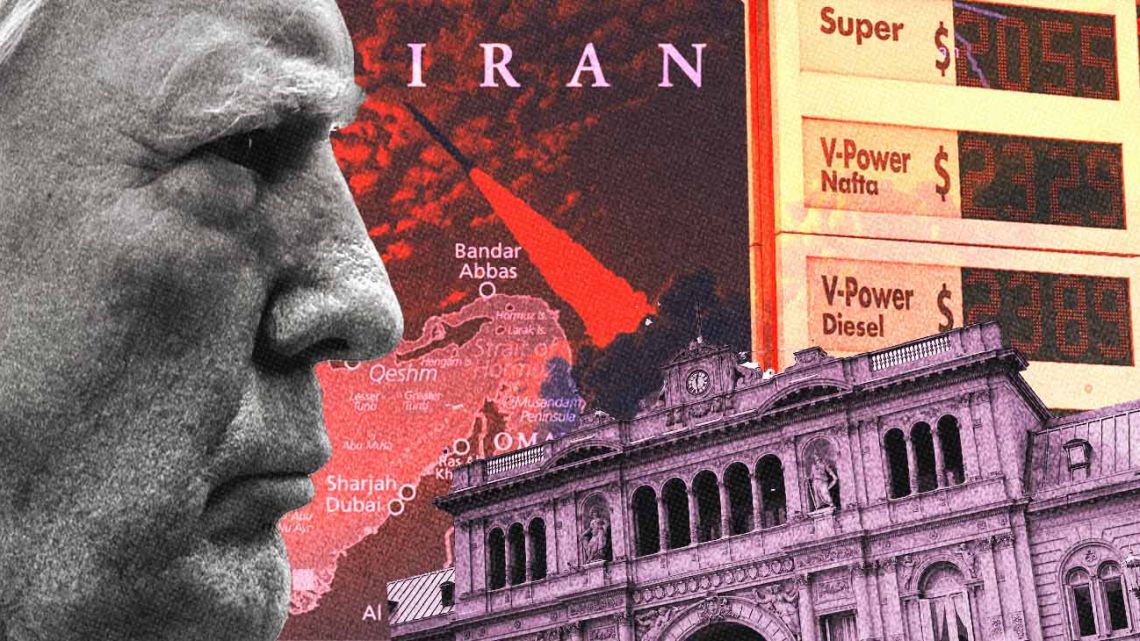
More than 30 days after the start of the conflict in the Middle East pushed by Donald Trump, the international setting begins to show more than geopolitical tension: it evidences an accelerated political wear and tear which can no longer be concealed. What started as a demonstration of power became, in a matter of weeks, a factor of internal instability.
In the United States, the war not only opened up an external front: it also triggered a sizeable domestic crisis. On March 28, over eight million people took part in over 3,000 protests all over the 50 states under the slogan “No Kings” – a cross-party demonstration which even got to Republican strongholds.
The protests summarise a cumulative unrest: rejection of the Iran war, questioning of migratory policies, denouncing authoritarianism and an increasingly more visible economic deterioration.
Data supports that climate: a fall in the approval of economic management, strong rejection of the military offensive and a growing institutional mistrust, also fed by scandals which erode the credibility of the government, such as the Epstein case. And all this without counting the eight consecutive elections where Trump’s candidates got crushed, which foretells a resounding defeat in the midterm elections in November.

The result is a critical combination: a crisis of political legitimacy and of confidence. And in that context, there is more to it than just wear and tear, such as scenarios of electoral defeat and even impeachment.
That deterioration does not stop at the US borders. Like in any global process, the effects carry over. And in that chain logic, Argentina is one of the most exposed pieces.
Javier Milei’s government is facing its own wear and tear amplified by this context. Agan, the data is decisive: disapproval is over 60 percent – 61.6 percent according to Atlas Intel – whereas approval is falling to between 30 percent and 38 percent. At the same time, nearly 65 percent of Argentines claim to be dissatisfied with the direction of the country.

This deterioration is not just political. It is the expression of a deeper unrest connecting economy, expectations and everyday life.
The inflationary slowdown, presented as the government’s main achievement, begins to show its limits. Inflation is dropping – around 32 percent – but purchasing power or living conditions are not improving.
Here is where one of the keys of the time comes in: inflation is no longer just a question of pace and becomes a problem of income. Prices rise less but salaries continue to lose in the face of those prices. The consequence is direct: growing social unrest, especially around employment and consumption capacity.
This is coupled with the impact of the international context. War adds pressure on energy and global logistic costs, which ends up affecting domestic prices. In fragile economies, these shocks are not dampened: they are amplified. And what looked like a controlled slowdown begins to show tension looking forward.
In this setting, credit changes nature. It stops being a consumption tool to become a survival mechanism.
Numbers reflect that transformation: 56.4 percent of households become indebted to live, while 60 percent of the adult population is in debt. In more extreme situations, as many as 90 percent finances basic consumption.
This configures a fragile balance. The economy does not grow but it does not collapse either: it is sustained through indebtedness. It is an apparent stability, backed by mechanisms which, over time, tend to generate more vulnerability.
This economic context fully affects politics. President Milei begins to lose his main asset: social legitimacy.
The popularity “shield” which protected him in the first few months of his administration is weakening, giving rise to an increasingly more volatile and tense social climate, with growing risks of conflict.
The data are significant: nearly 46.9 percent of the population already holds the government directly responsible for the crisis. That transfer of responsibility is a turning point because it breaks away from the initial “legacy” logic and places the focus on the current administration.
Conflict begins to express itself in the street. The general strike pushed by the CGT, massively observed throughout the country, worked as a clear sign of the level of discontent. This is in addition to sectorial conflicts with teachers, state employees, healthcare staff and security forces in different provinces, thus amounting to an increasingly active and demanding social setting.
In parallel, corruption cases in the power sphere begin to play a central role.
In a context of adjustment, loss of income and growing perceived inequality, any sign of privilege or irregularity gains much more impact. Social tolerance to corruption is drastically reduced when most people feel they are struggling.
It is not just a problem for the courts. It is a deep political problem. Because corruption, in this setting, not only erodes the government’s image: it erodes trust in the system and amplifies unrest.
This situation is coupled with an increasingly more visible tension between the government’s foreign policy and public opinion. Alignment with the United States, amid a war widely rejected by Argentines, opens up a representation gap.
It is not just an international matter. It is a domestic sign.
When a society does not feel reflected in strategic decisions, that distance is translated into political weakness. And in contexts of fragility, that disconnect is heavier.
What emerges is a multiple synchronised dynamic of wear and tear. In the United States, a leadership weakened by war, the economy and scandals. In Argentina, a government which bet on that leadership and now faces the consequences.
The logic is clear: an initial event triggers a chain of reactions.
War pressures the global economy.
The economy affects prices and income.
Economic deterioration feeds into social unrest.
Unrest amplifies sensitivity to corruption.
That all ends up eroding political legitimacy.
In this context, the question is no longer whether there will be an impact, but how far it will go.
What happens when a government builds its strategy over an ally which begins to weaken? How is internal balance sustained when persistent inflation, social conflict and loss of trust all merge?
As in any domino effect, it is not just a chip falling but the speed at which it drags the others.
And once that motion starts, stopping it is no longer a decision.
It becomes a race against time.











Comments