

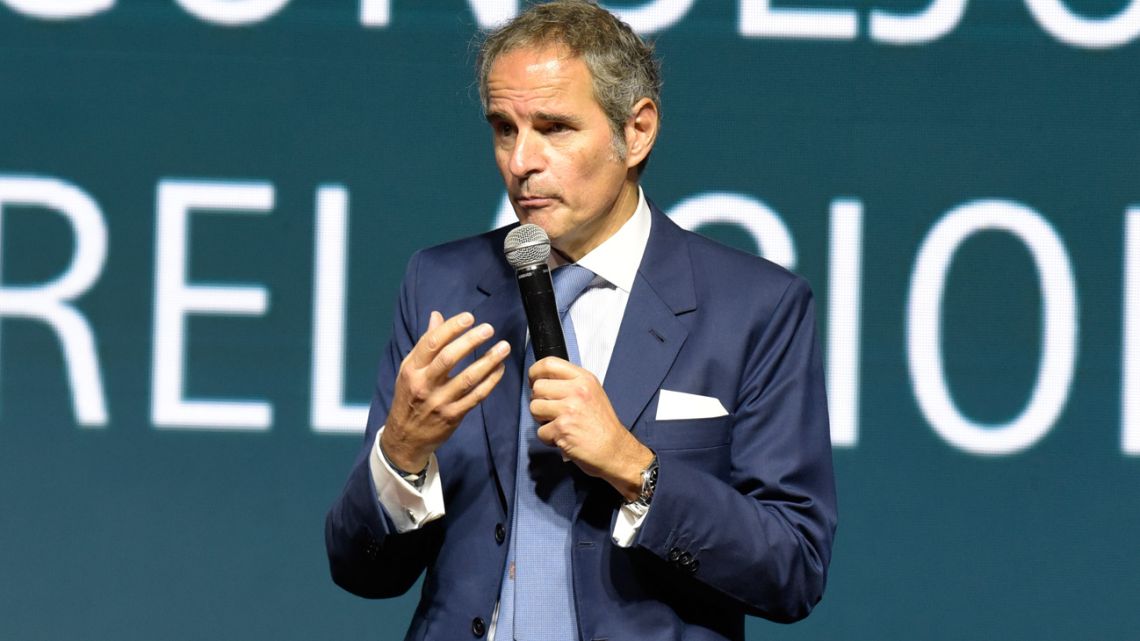
Rafael Grossi, Argentina’s candidate for the next secretary-general of the United Nations, outlined a bold reformist vision for the multilateral organisation on Monday night as President Javier Milei’s government formally threw its weight behind his campaign.
Speaking at an event hosted by the Argentine Council for International Relations (CARI) at the La Rural exhibition centre in Buenos Aires, an energetic Grossi said the UN must rediscover its founding values, tackle bureaucracy and act decisively to prevent conflict and respond to crises.
“We need a secretary-general who puts on their boots and goes where the problem is,” said the veteran diplomat, speaking just hours after Argentina formally launched his candidacy at the Palacio San Martín in Buenos Aires.
“We must always move forward, open doors and find solutions” to global security problems, he added.

Acknowledging the structural challenges facing the UN, Grossi called for frank and comprehensive reform. “There are many things that are not functioning well,” he said, urging a reform agenda pursued “without hypocrisy.”
Grossi, 64, is one of the top candidates to succeed current UN Secretary-General António Guterres, who is due to step down in December 2026.
According to the tradition of geographical rotation, the post should next go to a Latin American. Former Chilean president Michelle Bachelet and Costa Rica’s Rebeca Grynspan, currently head of the UN Conference on Trade and Development (UNCTAD), are also seeking the top UN post.

Members of the UN Security Council are due to begin the formal selection process by the end of July. The five permanent members with veto power – the United States, China, Russia, the United Kingdom and France – will have a decisive say.
‘Active’

A career diplomat who has served as director-general of the International Atomic Energy Agency (IAEA) since 2019, Grossi argued on Monday that the UN should take on a more “active” role in global hotspots.
He referenced his work on the Ukraine war and, crucially, the safety of the Zaporizhzhia nuclear power plant, and his direct talks with Russia’s Vladimir Putin and Ukrainian President Volodymyr Zelenskyy, to illustrate his ability to dialogue with all sides of a conflict.
Grossi has also had to navigate tense relations with Iran over Tehran’s nuclear programme. In June, France, Germany and the United Kingdom condemned “threats” issued by Iran against the IAEA chief, who was forced to travel with a security team.

The veteran diplomat’s handling of both situations, as well as a number of other controversial issues, has been highly praised. Experts have noted his willingness to travel into dangerous locations, tackle contentious issues head-on and negotiate with hostile actors.
Grossi’s candidacy is gaining momentum, with national figures lining up to voice their support for his bid. Several government officials, including Human Capital Minister Sandra Pettovello, Tourism, Environment & Sport Secretary Daniel Scioli and Education Secretary Carlos Torrendel, were in attendance at Monday’s event, alongside members of the accredited diplomatic corps.
A number of leading business figures, Eduardo Elsztain (IRSA), Marcos Bulgheroni (Pan American Energy) and Mario Montoto (Codesur) among them, were also in attendance.

Foreign Minister Pablo Quirno, who introduced the candidate and formally backed his application on behalf of the national government, highlighted Grossi’s “experience, prestige, credibility and authority.”
He also praised Grossi’s background in nuclear verification and work on complex missions, while noting Argentina’s desire to take on a larger role on the world stage.
Echoing previous criticism of the UN voiced by President Milei, Quirno said that Grossi would offer the multilateral organisation “effective and realistic” leadership.

Grossi’s leadership of the IAEA to date, argued Quirno, shows what is possible at the UN with “pragmatism.”
In brief remarks, CARI President Francisco de Santibañes highlighted Grossi’s “generosity,” personal qualities and front-footed approach to diplomacy. He described him as a highly “competitive” candidate for the UN’s top job.
Earlier this month, CARI honoured Grossi with its highest award, the Premio Embajador Carlos Muñiz, in “recognition of an exceptional trajectory in service to the country and the world.”
Vision
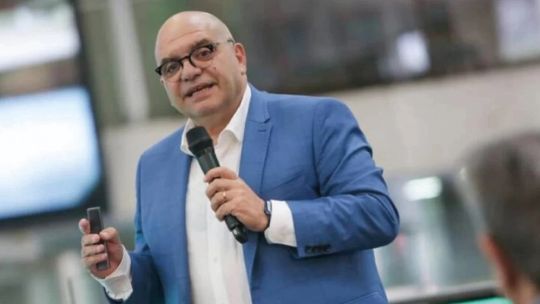
Grossi’s energetic approach to diplomacy and problem-solving was on display from the very start of his address. Rejecting the prepared lectern and switching to a handheld microphone, he was soon striding the stage, addressing the breadth of the audience as he outlined his vision for the UN.
Thanking CARI for giving him the “unique opportunity to speak in my own country, to my society, to my own people,” Grossi expressed his pride at being Argentine and at being given the opportunity to represent the country on the global stage.
The IAEA chief, however, did not offer unbridled optimism. Echoing criticism voiced by officials in the Milei administration – and by US President Donald Trump – Grossi said the challenges facing the institution were severe.
He called on world leaders to have the “courage to reform” the institution and lead it into a new era. Grossi said the UN needed to regain its capacity and credibility, intervening where necessary and retaining a core presence in key regions.
Speaking in an interview this week, Grossi said that he “knows what he can contribute” to the UN.
“In the war between Russia and Ukraine, I managed to build bridges and maintain a permanent dialogue with both Putin and Zelenskyy. The same applies to what we are doing in the Middle East, including Iran, with the nuclear programme, and in other parts of the world. We were able to bring positions closer together and achieve concrete solutions,” he told BAE Negocios.
Grossi says he wants a “United Nations that works,” that is not “overly bureaucratic” and delivers “concrete solutions.”
“My personal promise is that it can be a place where multilateralism is privileged over unilateralism,” he said in Monday's speech.
In a nod to his home nation and its ambitions at next year’s football World Cup, he closed with a comment designed to bring out a smile.
“In 2026 we will be playing in two World Cups. And I believe we are going to win both,” he declared to rapturous applause.







Comments