

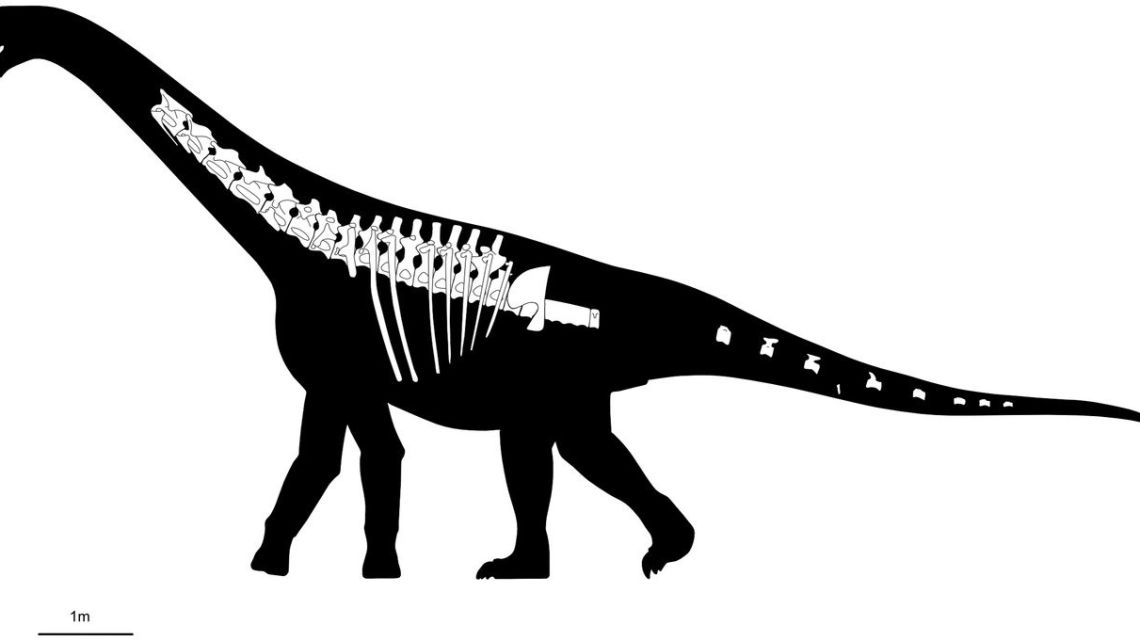
A team of scientists with Argentina’s CONICET national scientific research council has confirmed the discovery of a new species of dinosaur in southern Chubut Province on the basis of fossils found in the Cañadón Calcáreo rock formation.
Catalogued as Bicharracosaurus dionidei, the dinosaur inhabited the region during the Late Jurassic Period over 150 million years ago, according to the experts.
The study was published in the scientific journal PeerJ, detailing its anatomical characteristics and the evolutionary context of its discovery.
According to the research, Bicharracosaurus belongs to the group of sauropods, huge, long-necked herbivorous dinosaurs. The remains found– which were mainly dorsal, sacral and caudal vertebrae – present unique characteristics permitting it to be identified as a new species. Among them, particular details in the structure of the vertebrae, with complex internal cavities which indicate specific evolutionary adaptations within its lineage.

The researchers’ work notes that the dinosaur occupied an intermediate position in the evolutionary tree of the sauropods. This makes it a fundamental piece for understanding the transition between the more primitive forms of creature and the more advanced giants dominating the Cretaceous Period. In particular, it supplies information about the early diversification of these animals in the southern hemisphere.
The fossils were found in the Cañadón Calcáreo formation, a geological unit of great relevance in Patagonia. This site had already produced other important remains but the Bicharracosaurus discovery permits broader knowledge of the Jurassic ecosystems in the region, which at that time presented an environment with abundant vegetation ideal for the development of herbivorous giants.
The study’s publication highlights that the anatomical characteristics of the dinosaur show a combination of primitive and derived features. This suggests that the Patagonian sauropods experienced evolutionary processes on their own, different from other regions of the world. It further boosts the importance of South America as one of the key centres in the evolutionary history of these animals.

The discovery is the latest in a series of breakthroughs in Argentina’s south, highlighting the value of the work of national scientists and their collaboration with local communities.
The name of the species pays tribute to Dionide Mesa, who collaborated on the initial identification of the remains.
Bicharracosaurus dionidei thus not only broadens the catalogue of known dinosaurs but also reaffirms the role of Patagonia as one of the richest territories for fossils on the planet.
– TIMES/NA













Comments