

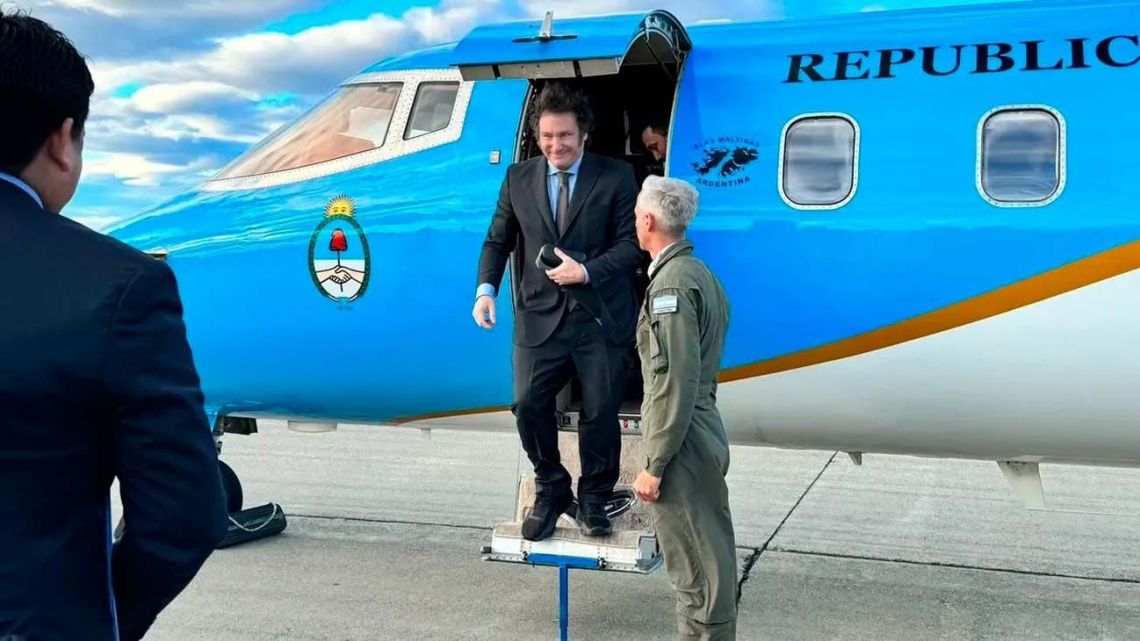
Javier Milei’s government has taken up Argentina’s sovereignty claim over the Malvinas Islands as a cause with which to relaunch its administration a year ahead of the next elections. But despite the President’s fiery speeches and national address, the possibility of him travelling to London this October is under discussion.
Although the trip has not yet been confirmed, Milei has received an invitation to give a speech at the University of Oxford on either October 23 and 24, an engagement that is already being worked on by the Presidency.
The itinerary could potentially include meetings with British business leaders and political figures. Milei himself had previously expressed his intention to travel to the United Kingdom and meet British authorities, as well as political figures such as Nigel Farage. He also has a longstanding ambition to meet one of his idols, Rolling Stones singer Mick Jagger.
Given the tensions currently affecting relations between the two countries, a trip raises the question of a possible bilateral meeting. No talks with the British government have been confirmed so far and no information has been given.

It has also not been confirmed whether Milei will take part in a new edition of the ‘Argentina Week’ roadshow set for London, although the government is considering holding a leg of the event there.
Presidential Spokesperson Adrián Ravier confirmed on Tuesday that London forms part of the Argentina Week agenda, but clarified that no date has yet been set yet, nor had the President agreed to attend.
“For the time being, the President’s attendance has not been confirmed ... I do know that it is being considered,” he said.

The uncertainty contrasts with the organised agenda for the Argentina Week event planned for Paris, set to take place between September 30 and October 2.
If Milei does travel to London, the visit would also carry particular political significance. It would be the first bilateral trip to the United Kingdom by an Argentine head of state since Carlos Menem, who met then-prime minister Tony Blair and Queen Elizabeth II in 1998.
Former presidents Néstor Kirchner and Cristina Fernández de Kirchner also travelled to London, in 2003 and 2009 respectively, although both visits took place in the context of multilateral summits.
UK response
For its part, the United Kingdom has sought to lower the temperature of the diplomatic dispute, all the while making clear that it is not prepared to discuss sovereignty of the Malvinas Islands.
That position was set out by UK International Development Minister Kirsty McNeill, who told the House of Commons this week that London wanted to maintain a “modern and constructive” relationship with Argentina on issues of common interest.
However, the minister drew a clear line over the archipelago, saying there should be no doubt about Britain’s commitment to the islanders, their democratic rights and UK sovereignty. She recalled the 2013 referendum on the islands, in which 99.8 percent of voters backed remaining under British administration.
British Prime Minister Andy Burnham, meanwhile, told Parliament that the United Kingdom would maintain its position on the islands and would be “relentless in defending” the islanders’ right to decide their own future.
During a parliamentary session, Conservative leader Kemi Badenoch warned that Argentina was “threatening” the islanders and called for a stronger show of force from the British government.
Burnham said the United Kingdom would increase its defence budget, while stressing that it would seek to do so without cutting funding for social services.










Comments