

Preliminary data from the Buenos Aires City government shows that all crimes decreased last year in the nation’s capital.
Figures from the Mapa del Delito 2025 report show that in 2025, the homicide rate dropped to 2.5 per 100,000 inhabitants, which placed it as the second-safest capital in the Americas, behind Ottawa, Canada, according to officials.
According to City Hall’s crime map, there were 78 murders in 2025 – three percent fewer than in 2024, when 80 cases had been reported. That’s the lowest figure in 31 years and a 60-percent fall from the historic peak in 2014, when 197 were recorded.
As for the causes of homicides, the main one was a “quarrel or vendetta,” with 21 cases (27 percent of the total). It was followed by “murders resulting from mugging” (14 cases, 18 percent), those linked to “intra-family conflicts or violence” (10 cases, 13 percent) and “femicides” (eight cases, 10 percent).

Out of the 78 murders, 24 occurred in vulnerable areas and 54 in the rest of the territory. Firearms were used in 31 cases and other weapons in 27 of them.
The homicide rate is considered the main international indicator to measure insecurity and violence within a territory. With last year’s figures, Buenos Aires City became the second- safest capital in the Americas. Its rate was below the nationwide rate (3.7) and that of neighbouring Buenos Aires Province (4.34), the most-populous region in the country.
Making headlines
Officials in City Mayor Jorge Macri’s government highlighted that for murders, carjacking and muggings with a firearm, the rates are the lowest since official records started.
Some of the most resonant police cases last year were the murder of 61-year-old economist Juan Pablo Jiménez in Palermo (for which members of a gang linked to “black widows” were arrested), the so-called ‘Villa Crespo massacre’ (in which Laura Leguizamón killed her husband, Adrián Seltzer, their two children and killed herself) and the murder of Maria Vilma Das Dores, a Brazilian tourist who was attacked by a homeless man with a criminal record and a history of psychiatric problems.
Regarding the latter two incidents, Macri called for the repeal of Article 20 of the Mental Health Law, which establishes strict legal criteria for involuntary hospitalisation. “It’s a catastrophe,” said the mayor of the law.
“There has been a movement in the world calling for people to be taken out of institutions because the logic of committing someone there caused many injustices. It led to a break from the concept of institutionalisation, but it is part of the problem in some criminal cases. The concept of imminent self-risk or risk to others or imminent danger comes too late and I hope Congress deigns to handle this,” he told the press.
Robberies and violence
Total robberies fell by 27 percent from 2024 levels and reached the lowest level in the last 25 years, excluding 2020 and 2021, when much of Argentina and the capital was under coronavirus pandemic restrictions.
However, arrests for all crimes totalled 36,512 – three percent more than in 2024.
In Buenos Aires City, there were 50,069 recorded robberies in 2025, as against 68,392 the year before. Since its historic peak in 2008, the cumulative decrease is 43 percent.
Muggings using weapons, including firearms, sharp blades and blunt instruments fell by 34 percent – 5,566 last year, as against 8,445 the previous year.
According to the City Hall report, these are now at their lowest levels since records began, including the pandemic years. Since 2016, when 19,554 such events had been reported, the cumulative reduction is 71 percent.
In the meantime, carjacking was the crime with the greatest fall. In 2025, 524 cases were reported, a 54-percent drop from 2024 (1,140 cases). That’s the lowest figure since 2002 and accounts for a 92-percent decrease compared with the historic peak that year, when 6,667 carjackings had been reported.
Muggings on motorcycles also had a slight drop, three percent, falling from 5,758 cases in 2024 to 5,587 in 2025. This method is 51 percent below its historic peak in 2018.
As for robberies (without using violence or intimidation), there was a 21-percent fall, with 49,641 cases from the 62,771 the year before. The report underlines that reporting is key to recording this crime and designing public policies to combat it.
Public order
“We have never had figures like these. All crimes in the City have fallen, and in some cases to record lows,” said Mayor Macri at a Tuesday press conference, flanked by City Security Minister Horacio Giménez and City Security Secretary Maximiliano Piñeiro.
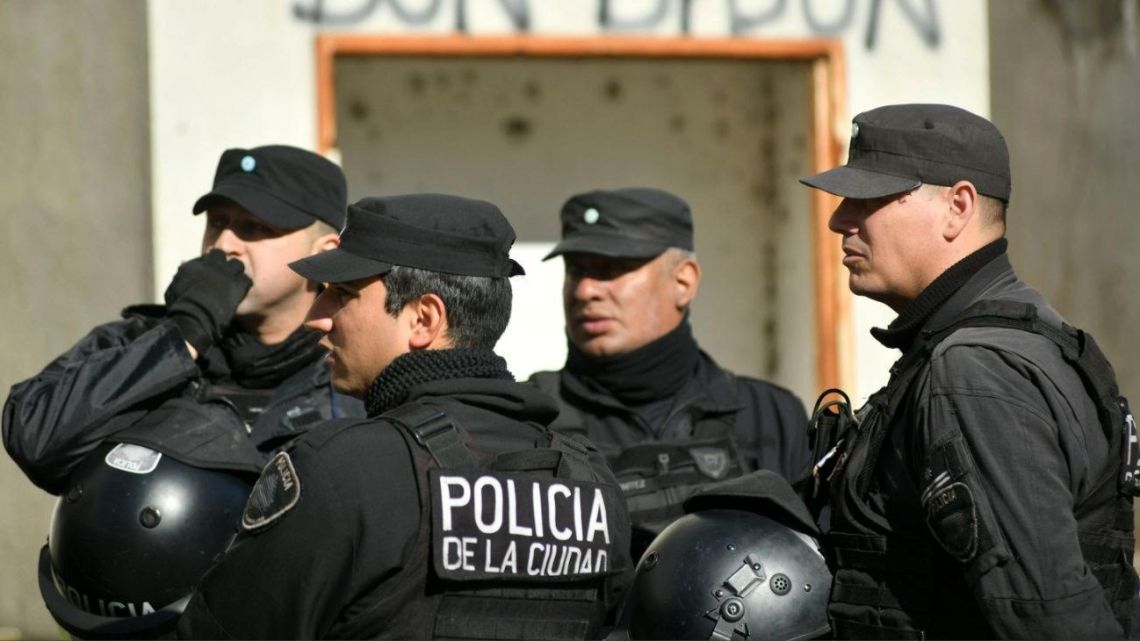
City Hall attributed the evolution of indicators to a series of measures implemented over the last few years, such as the incorporation of 2,500 police officers, the addition of nearly 500 vehicles (patrol cars, motorcycles, vans and special units), the creation of the Access Control Patrol and reinforced night patrols, among others.
In terms of equipment, more than 7,000 high-tech bulletproof vests were distributed, and the video surveillance system was expanded with 1,200 new cameras (there are already 17,000 devices monitored from the Urban Monitoring Centre).
The so-called “Digital Ring” (licence plate-reading cameras) was also strengthened, and 400 Safe Points were installed.













Comments