

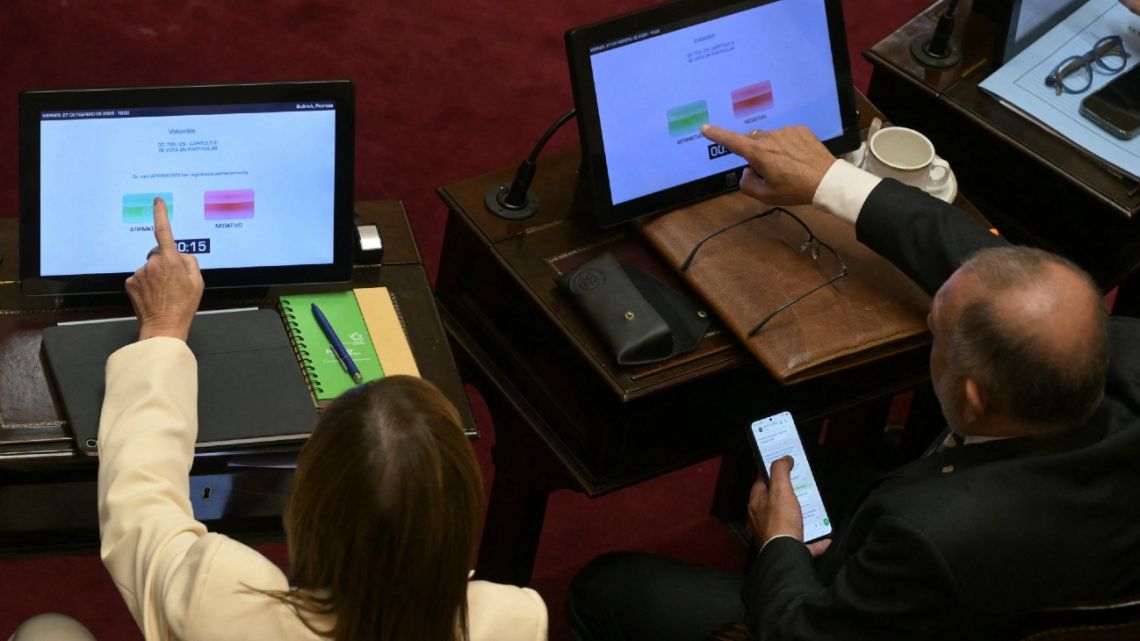
Argentina's Congress approved President Javier Milei's labour reform package Friday after weeks of sometimes violent protests and fraught negotiations, securing a flagship reform that loosens rules on workers' rights.
Milei's Labour Modernisation Bill allows working days of up to 12 hours, reduces severance pay, limits the right to strike and lowers employer taxes, among other provisions.
The Senate approved the bill by a comfortable majority: 41 votes in favour, 28 against and two abstentions.
It received the greenlight from the lower house one week ago.

Patricia Bullrich, the head of the La Libertad Avanza caucus who played a leading role in the negotiations to reach consensus with dialogue-oriented sectors, was elated when the result came in.
"This reform sends clear signals. Argentina wants to grow again. We have not grown for 15 years, many of which were governed by those on the other side," she said.
"We want workers' rights not to be the property of a caste, of a group. Today, workers want to work with more freedom," she concluded.

As senators voted, protests against the reform continued outside the National Congress building.
The reforms, described as "regressive and unconstitutional" by Argentina’s leading labour federation, the CGT, would reduce severance pay, extend the working day to a potential 12 hours and limit the right to strike, among other measures.
Milei’s government says the reform will help reduce informal unemployment and create jobs by reducing the tax burden on employers.

Opposition Peronist caucus leader José Mayans said the reforms would "severely affect Argentine workers, retirees and pensioners."
The Formosa senator denounced the "express treatment of a law that affects 20 million people" and predicted that "it will lead straight to legal conflict."
"It was born bad and will end badly," he said, adding that "it is a bill that was drafted without consultation, by law firms representing business owners who are against workers' rights."
– TIMES/AFP/NA














Comments