

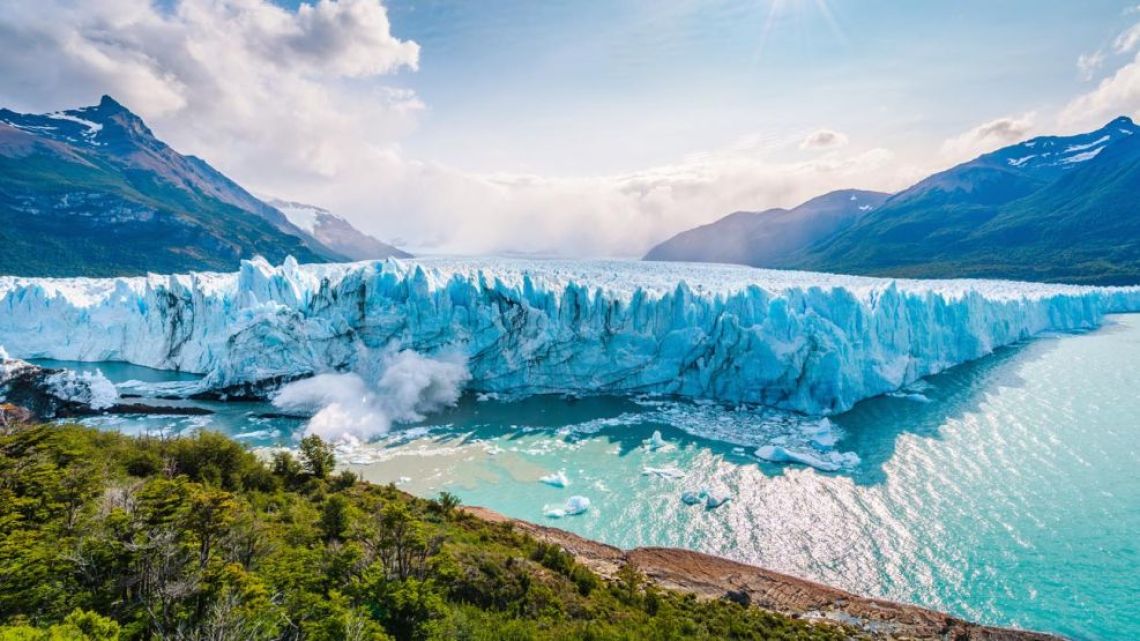
President Javier Milei’s government announced on Monday that it has sent Congress a bill to reform the country’s Glacier Protection Law, kickstarting a controversial push to amend the legislation.
The Casa Rosada wants the bill to be debated during special sessions called by the President, which are due to run until December 30.
The proposed changes would amend National Law 26.639 (the Minimum Standards for the Preservation of Glaciers and the Periglacial Environment Law) and allow industrial activity, mining and oil or gas exploration in periglacial zones, with decision-making powers placed in the hands of provincial governments.
The bill aims to "bring order to the existing regulatory framework, put an end to arbitrary interpretations and consolidate a model of environmental federalism," the government said in a statement.

The Glacier Protection Law, in force since 2010, bans activities that could damage glaciers and periglacial areas, such as mining and hydrocarbon exploitation.
The current legislation adopts a broad definition of glaciers, protecting not only the ice masses most people associate with the term, but also so-called ‘rock glaciers’ and frozen groundwater found on mountaintops where surface glaciers have retreated.
The National Glacier Institute, which played a role in drafting the original law, promoted this definition on the basis that most glacial water is believed to come from such reserves.

Argentina is one of almost 50 countries worldwide with glaciers. Around 2,000 of them cover an area of 310,000 hectares, according to the country’s Biodiversity Information System.
'Real federalism'

According to the Executive, the initiative seeks to bring order to legislation that for more than a decade has generated legal uncertainty and hindered the use of natural resources in Andean provinces.
The Executive Branch asked Congress to give the bill prompt consideration and to ensure proper public participation during the legislative process.
Milei’s government claims the proposal represents "a decisive step towards getting Argentina back on its feet, with clear rules, real federalism, productive development and economic growth."

The bill reaffirms the constitutional mandate of Article 41, which requires environmental protection without preventing human development, and Article 124, which recognises provincial ownership of natural resources.
Along these lines, the proposal seeks to strengthen the role of provincial authorities in environmental impact assessments, recognise their technical and scientific capacity and promote efficient coordination with the National Glacier Inventory.
The current Glacier Protection Law designates glaciers and the periglacial environment as strategic public assets for water supply, bans activities such as mining and hydrocarbon exploration in these areas and established the national inventory.
Environmental concerns
International organisations, including the United Nations, as well as environmental NGOs, have expressed concern over changes to the Glacier Protection Law.
In February 2024, five UN special rapporteurs described the proposal as "regressive," warning of its potential impact on the natural defences of mountain ecosystems.
In a statement, environmental youth organisation Jóvenes por el Clima said the changes would put “the drinking water of millions at risk,” arguing that the bill fails to protect Argentina’s strategic reserves.
Argentina has 16,968 glaciers covering 8,484 square kilometres. These ice masses feed 36 river basins that supply water to 18 percent of the population, representing the second-largest freshwater reserve in Latin America, noted the NGO.
“We are not against mining development. We are against putting the drinking water of millions of Argentines at risk to satisfy the copper demand of [US President] Donald Trump’s government,” it said, referencing mining pushes in several provinces.
“We cannot give away what is ours in this way. We cannot put the water supply of millions of Argentines at risk. Argentine water is not for sale. It is not negotiable. It is untouchable,” said Jóvenes por el Clima.
– TIMES/NA/PERFIL












Comments