

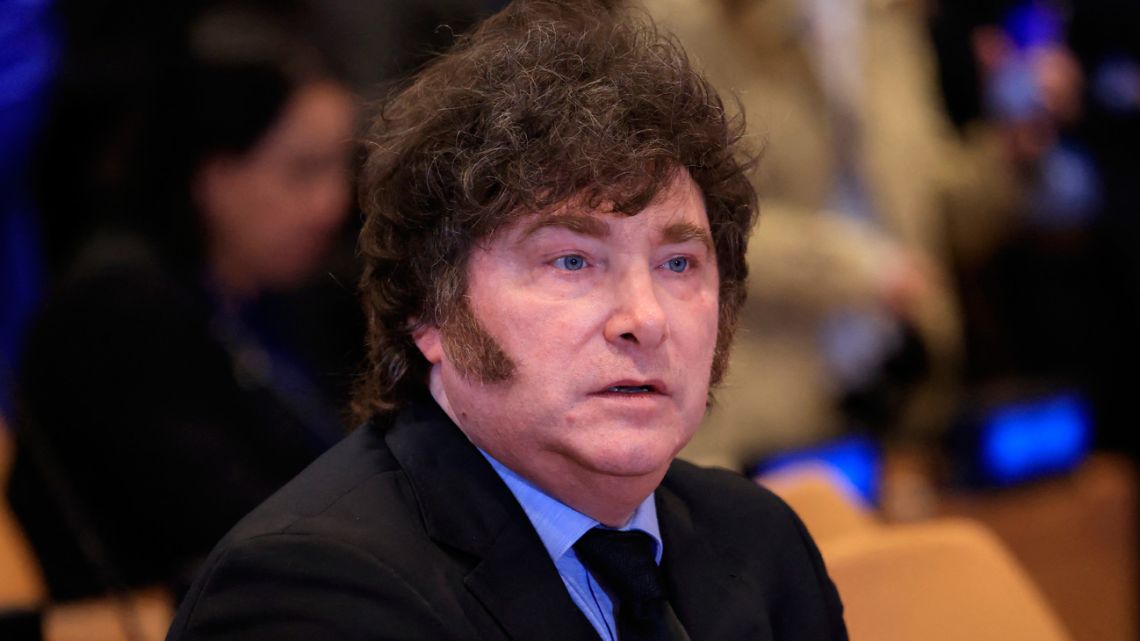
The Supreme Court on Tuesday cleared the way for President Javier Milei's repeal of restrictions on foreign ownership of rural land, ending a legal challenge that had blocked the measure since 2024.
The restrictions were contained in Law 26.737, commonly known as the ‘Ley de Tierras’ and formally the Régimen de Protección al Dominio Nacional sobre la Propiedad, Posesión o Tenencia de las Tierras Rurales, enacted in 2011 under Cristina Fernández de Kirchner's government.
The law capped foreign ownership of rural land at 15 percent nationally, with the same ceiling applying at provincial and municipal level. It also imposed limits on the amount of land that could be held by a foreign individual and prohibited foreign ownership of areas of strategic importance.
Milei repealed the restrictions through an emergency decree immediately after taking office in December 2023, arguing that removing barriers to private property and investment was part of his drive to deregulate the economy.

But in March 2024, a federal appeals court in La Plata blocked the measure after a veterans group, the Centro de Ex Combatientes Islas Malvinas de La Plata (Centre of Falklands War Veterans of La Plata, CECIM), challenged the decree in court on the grounds it threatened national sovereignty.
On Tuesday, the Supreme Court rejected the challenge, ruling that CECIM did not have the necessary legal standing to bring the case and that there was no constitutionally valid case.
The justices said that its decision "does not constitute a judgement on the constitutional validity" of Article 154 of the decree, which repealed the law.

In practice, the decision removes the ruling that had blocked the decree's application, leaving the repeal in effect.
‘Without any limit’

The ruling drew strong criticism from opposition politicians, who called for Congress to reject the decree that repealed the law.
Germán Martínez, head of the Unión por la Patria bloc in the lower house, linked it to the repeal of the Land Law. "The Supreme Court of Milei has left the repeal … in force," he wrote on social media.
Socialist lawmaker Esteban Paulón also called for the lower house to convene an emergency session to consider the decree, in line with the Senate's earlier rejection of Milei's DNU.

Socialist lawmaker Esteban Paulón also called for the lower house to convene an emergency session to consider the decree, in line with the Senate's earlier rejection of Milei's DNU.
Constitutional lawyer Andrés Gil Domínguez wrote in a post on X that the ruling means "any foreign individual or legal entity, or any foreign state, can buy any rural land it wishes – including in border areas – without any limit."
“A Supreme Court of Justice that has turned its back on the people and the heroes of the Malvinas” war, he added.
Foreign ownership
A map produced by researchers from the University of Buenos Aires (UBA) and CONICET scientific research council, based on official data, estimated in late 2025 that more than 13 million hectares – around five percent of Argentina's territory, an area comparable to England – were in foreign hands.
The researchers also found that the ceiling was already exceeded in 36 areas, with particularly high levels of foreign ownership in areas containing strategic water and mineral resources and along important logistical corridors.
The CECIM condemned Tuesday's ruling. "The Supreme Court has solved Milei's political problem. As of September 29, it has just put the Argentine Republic up for sale," the group said in a statement.
Opposition and environmental groups have campaigned against the government's attempts to loosen restrictions, with protesters carrying banners reading "the homeland is not for sale."
The government also sought to change the rules through Congress earlier this year, incorporating provisions on foreign ownership into a broader bill on private property.
It withdrew that section in August after failing to secure enough support.
– TIMES/AFP/PERFIL









Comments