

President Javier Milei has kicked off a December battle with organised labour as he seeks to overhaul Argentina’s employment laws.
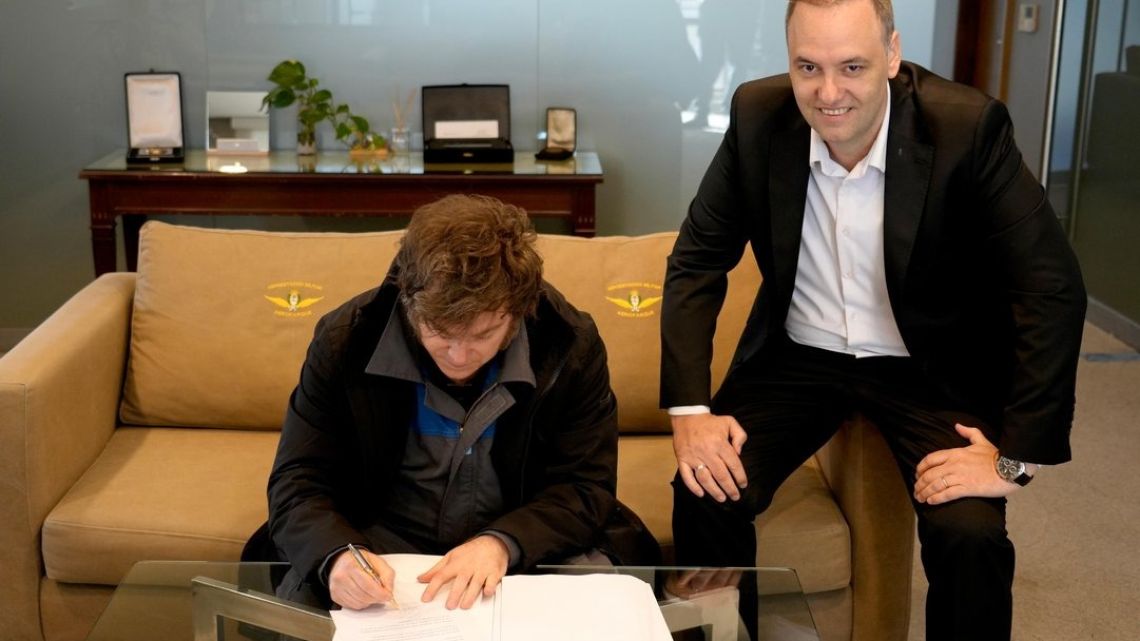
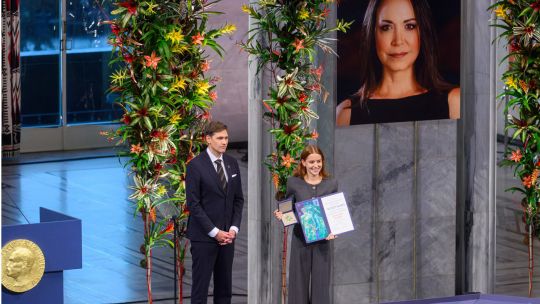
After his return to Buenos Aires from Oslo on Thursday morning – where the La Libertad Avanza leader attended the Nobel Peace Prize ceremony honouring Venezuelan opposition figure María Corina Machado – Milei put pen to paper on the final text of his government’s Labour Reform package.
The bill was sent to the National Congress later that day, with the Senate set to take it up first. Officials aim to secure initial approval during December’s special sessions, which will run until the end of the month.
The Presidency posted a video online showing the moment Milei signed the document. “For more growth, more prosperity, for more employment, and for Argentina to be great again,” he says in the clip, which also features Cabinet Chief Manuel Adorni and is set to a track by Australian rock band AC/DC.

Milei has appointed three officials to defend the government’s proposed “labour modernisation” push in public: Deregulation & State Transformation Minister Federico Sturzenegger; State Transformation & Public Function Secretary Maximiliano Fariña; and Labour, Employment & Social Security Secretary Julio Cordero.
The “spokesmen” are expected to make media rounds to put forward the government’s case. The reform push is likely to face resistance from trade unions and organised labour groups.
Details of the reform bill have been circulated by local media. The proposals include an extension of the working day, allowing for extensions of up to 12 hours per day, which may be agreed through collective bargaining talks and union contracts.

It would also introduce changes to holiday entitlements, which may be taken at any time of the year and divided into periods of no less than one week. Under the new scheme, each worker would be guaranteed at least one summer holiday every two years, unless they choose otherwise. Couples who work in the same company would retain the right to vacation together.
Proposed changes include new rules for holiday periods, adjustments to dismissal and severance pay, the creation of new funds to finance redundancy payouts and modifications to notice periods.
The text also broadens the distinction between remunerative and non-remunerative items, would allow the creation of dynamic (fixed or variable) pay components through collective bargaining or unilateral decision and requires wages to be paid via bank transfer or electronic means.

Many of these changes have long been demanded by private-sector employers, who see the current rules as obstacles to growth.
On labour formalisation, the government wants to introduce a new centralised registration system and modify rules surrounding collective wage-bargaining agreements. It recognises that such agreements may cap part-time staffing, define methods for calculating working hours by averages and negotiate variable salary components.
After the bill’s submission, it emerged that the ruling party wants to eliminate the so-called “Teleworking Law,” which regulates remote and home office work.

One clause of the reform bill repeals Law 27.555 and its amendments, proposing that such conditions be regulated under the government’s new Employment Contract Law that allows employer and employee to reach agreement.
Specific regulations on the right to disconnect, returning to face-to-face work and the provision of equipment and compensation for expenses would be eliminated, according to reporting by the Noticias Argentinas news agency.
Resistance?
Leaders from the CGT umbrella union grouping, Argentina's largest labour federation, met Thursday to discuss tactics ahead of the legislative push.
While there is no defined plan for action in the short term, union sources said its leaders will initially take "institutional" actions as they look to persuade lawmakers to back their cause.
CGT triumvirate members Jorge Sola, Cristian Jerónimo and Octavio Arguello convened the Executive Committee at the federation's headquarters in Buenos Aires, where the majority of union members will seek a common position in rejection of the government's bill.
There will be palace intrigue, but there will also be street protests," one union source said, implying that union hardliners will ultimately call a demonstration.
CGT leaders and the head of the UOCRA construction workers union, Gerardo Martínez, held a meeting on Wednesday with Peronist senators who pledged to reject any reform.
– TIMES/NA










Comments