

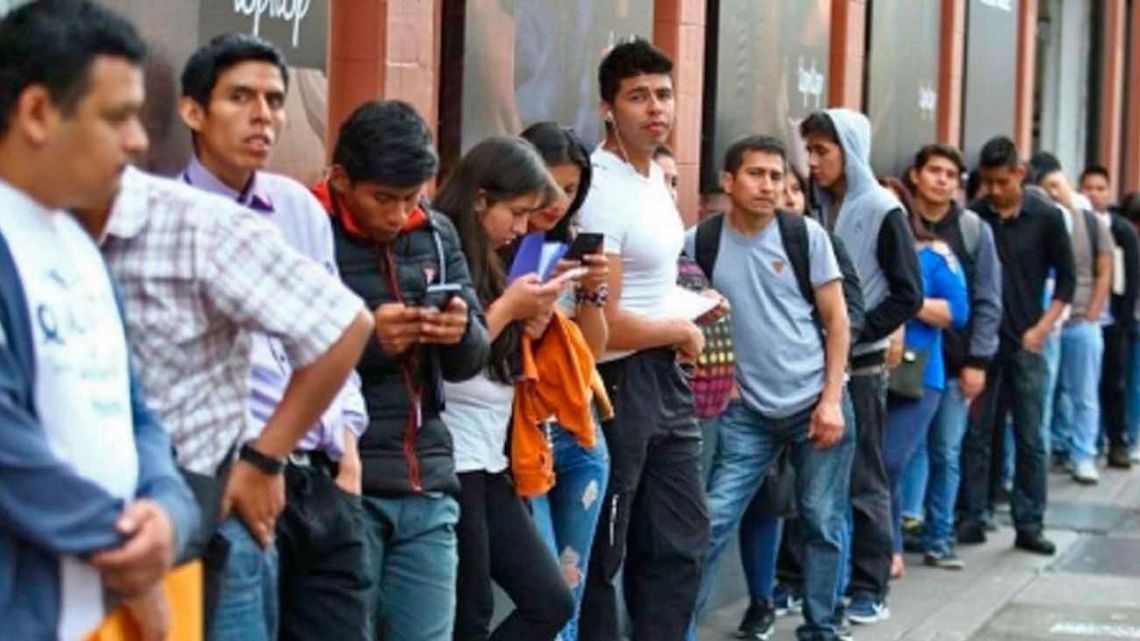
Unemployment has become the main concern for Argentines, overtaking rising prices and utility bills, with more than half of households report some degree of difficulty covering their expenses.
The figures come from the latest Public Opinion Monitoring survey by Management & Fit consultancy firm, conducted last month.
The poll found that 19.8 percent of respondents identified unemployment as the country's main problem, up 2.2 percentage points from July. Meanwhile, concern over rising prices and utility bills fell 3.5 points, from 22.4 percent to 18.9 percent.
Overall, almost seven in 10 personal concerns are directly linked to the economy.

The shift is significant as it reflects a change in households' economic priorities. Although inflation and utility costs are still among the main reported concerns, employment has moved into first place. Anxieties over the lack of work and the risk of losing jobs has also increased at a personal level.
Corruption ranked third among national problems, cited by 15.9 percent of respondents, followed by insecurity at 13.7 percent and poverty at 13.5 percent .
The picture becomes clearer when respondents are asked about problems directly affecting their households. Economic difficulties accounted for 69.1 percent of mentions, according to Management & Fit.
Making ends meet
The main personal concern remains the difficulty of making ends meet, cited by 22 percent of those surveyed. This was followed by low incomes, at 17.2 percent, while personal or family debt problems accounted for 10.4 percent.
Concerns linked to the labour market also increased. A lack of work or being unemployed was cited by 9.4 percent of respondents, up from 8.9 percent in July, while concerns about losing one's job rose from 3.5 percent to 4.5 percent.
Difficulty renting or accessing housing also increased, from 4.9 percent to 7.4 percent between July and September.
Another indicator of the deterioration in day-to-day economic conditions is household income. Some 52.4 percent of households said their income either did not cover their expenses or only did so with difficulty.
A further 31.2 percent said their money “just about covers everything, without major difficulties”, while 21.2 percent said their income was insufficient and they faced “some difficulties.” Another 11.8 percent reported experiencing major difficulties.
At the other end of the scale, just 11.8 percent of households said their income comfortably covered their expenses and allowed them to save.
Perceptions
The study found differences by gender, age and educational attainment. Economic difficulties were more common among women, people aged over 40 and those with lower levels of education.
Perceptions of respondents' own economic circumstances also deteriorated from the previous survey. Some 39.3 percent rated their personal financial situation negatively, up 1.8 percentage points from July, while only 25.7 percent viewed it positively.
Of those surveyed, 34.9 percent described their situation as “bad” and 21.6 percent as “very bad,” while 16.8 percent considered it good and just 0.1 percent very good. The report said negative assessments were particularly prevalent among women and people with low or medium levels of education.
The deterioration extends beyond personal finances. When respondents were asked about Argentina's overall economic and social situation, 56.7 percent gave a negative assessment, up from 54.8 percent in July. The positive assessment was virtually unchanged at 16.8 percent.
The survey also showed that, among those who still expect conditions to improve, their anticipated timeframe has been pushed further into the future.
Some 45.8 percent believe the economic situation will not improve for more than a year, compared with 40.4 percent who held that view in July. Another 10.1 percent expect a recovery within six months to a year.
Just 0.8 percent expect an improvement within the next three months and 2.4 percent believe it could happen within four to six months. At the same time, 35.2 percent believe the economy “will not improve” at all.
The study summarises the findings by saying that 59.1 percent believe there is some possibility of future improvement, but expectations are concentrated over longer timeframes. Among those under 40, expectations that recovery will take more than a year have increased, while older respondents are more likely to believe there will be no improvement at all.
The deterioration is also evident when respondents are asked how they expect the country to fare over the next 12 months. Some 46.4 percent foresee a worse situation, 3.2 points more than in July, while 33.8 percent expect an improvement.
Some 22.3 percent believe the country will be “much worse” and another 24 percent expect it to be “worse.” By contrast, 21.8 percent expect conditions to improve and just 2.5 percent anticipate they will be “much better.”
The survey was conducted between September 14 to 18, 2026, among people aged 16 to 75 living in Argentina. A total of 2,600 completed responses were collected, with 2,200 weighted at the national level. The reported margin of error is +/-2.1 percent, with a 95 percent confidence level.














Comments