

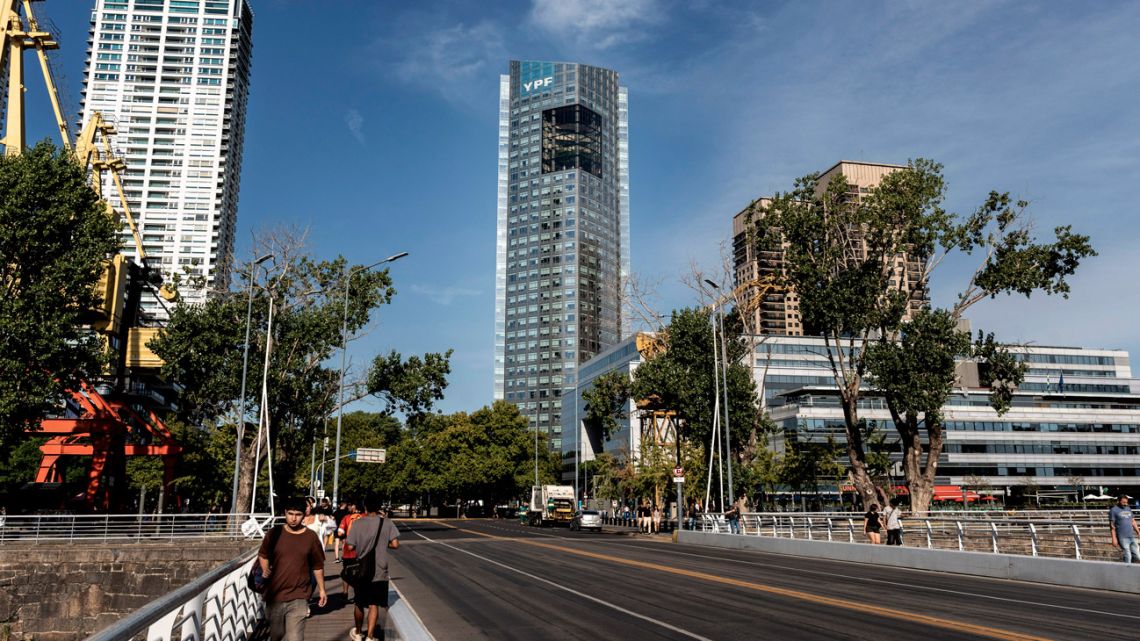
One week on from a crucial court ruling that removed a shroud of uncertainty hanging over the national flagship firm, state energy giant YPF’s shares are soaring.
In midweek trading, YPF shares jumped to their highest price in 15 years on Wall Street thanks to a combination of a positive court ruling, soaring global oil prices and improved prospects for Argentina’s energy sector.
The main driver is on the international front. The price of Brent crude has surged, almost touching US$100, amid geopolitical tensions in the Middle East – a product of US and Israeli strikes on Iran and Tehran’s response – and uncertainty over global demand.
Oil companies are the big winners and YPF is no exception – the firm’s ADRs on Wall Street have risen by more than four percent to exceed US$48 per share, a level not seen since March 2011.

This means the state-owned oil company has returned to levels seen prior to its controversial 2012 expropriation, marking a milestone in its stock market recovery after years of volatility.
Nationalisation case

Local factors have also played a major role in boosting the company’s shares. Markets have reacted positively to last week’s ruling by the United States Court of Appeals for the Second Circuit, which overturned a massive damages award linked to YPF’s 2012 nationalisation.
In a victory for President Javier Milei’s government, the court’s judges concluded that a lower court had wrongly ruled in favour of former shareholders, who claimed they were harmed by the nationalisation.
The suit had been backed by Britain-based Burford Capital, a company that provides financing for other firms' lawsuits. The parties still have a final avenue of appeal before the Supreme Court of the United States.

The legal process, which began in 2015, resulted in a first-instance ruling against Argentina in 2023. US District Judge Loretta Preska ordered the country to pay more than US$16 billion after finding that the nationalisation violated YPF’s bylaws requiring a tender offer to minority shareholders.
But last Friday, the New York-based appeals court ruled that Preska had misinterpreted Argentine law.
The ruling not only prevented Argentina from having to pay the initial judgement, but also confirmed the dismissal of claims against YPF itself, in line with the decision of the lower court.

President Javier Milei celebrated the decision on social media, writing: “We won in the YPF lawsuit... !!! The Court of Appeals has just completely overturned the ruling against Argentina: the best possible scenario.”
He then went on the attack, criticising Buenos Aires Province Governor Axel Kicillof – a former economy minister who oversaw the YPF nationalisation and a potential opposition presidential candidate in the future – for his handling of the case.
Background

Argentina expropriated 51 percent of YPF shares, which had been partially controlled by Spanish energy giant Repsol, in 2012.
Two years later, the Spanish oil company was awarded US$5 billion in damages but smaller shareholders like Petersen Energía Inversora and Eton Park Capital Management, which together controlled a 25.4 percent stake, got nothing and sued in 2015.
In 2015, the firms filed a lawsuit alleging that the country had not launched a public tender offer for shares to these two companies, which were YPF's second and third largest investors, as required under the company’s bylaws.

Argentina has long argued that having to pay the settlement – US$18 billion with interest, it says – would cause severe harm to the finances of the country. It said the settlement would have amounted to a large chunk of its foreign currency reserves.
YPF, an iconic national firm, was founded in the early 20th century as a state-owned entity. It was privatised in 1993 under then-president Carlos Menem and eventually came under the control of Repsol.
Then-president Cristina Fernández de Kirchner re-nationalised YPF in 2012, arguing that it did not produce enough oil and gas to satisfy national demand.

If the US$16.1 billion judgment had been upheld, much of the money would have gone to Burford Capital.
– TIMES/NA/AFP











Comments