

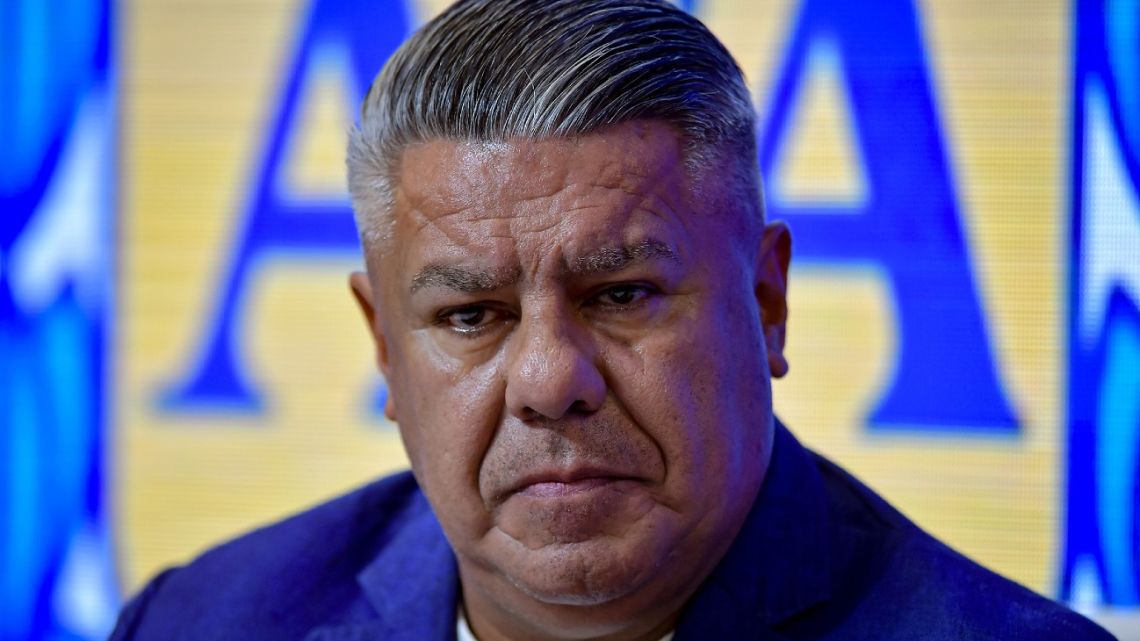
The Argentine Football Association (AFA) is headquartered at Viamonte Street in Buenos Aires City, but the true address of power is not on Google Maps – it is a network of relationships, contracts, silence and decisions which for years worked without too many questions being asked. Until now.
Argentine football, world champions on the pitch, is going through its most uncomfortable time off the turf: court investigations, business complaints, political accusations and an all-out war over the control of the business. At the centre of the stage there are two names: Claudio ‘Chiqui’ Tapia, president of AFA, and Pablo Toviggino, treasurer and a key political player of the system.
There is no single case. There are several overlapping stories, with different players and goals which at times coincide and at other times do not. Some have been brought to court. Others sit at political desks. Others are international contracts. They all speak the same language: power.
The most delicate case file was not born in a newsroom or a press conference. It was born in a controlling body and it reached economic criminal courts. The complaint investigates whether AFA withheld social security and tax contributions and did not pay them in a timely fashion, which in tax criminal law amounts to something called unlawful withholding. It is not your classic avoidance. It is worse: pocketing money which has already been deducted.

Both Tapia and Toviggino have been indicted in this case. An indictment is not tantamount to a sentence. It means the courts consider them formally a part of a criminal investigation. The case file is still at the preliminary stage. Balance sheets, bank transactions, cash flows and administrative liabilities are all being analysed.
Nobody has been prosecuted or sentenced. But the risk is there: if the crime is proved, penalties include fines, disqualifications and ultimately prison time. In terms of power, this case has an additional problem: it does not depend on political mood, but on papers, numbers and deadlines. Accounting has no opinion. It adds up.
In parallel, another investigation is making slower progress in silence: changes in the AFA leaders’ equity. The trigger was simple and typical: expensive assets which do not add up with their declared income. Houses, properties, corporate transactions. Nothing proved. Everything under analysis.
The courts are attempting to answer a basic question: can investigated assets be explained with known income? For that purpose, companies, middlemen, possible frontmen and fund transfers are all analysed. There are no decisive indictments for illegal enrichment or embezzlement. Nor has the investigation been closed. It is a case which makes no noise, but it is uncomfortable. Because once assets come into play, the story is no longer political, it is mathematical.
There is more to Argentine football than just passion. It is a multimillion-dollar industry. TV rights, sponsors, financial advances, loans, middlemen. In that world there are contracts which are under court review today. Courts are analysing whether some agreements were disadvantageous for AFA, whether they were inflated, helped divert funds or covered up irregular manoeuvres.
The cases include searches, documentation being seized and accounting experts’ reports. There has been no sentencing. Yet there is something more serious for a system which prides itself on being tidy: opacity. Once contracts cannot be explained, suspicions become self-explanatory.
For years, sponsors negotiated in silence. Until one of them decided to speak up. Socios.com, an international company linked with crypto business and sports marketing, broke the mould. It suspended payments. It reported breaches. It publicly accused AFA’s top brass. And it called for Tapia’s resignation.
It is not a criminal case in Argentina. It is a business and contractual conflict, with international derivations. Yet it has a huge symbolic value: for the first time, a global private player has called the governance of Argentine football into question. For AFA, it was a betrayal. For the system, an alarm. For politics, an opportunity.
When money and power move, politics always shows up. Legislators and leaders filed complaints to international sports bodies, questioning AFA leadership.
These are not criminal cases. They are ethical and institutional complaints. They talk of concentration of power, lack of control and conflicts of interest. The possible consequences are not prison time, but sports sanctions, suspensions or institutional isolation. For a football leader, that can be as serious as a court sentence.
History is not a one-way street. AFA is also filing its own complaints. Tapia and his top brass hold that there is a political attack to discipline football. They denounce intrusion by the State, selective use of controlling bodies and coordinated media pressure. AFA is defending the autonomy of sports associations, a historically powerful argument. It is also bringing court charges, rejecting indictments and providing documentation. From its outlook, there is no corruption: there is persecution.
There are open court cases, there are formal indictments, there are assets investigations and there are real business conflicts. There are no firm convictions, court interventions or final disqualifications. The match is still being played. But the wear and tear is already being felt.
The conflict is not just Tapia. Or Toviggino. It is a closed model of power, built for years without any strong external audits, no real opposition and with a system of rewards and punishments which fixed football from the top down. When that model is starting to crumble, case files emerge.
The question is not whether AFA will change presidents anymore. The question is more uncomfortable: can Argentine football continue to govern itself as if it were a black box in a country which no longer tolerates black boxes? The courts have not spoken yet. But the match has definitely already started.







Comments