

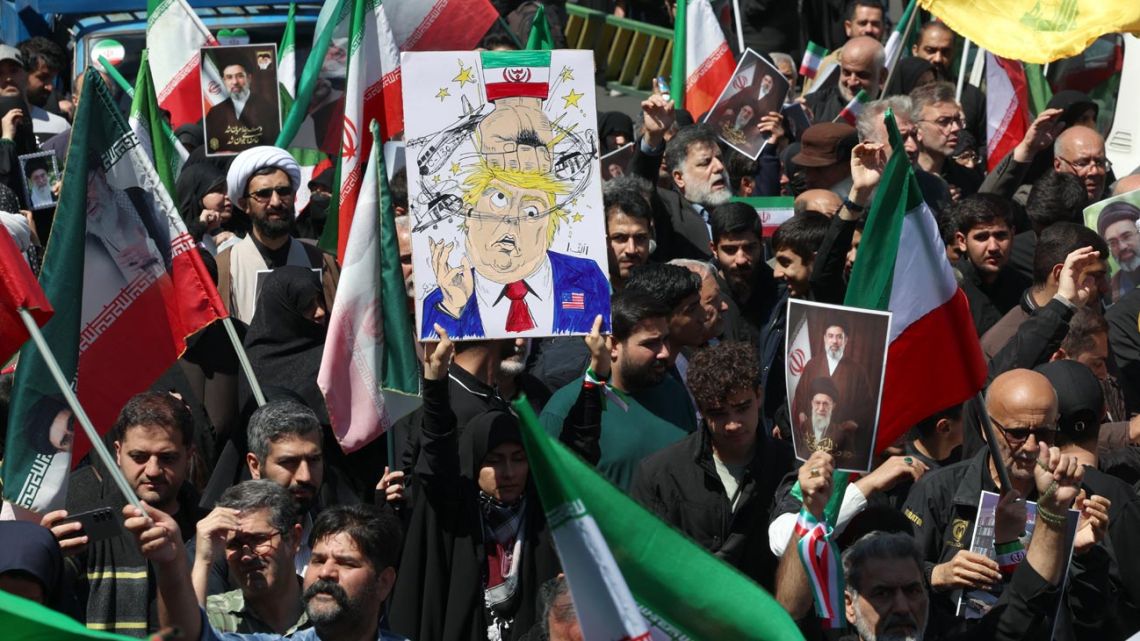
Israel is vowing to continue its campaign against Hezbollah, dismissing mounting international concern that its strikes on Lebanon threaten a fragile US-Iran truce that could lead to peace negotiations.
At least 203 people were killed and 1,000 wounded in airstrikes on Wednesday, the Lebanese Health Ministry said, while Hezbollah said it was engaged in close quarters combat against Israeli forces on the ground on Thursday in the south Lebanon town of Bint Jbeil.
Iran's parliamentary speaker Mohammad Bagher Ghalibaf warned Tehran sees Lebanon as an "inseparable part of the ceasefire" and President Masoud Pezeshkian said Israel's strikes rendered "meaningless" talks with US envoys planned for the end of the week in Pakistan.
US President Donald Trump claimed victory in the Middle East war after agreeing a two-week truce to allow talks between US and Iranian negotiators to end a conflict that has already killed thousands and plunged the global economy into turmoil – but both Israel and the US insist the fighting in Lebanon is not covered by the ceasefire.

"We are continuing to strike Hezbollah with force, precision, and determination," Israel's Prime Minister Benjamin Netanyahu said, in a social media post. "Our message is clear: anyone who acts against Israeli civilians, we will strike them. We will continue to hit Hezbollah wherever necessary."
Amid fears that the fragile truce could break down in the Gulf, there were international calls for the ceasefire to encompass Lebanon. France's foreign minister Jean-Noel Barrot condemned the strikes as "unacceptable," while his British counterpart Yvette Cooper called for the ceasefire to include Lebanon.
UN rights chief Volker Türk called the scale of killing in Lebanon "horrific," after strikes across the capital Beirut that came without warning triggered horror and panic.

Trump said late Wednesday that US forces deployed near Iran would remain stationed in the area until a "real agreement" is reached.
"All US Ships, Aircraft, and Military Personnel, with additional Ammunition, Weaponry, and anything else that is appropriate and necessary for the lethal prosecution and destruction of an already substantially degraded Enemy, will remain in place in, and around, Iran, until such time as the REAL AGREEMENT reached is fully complied with," Trump wrote on his Truth Social platform.
High-stakes

Separately, the head of Iran's nuclear energy agency, Mohammad Eslami, dismissed Washington's suggestions that the truce deal would halt Tehran's nuclear programme.
"The claims and demands of our enemies to restrict Iran's enrichment programme are merely wishes that will be buried," Eslami was quoted as saying by Iran's ISNA news agency.
The issue of uranium enrichment has been central to Western relations with Iran for more than two decades, with the US and its allies accusing Tehran of seeking atomic weapons, while Iran has always insisted its programme is for civilian purposes only.

Trump has insisted "there will be no enrichment of uranium" by Iran after the war. He argued before the conflict that Iran was rushing to build atomic weapons, an assertion not backed by the UN's nuclear watchdog.
The US-Israeli strikes on February 28 that began the latest conflict took place with Washington and Tehran engaged in negotiations that included Iran's nuclear programme.
During last June's 12-day war, Israel and the United States hit Iran's nuclear programme, claiming to have obliterated its ability to enrich uranium.

Nevertheless, the whereabouts of several hundred kilograms of highly enriched uranium remains unknown following the bombing.
It is thought to be buried under the rubble of a bombed location, with Trump suggesting in a social media post that Iran and the US could work together to "dig up and remove all of the deeply buried" nuclear material.
Strait of Hormuz
His remarks came with talks set to take place at the end of the week between Iran and the United States under Pakistani mediation.
A key point of contention remains the Strait of Hormuz, through which a fifth of the world's oil as well as vast quantities of natural gas and fertiliser pass in peacetime.
Iran announced alternative routes on Thursday for ships travelling through the strait, citing the risk of sea mines.
But it was unclear if Tehran was in practice allowing vessels to pass through the strait, following reports on Wednesday suggesting it was shut – something the White House called "completely unacceptable.”
Iran agreed to reopen the vital thoroughfare during the two-week truce, but said it would maintain "dominion" over it.
– TIMES/AFP









Comments