

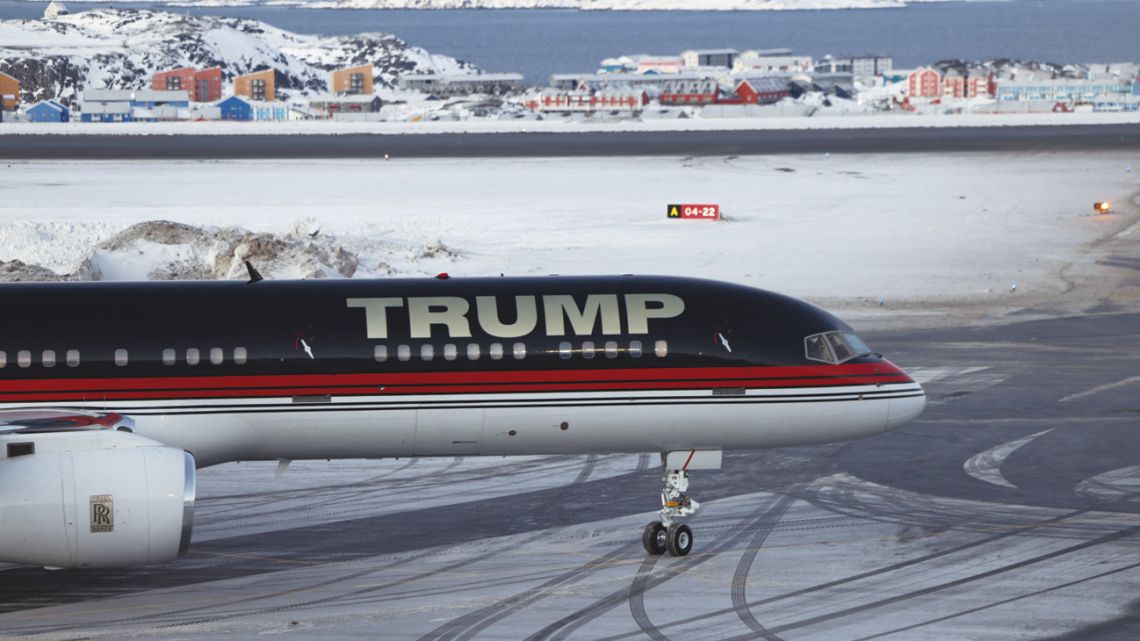
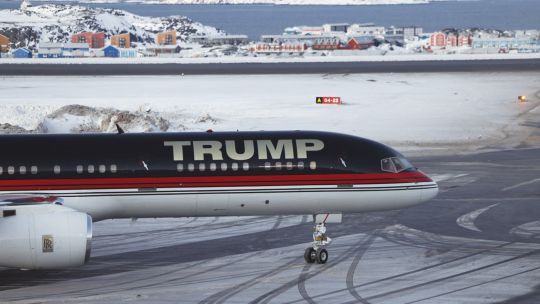
US President Donald Trump is considering making an offer to buy Greenland, the White House said Wednesday, despite the island's people and controlling power Denmark making clear the territory is not for sale.
Trump has repeatedly refused to rule out using force to seize the strategic Arctic island, prompting shock and anger from Denmark and other longstanding European allies of the United States.
After a request from Copenhagen to clear up misunderstandings, US Secretary of State Marco Rubio said he would soon hold discussions with Danish representatives. "I'll be meeting with them next week. We'll have those conversations with them then," Rubio told reporters.
White House Press Secretary Karoline Leavitt said that Trump and his national security team have "actively discussed" the option of buying Greenland. She reiterated that Trump believed it was in the US interest to acquire sparsely populated Greenland, whose size is around that of the largest US state, Alaska.

"He views it in the best interest of the United States to deter Russian and Chinese aggression in the Arctic region. And so that's why his team is currently talking about what a potential purchase would look like," Leavitt told reporters.
Neither Leavitt nor Rubio ruled out the use of force. But Leavitt said, "The president's first option, always, has been diplomacy."
House Speaker Mike Johnson, speaking as Rubio and Pentagon chief Pete Hegseth briefed lawmakers, also said that the administration was "looking at diplomatic channels" for a solution. "I don't think anybody's talking about using military force in Greenland," Johnson said.

Johnson, however, has acknowledged he had no prior notice when Trump on Saturday ordered a deadly attack on Venezuela, in which US forces removed the president, Nicolás Maduro.
The at least tactical success of the operation has appeared to embolden Trump, who has since mused publicly about US intervention in Greenland, Cuba, Iran, Mexico and Colombia.
'Stay focused on real threats'
Senator Thom Tillis, a Republican who is retiring, criticised Trump's threats in a joint statement with Democrat Jeanne Shaheen, the top Democrat on the Senate Foreign Relations Committee.
"When Denmark and Greenland make it clear that Greenland is not for sale, the United States must honour its treaty obligations and respect the sovereignty and territorial integrity of the Kingdom of Denmark," they said in a joint statement. "We must stay focused on the real threats before us and work with our allies, not against them, to advance our shared security."
Greenland's leaders have insisted that the island, a semi-autonomous territory under Denmark, is not for sale and that only its 57,000 people should decide its future.
Greenland's foreign minister, Vivian Motzfeldt, said the government would join the meeting with Rubio that she hoped would "lead to a normalisation of our relations" with the United States.
"Greenland needs the United States and the United States needs Greenland when it comes to security in the Arctic," she told Danish public broadcaster DR.
Denmark is a founding member of NATO and has been a steadfast US ally, including controversially sending troops to support the 2003 US invasion of Iraq.
Danish Prime Minister Mette Frederiksen has warned that an invasion of Greenland would end "everything" – NATO and the post-World War II security structure.
Trump, in sharp contrast to previous US presidents, has criticised NATO, seeing it not as an instrument of US power but as smaller countries freeloading off US military spending.
"We will always be there for NATO, even if they won't be there for us," Trump wrote Wednesday on his Truth Social platform.
Macron accuses US of 'breaking free from international rules'
French President Emmanuel Macron said Thursday that the United States was "breaking free from international rules" and "gradually turning away" from some of its allies.
Macron delivered his annual speech to French ambassadors at the Élysée Palace as European powers are scrambling to come up with a coordinated response to US assertive foreign policy in the Western hemisphere following Washington's capture of Venezuela's leader Nicoáas Maduro and Donald Trump's designs on Greenland.
"The United States is an established power, but one that is gradually turning away from some of its allies and breaking free from international rules that it was still promoting recently," Macron told ambassadors at the Élysée Palace.
"Multilateral institutions are functioning less and less effectively," Macron added. "We are living in a world of great powers with a real temptation to divide up the world."
Macron spoke after US special forces snatched Maduro and his wife from Venezuela on Saturday in a lightning raid and whisked them to New York, sparking condemnation the United States was undermining international law.
In the wake of his military intervention in Venezuela, President Trump set off alarm bells in Europe by repeating his insistence that he wants to take control of Greenland.
Trump has repeatedly refused to rule out using force to seize the strategic Arctic island, prompting shock and anger from controlling power Denmark and other longstanding European allies. Copenhagen has warned that any attack would spell the end of the NATO alliance.
The French leader said "global governance" was key in a time when "every day people wonder whether Greenland is going to be invaded" as well as whether "Canada will face the threat of becoming the 51st state."
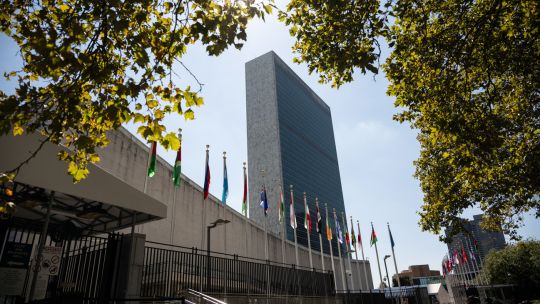
He said it was the right moment to "reinvest fully in the United Nations, as we note its largest shareholder no longer believes in it."
The White House on Wednesday flagged the US exit from 66 global organisations and treaties – roughly half affiliated with the United Nations – it identified as "contrary to the interests of the United States."
– TIMES/AFP









Comments