

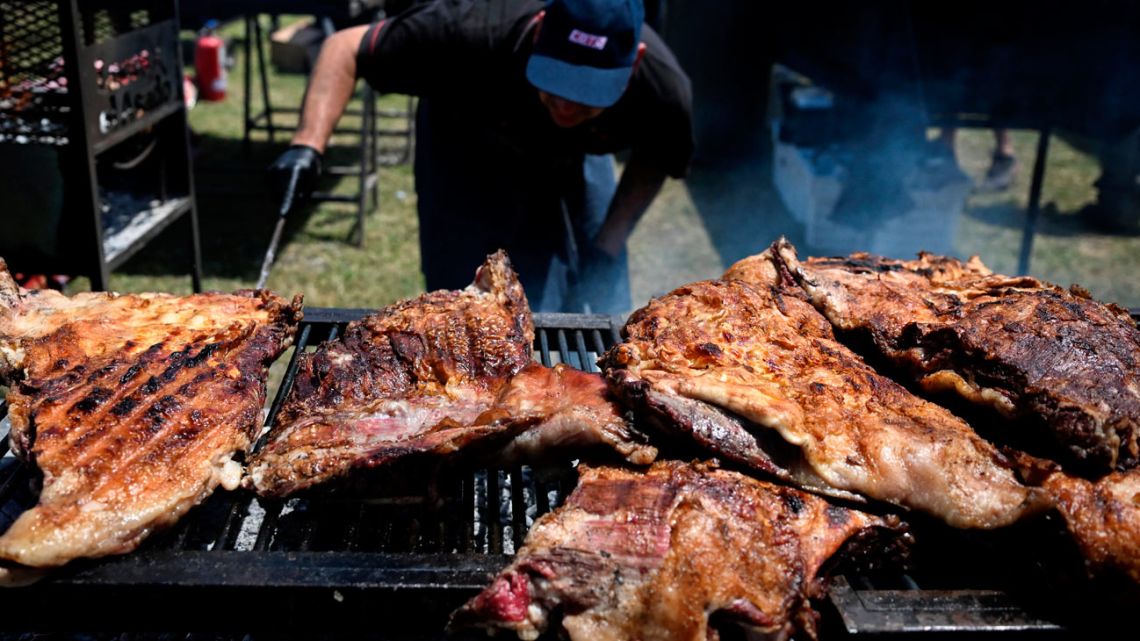
Argentines are world champions, alongside neighbouring Uruguay, when it comes to meat consumption, yet they have never eaten so little of it. The nation’s relationship with beef is changing: it is losing its central place on the dining-room table with producers increasingly looking towards export markets.
Grilled meat is Argentina’s greatest culinary tradition, but the country is undergoing a tectonic cultural shift as tastes become more globalised, prices increasingly favour chicken and pork and concern grows about the environment and health.
In 2024, beef consumption in Argentina fell to a historic low of 47kg per person, level with Uruguay.
This year, there has been a slight rebound, to 50kg per person, partly linked to easing inflation, but the overall trend is downward: in the late 1950s, each Argentine consumed almost 100kg a year, falling to around 75kg per person by 1995, according to the Instituto de Promoción de la Carne Vacuna en Argentina (Institute for the Promotion of Argentine Beef, IPCVA). By way of comparison, consumption in Mexico stood at 16kg in 2024.

“We eat it two or three times a week at least. … Not every day like before,” says 39-year-old Alejandro Pérez amid the smoke and aromas of an open-air barbecue festival in San Isidro, Buenos Aires Province.
At the ‘Locos por el Asado’ event, which recently brought together thousands to a racecourse to enjoy barbeque, Graciela Ramos recalled the tradition of meat cooked over embers, at “those long tables, with lots of family” gathered around.
But over the years she has had to adapt her diet. “For pleasure and because meat, obviously, in large quantities at my age doesn’t suit me,” said the 73-year-old.
Cattle, cattle everywhere
The bond with meat goes way back. Historian Felipe Pigna, author of Carne, una pasión argentina (“Meat: an Argentine Passion”), explained that at the beginning of the 19th century meat consumption reached 170 kg per person per year.
“All social classes consumed meat … at lunchtime, in the evening. It was plentiful, very cheap and became part of the daily diet of rich and poor alike,” he said. “It was only with immigration that a habit developed of adding vegetables, mash and other accompaniments.”
Cattle, which arrived in the 16th century with the Spanish conquest, were everywhere. By the end of the 19th century there were 20 million head of cattle in the country for fewer than two million inhabitants, Pigna notes. In earlier times, animals were slaughtered mainly for their hides.
The advent of salting, and later refrigeration, at the end of the 19th century transformed the destiny of Argentine beef, turning it into a global “brand,” thanks to grazing options on the vast pampas, the introduction of British breeds such as Angus and Hereford and supplies to fighting nations during the two world wars.
Meat “is central, it is part of our history, of our culture; it is in tango, in folk music, it is a constitutive element of what it means to be Argentine,” says Pigna.
But is that still the case? In 2020, a survey by the Unión Vegana Argentina (“Argentine Vegan Union,” UVA) identified 12 percent of the population as vegetarian or vegan.
Twenty-five years ago, “coming across another vegetarian was an event,” said UVA President Manuel Alfredo Martí. Now, “everyone has a vegan or a vegetarian in the family.”
Today, vegan products can be found in supermarkets, vegetarian restaurants are opening in affluent neighbourhoods and university courses specialising in vegetarian nutrition are emerging.
Pigna also points to the economic factor behind the drop in consumption: “In the whole of Argentina’s history, meat has never been so expensive.”
Asian demand
The meat industry is taking note of the changes, but is not worried: the Argentine market remains its stronghold.
According to the Argentina’s Agriculture, Livestock & Fisheries Secretariat, Argentina produced 3.1 million tonnes of meat in 2024, of which it exports almost a third.
International demand is rising, led by Asia and particularly China, which alone buys 70 percent of Argentina’s exported beef, said IPCVA president George Breitschmitt.
“In Asia we’re talking about consumption of three to five kilos per person per year,” says Breitschmitt. “There is a lot of room to grow in the global market.”
After all, “Argentina still carries the label of having the best beef in the world, but we must not rest on our laurels because competitors are improving,” he concluded.
related news


by Philippe Bernes-Lasserre, AFP










Comments