

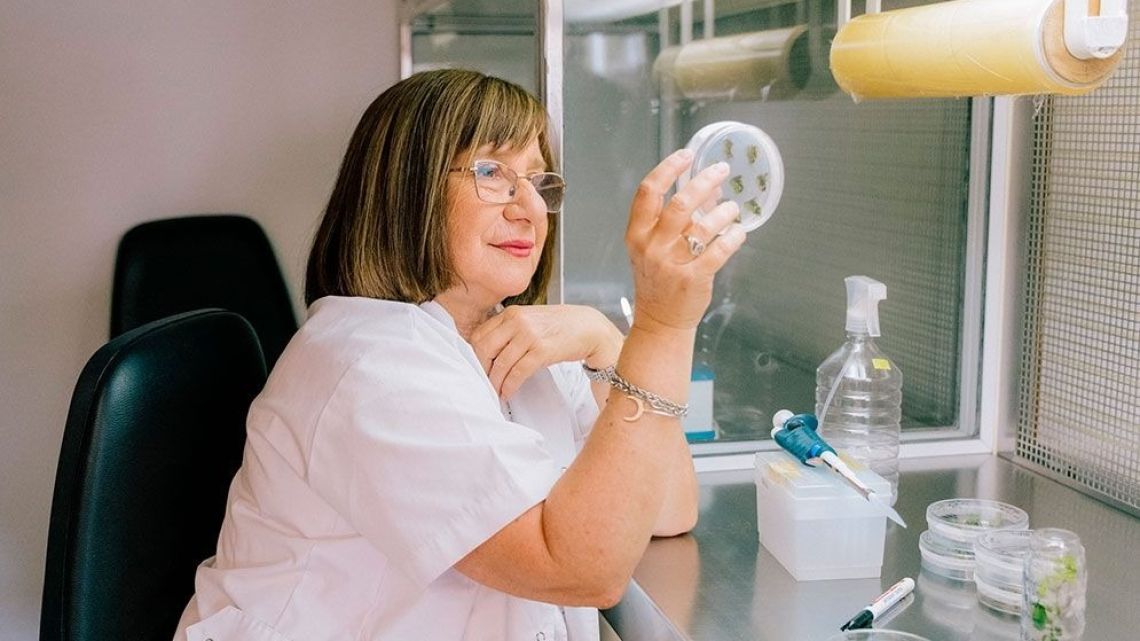
Dr Raquel Chan has a CV that could be summed up in a single sentence: she discovered how to prevent plants from “giving up” and help them “endure” climatic adversity. The researcher, a senior member of the CONICET scientific research institute and professor at the Universidad Nacional de Litoral, where she is the director of the Agrobiotechnology Institute, has just been awarded the one of the 2026 L'Oréal–UNESCO For Women in Science International Awards.
The prize is considered one of the most prestigious scientific awards for women. Dr Chan received it representing the Latin American and Caribbean region.
The announcement marks a milestone: it is the first time in the award’s 28 editions that agricultural biotechnology as a research topic has reached the podium. Chan will travel to UNESCO headquarters in Paris in June to receive the distinction, which includes a prize of 100,000 euros.
In conversation with Perfil, the scientist behind this biotechnological achievement – who has spent four decades working on the topic – said that “the science underpinning this research is sound, safe and profitable, although testing it and obtaining the corresponding patents was an extremely complex process.”

She also recalled that “at CONICET we worked together with the [agricultural] company Bioceres and had to overcome countless obstacles, mainly due to a lack of resources.”
Dr Chan’s scientific work addresses a key question, one that appears simple but in reality, it took decades to uncover the answer: what biological mechanism allows a plant to survive when water is scarce or temperatures become hostile?
Her laboratory identified key genes and proteins involved in this response. They then went a step further by applying this knowledge to the improvement of wheat, maize, rice and soybean varieties with greater drought resistance. In a global context of accelerating climate change and growing pressure on food production, this contribution carries major significance.

“Together with my team, we identified very specific genes that give certain plants the ability to be more resilient under adverse conditions,” Dr Chan explained. “We then applied this knowledge to protect more vulnerable crops. In particular, these genes help them cope with water shortages, flooding, cold, waterlogging, high temperatures and other environmental stress factors,” said the expert, who has previously received other awards.
The team subsequently managed to incorporate these protective genes into the genomes of crops that did not possess them, ultimately making them more resistant. “These improved plants are capable of producing more biomass and more seeds, using less water, reducing their carbon footprint and delivering higher yields. Ultimately, my dream is that no child should go without a plate of food,” she said.
All of this while reaffirming that the new variants developed in the laboratory are entirely safe for both human health and the environment when planted, processed and consumed.

The international jury that selected Chan — which is made up of scientists from all five continents — evaluated 504 nominations from around the world, 84 of which came from Latin America and the Caribbean. The final selection was narrowed down to five laureates, one from each global region. This year, the prize focused on life and environmental sciences.
With this recognition, Argentina consolidates its remarkable position of regional leadership: it is the Latin American country that has the highest number of female scientists honoured by L’Oréal-UNESCO, with a total of 12 throughout the prize’s history — nine in the Laureate category and three as Rising Talents. The list began in 2003 with Mariana Weissman and includes names such as Belén Elgoyhen, Andrea Gamarnik, Karen Hallberg and Alicia Dickenstein, among others.
The last recipient before Dr Chan was María Teresa Dova, who was honoured in 2025 for her work in high-energy physics.

These figures have context. According to UNESCO data, only 31.7 percent of the world’s researchers are currently female. Since 1901, fewer than four of Nobel Prizes in science have been awarded to women. A
Argentina, in this landscape, is not merely a modest exception. It is a remarkable success: 53.6% percent of its active researchers are women, placing the country 12th among the 20 nations with the highest proportion of women in science worldwide. Even so, barriers remain. An Ipsos survey for the L’Oréal Foundation revealed that 86 percent of female researchers in Argentina and globally have faced sexism during their careers, 49 percent have experienced sexual harassment and only 12 percent of senior leadership positions in STEM are held by women.
One of the points Chan frequently raises in her talks is that “countries must invest in science in order to develop properly and generate wellbeing for their citizens.” For example, in 2023 Argentina invested around 0.3 percent of GDP in science and technology. Currently, that investment has fallen to an annual 0.15 percent of GDP. In other words, we are going backwards.
related news
Researchers collect rodents near Ushuaia for hantavirus tests
Milei’s La Libertad Avanza party sizes up provincial agreements for 2027 election

Luis Caputo predicts ‘Milei will win 2027 election by landslide in first round’











Comments