


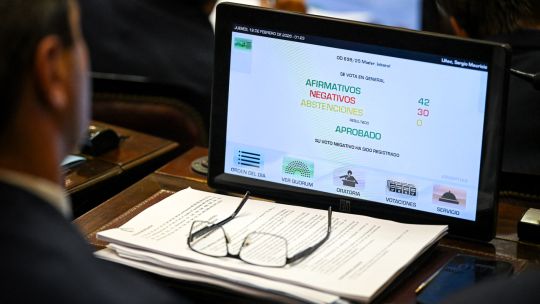
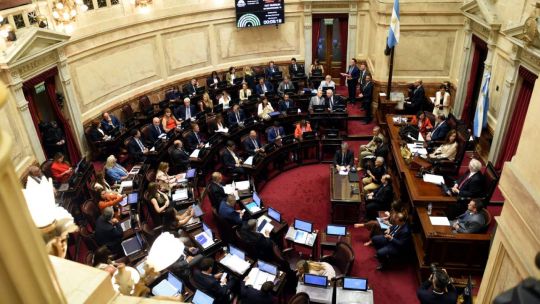
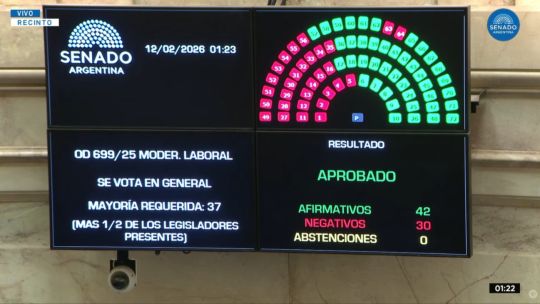
President Javier Milei’s Labour Modernisation Bill was approved by the Senate on Wednesday night with the support of La Libertad Avanza and the moderate opposition.
The package of reforms alters the severance and overtime regimes, permits wage bargaining at company level and lowers employer contributions to encourage the hiring of labour.
The central points of the initiative passed by the Senate are:
Wage bargaining
Wage bargaining at company level is permitted by establishing that a collective agreement on a wider scale may not modify the content of one on a lesser scale.
Once a collective agreement expires, its clauses may be negotiated over the period of no more than a year during which the expired agreement remains in place. The parties must also be called to the negotiating table within one year of promulgation of the labour reform law.
Assemblies may be held with the authorisation of the employer.
Dismissals
Severance will be capped with the average wage under the collective agreement per year, excluding bonuses and any other special items which are not monthly.
A FAL (Fondo de Asistencia Laboral) fund is created to finance dismissals for those firms which cannot afford them. It will be financed with one percent of employer contributions to ANSES social security administration in the case of major companies and 2.5 percent from other firms.
Labour courts may not increase labour credits with interest rates superior to inflation plus an annual three percent.
PyMES (small and medium-sized firms) may pay off severance in 18 instalments while major companies may do it in 12.
Trade unions
Voluntary and compulsory union dues of workers are maintained but with a ceiling of two percent.
Union-run obras sociales healthcare schemes are to be maintained with an employer contribution of six percent from the companies instead of the five percent proposed by the government.
Banks
Banks will be the only institutions authorised to pay wages, with digital e-wallet and fintech options ruled out.
Justice
The national labour courts will be transferred to Buenos Aires City
Overtime
An “hour bank” is to be created to compensate overtime with extra days off or some other system, always permitting the legally stipulated minimum rest periods.
Holidays
Holidays may be taken between October 1 and April 30 and may be broken up, but into periods of no less than seven days.
Medical certificates
A series of requisites is established for the validity of medical certificates justifying absence from work due to illness or accident for which the employee is not to blame.
Should the medical certificates of the company and worker clash, a medical board may be requested.
New jobs
Incentives for companies hiring new staff in the form of lower employer contributions.
RIMI
The RIGI incentive scheme for major investments will be extended to small- and medium-sized companies embarking on new ventures (under a scheme called RIMI) with benefits in the form of income and IVA value-added tax write-offs.
Platforms
Those delivering or other work for digital platforms will be denominated “independent service providers” although their companies will have to contract accident insurance and train those workers.
Taxation
Excise on boats, aircraft, automobiles, mobile telephones and health products is repealed while establishing a company obligation to provide accident insurance, training in road safety and communication transparency.
A regime of private services is established for the mobility of persons and/or delivery via technological platforms in which the rights and obligations of the independent service providers is established, as well as the obligations of the companies owning the platforms.
– TIMES/NA
related news

Argentina's lower house backs bill to lower age of criminal responsibility

Clashes between police and protesters mar labour reform protest

Former Menem minister Manzano backs purchase of Ecuador’s leading newspaper












Comments