

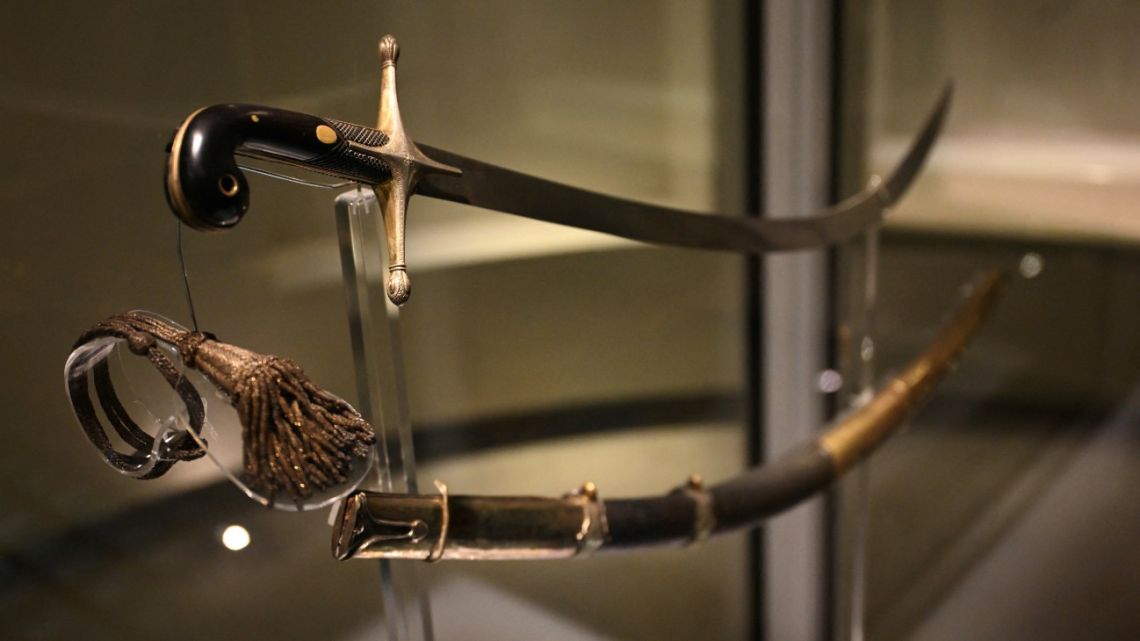
A decision by President Javier Milei’s government to transfer the sabre of Argentine liberator General José de San Martín to a military regiment in Santa Fe Province has sparked debate and a legal push over its custody.
Heirs of the artefact have asked the courts to ensure the weapon remains at the Museo Histórico Nacional, to which it was donated in 1897.
The curved sabre, one of the most valuable pieces in Argentina’s national historical collection, is set to be handed over to the Regiment of Mounted Grenadiers, which was founded by San Martín, according to a presidential decree published on Tuesday.
The decision prompted the resignation of María Inés Rodríguez Aguilar, the director of the Museo Histórico Nacional, and a request for an injunction filed with the courts by the sabre’s heirs.

Milei’s government is planning a handover ceremony this Saturday in the city of San Lorenzo in Santa Fe Province, where San Martin won a decisive battle for independence from the Spanish crown in 1813.
The reaction threatens to overshadow the event, which includes transporting the sabre by helicopter from the museum in Buenos Aires to San Lorenzo and then back again, before reaching its final destination at the regiment’s headquarters in the Palermo neighbourhood of the capital.
The English-made curved sabre belonged to San Martín throughout the liberation campaigns he led in Argentina, Chile and Peru. It was later donated by his heirs to the state so that it could be displayed at the national museum.

“Any change to the destination of the curved sabre would violate the terms assigned as a condition of the donation,” the heirs argued in their court filing.
They claimed that the transfer would cause irreparable harm by altering its public exhibition and breaching the conditions of the donation.
With an ebony hilt, stretching 95 centimetres in length and devoid of ornamentation, the sabre was acquired by San Martín during a trip to Great Britain.

San Martín, who died in exile in France in 1850, bequeathed it in his will to another independence leader, Juan Manuel de Rosas, who in turn left it to his son-in-law, Juan Nepomuceno Terrero.
The heirs later donated it to the state on the condition that it be deposited at the Museo Histórico Nacional, though its history has since been chequered.
It was stolen twice in the 1960s before being transferred in 1967 to the Regiment of Mounted Grenadiers by a then-military government. In 2015, it was returned to the museum by presidential decree.

Milei's move drew instant criticism. Argentina Humana, a social platform, accused the head of state of "stealing San Martín's sabre" and described the decision as "a whim of Milei's.”
"Milei wants to steal a symbol of our continent's sovereignty to take a photo and put on a show,” said the opposition-linked group.
Córdoba national deputy Natalia de la Sota has presented a bill to Congress that would order San Martín's curved sabre to remain at the museum and repeal the decree ordering its move.

The Argentine Association of Historical Researchers (ASAiH) also expressed its "rejection" of the decision.
"The provision contravenes the presidential decree of 1897, which accepts the donation of the relic to the Argentine Nation by its last owners and establishes as its destination the National Historical Museum, a public, civil institution open to the public," said the group in a statement.
The debate over the fate of national heroes’ relics is nothing new in Latin America. In Venezuela, the late president Hugo Chávez ordered the exhumation of Simón Bolívar’s remains in 2010 to investigate the causes of his death, a move that also generated controversy.
– TIMES/AFP/NA











Comments