

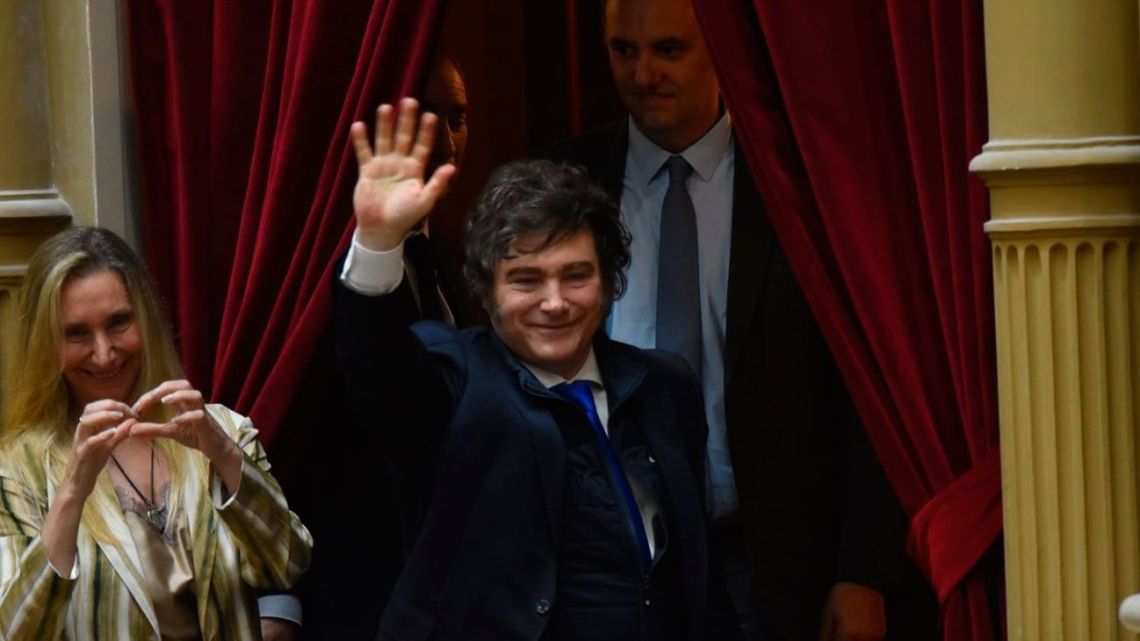
Argentina’s Congress has opened debate on several key bills put forth by President Javier Milei’s government as lawmakers gear up for a busy summer of special sessions.
Lawmakers began debating Milei’s 2026 Budget bill, a labour reform package and controversial changes to the National Glaciers Law on Wednesday.
The proposals are would deepen fiscal austerity, loosening labour market regulations to ease hiring and firing and pave the way for provincial governments to approve mining projects in protected areas.
A Senate committee led by Milei’s ruling party opened discussions on the labour reform, which is opposed by the opposition and trade union confederations.

Unions demonstrated on the streets of Buenos Aires on Thursday against the changes, which they say would worsen working conditions.
Among other measures, the reform would allow the working day to be extended to 12 hours in some cases and annual vacations allowances to be split up. It would also reduce redundancy payments and create a dismissal fund which, according to the opposition, draws on social security resources.
The government says the steps would improve conditions for businesses and encourage firms to bring workers employed off-the-books into the formal system.

The reform would help revive the labour market, officials argue, and contribute to formalising the nearly 40 percent of the workforce that are in the informal economy.
“This allows us to move forward with labour modernisation. We are not going after anyone’s rights,” Milei said in a recent television interview, in which he described the current contractual system as “anachronistic” and flawed.
Addressing a congressional committee this week, Labour Secretary Julio Cordero said the current law “brings hiring to a standstill” because firms are fearful of “entering a world that is conflict-ridden.”

“Labour regulations create jobs because they create an environment of legal certainty,” he said on the first day of debates.
Milei’s government is hoping for a fast-track process in order to secure preliminary approval before the close of the first round of special congressional sessions on December 30.
Peronist Senator Mariano Recalde, a labour lawyer, criticised the measure, saying it “settles every dispute in favour of the employer – there is no balance.”
The law “degrades the human condition and the dignity of workers,” he argued.

“This so-called government of freedom wants to bring back slavery, servitude, workers without rights,” said Recalde during debate.
The lower house also began debating the 2026 Budget bill. Milei has to date extended the 2023 budget each year, despite the outsized impact of inflation in recent years (211 percent in 2023, 118 percent in 2024 and nearly 30 percent so far in 2025).
The draft Budget bill projects inflation of 10.1 percent and five percent GDP growth ext year.

It also removes an obligation to allocate six percent of GDP to education and cuts funding for disability programmes, one of the areas hardest hit by Milei’s fiscal adjustment. By contrast, funding for the national literacy plan would rise 39 percent.
The Senate has also opened debate on controversial amendments to an environmental law that restricts extractive activities in glacier areas.
– TIMES/AFP












Comments