

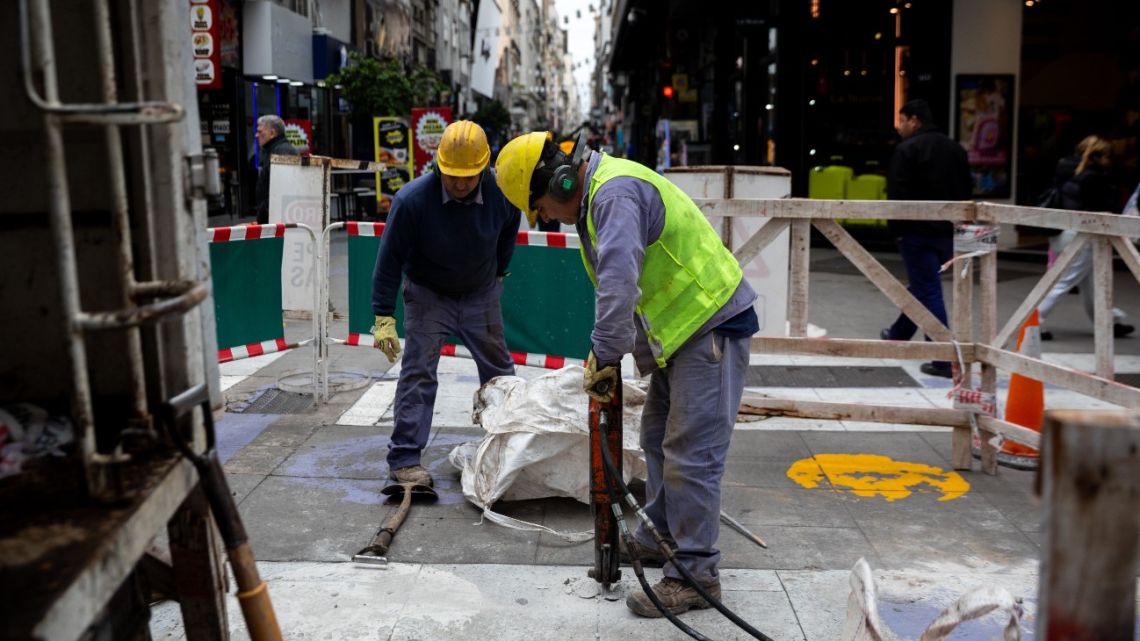
President Javier Milei lowered inflation and poverty in Argentina, while eliminating its budget deficit. But the nation’s labour market is still mired in the crisis he was elected to confront.
For a second straight year, the South American economy is growing yet employment is falling in the formal sector, where workers have a salary, benefits and healthcare.
Those job losses represent arguably the top threat to Milei’s re-election bid next year, with investors hoping Argentina’s political pendulum doesn’t swing away from his pro-market approach.
“What appears to be increasingly important is job creation, as surveys show this is becoming a key driver of consumer confidence,” said Pablo Goldberg, an emerging markets portfolio manager at BlackRock Inc. “Given this correlates with votes, the market will likely pay attention to this indicator.”

Argentina has lost 241,000 private-sector payroll jobs since Milei took office – or four percent of the total – while his administration has cut 73,000 state employees, official figures show. The number of private-sector employers has fallen to 482,000 companies, the lowest level since 2007, according to think tank Fundar.
Only one province – Neuquén, home to the nation’s energy boom – has added businesses during Milei’s tenure, indicating workers aren’t transitioning from struggling to thriving industries, consulting firm Equilibra found.
“We’re living through a process that we can characterize as growth without quality job creation – jobless growth,” said Matías Maito, a labour economist at the University of San Andres, referring to payroll employment. “The only thing that’s grown in the past two years is informal employment.”

Labour Secretary Julio Cordero didn’t respond to an interview request.
Unemployment has ranked above inflation as the top economic concern among voters for a year, while Milei’s 37 percent approval rating is near the lowest level of his Presidency, according to LatAm Pulse, a public opinion survey conducted by AtlasIntel for Bloomberg News.
Part of the shift in concerns is a result of Milei’s success in bringing down inflation from triple-digit territory, and higher unemployment isn’t always a dealbreaker for voters. President Carlos Menem won re-election in 1995 with double-digit joblessness after defeating hyperinflation. But Menem had annual inflation below two percent at the time; economists project inflation next year will be around 20 percent.

As Milei’s policies curb price gains, they’re also driving at least some of the job losses. His spending cuts, albeit necessary, have translated into fewer public works and higher utility bills, resulting in less construction jobs, disposable income and consumer spending.
With some currency controls still in place, a stronger exchange rate has also made Argentine services, from technology to tourism, more expensive. Milei’s measures to open up the economy to more foreign competition have cooled prices, but hit aging industries hard too.
Even hiring in Argentina’s competitive sectors, from oil to mining to technology, is either down in the Milei era or flatlining, government figures and industry reports show.

Headcount at Patricio Pagani’s cloud services firm The Black Puma roughly doubled to about 40 employees from the Covid-19 pandemic to Milei’s Presidency. But salaries in the private sector have doubled in dollar terms since the libertarian took office, shrinking Pagani’s margins. Now he’s looking to hire more in Brazil and open a shop in Colombia, where labour costs are lower.
So many experienced tech veterans are looking for work in Buenos Aires that Pagani, 48, isn’t even hiring for entry-level jobs anymore. “I see the high-skilled unemployment rate much higher than it was five years ago,” he said. “At this point, Argentina stopped being cost effective.”
Unemployment in the formal economy is up to 7.8 percent but the damage is camouflaged by a booming informal labour market, which now accounts for 44 percent of the nation’s workforce. A study from Argentina’s UCA Catholic University showed workers across education and income levels are increasingly toiling off the books, but economists see it as a last resort rather than a preference.

“Informality continues to be a second best to a salaried formal job,” though better than unemployment, said Roxana Maurizio, a researcher at the IIEP policy institute at UBA, the University of Buenos Aires. “At least in the big picture, it isn’t a desirable destination.”
Sergio Moreno received over 3,500 applications for 700 spots this year at Fundación Oficios, the job-training programme he leads outside Buenos Aires, featuring carpenters, electricians and other trades. That’s up 40 percent from a year ago, and Moreno has never received so many applications.
He’s building new classrooms as demand surges from working-class Argentines looking to get a job as many can’t find work or enough of it to make ends meet.

“In moments of crisis, at least in Argentina, there’s a trend to go into informality because it’s cheaper, you don’t pay taxes,” Moreno said. “A lot of businesses have closed, and I’m not talking against or in favour of the government, it’s just a fact.”
Rubén Barboza, 56, has been unemployed since last November when a furniture builder that had hired him closed due to plunging sales. The former factory worker is on his second job-training course after he says he applied for 30 jobs without an offer. He’s living off his wife’s income for now.
“Working people I know, yes, inflation matters to them, but it matters less than having a job, making ends meet and putting food on the table,” said Barboza, who doesn’t support Milei. “It’s not just me. A lot of people aren’t making it to the end of the month.”
related news


by Patrick Gillespie, Bloomberg











Comments