

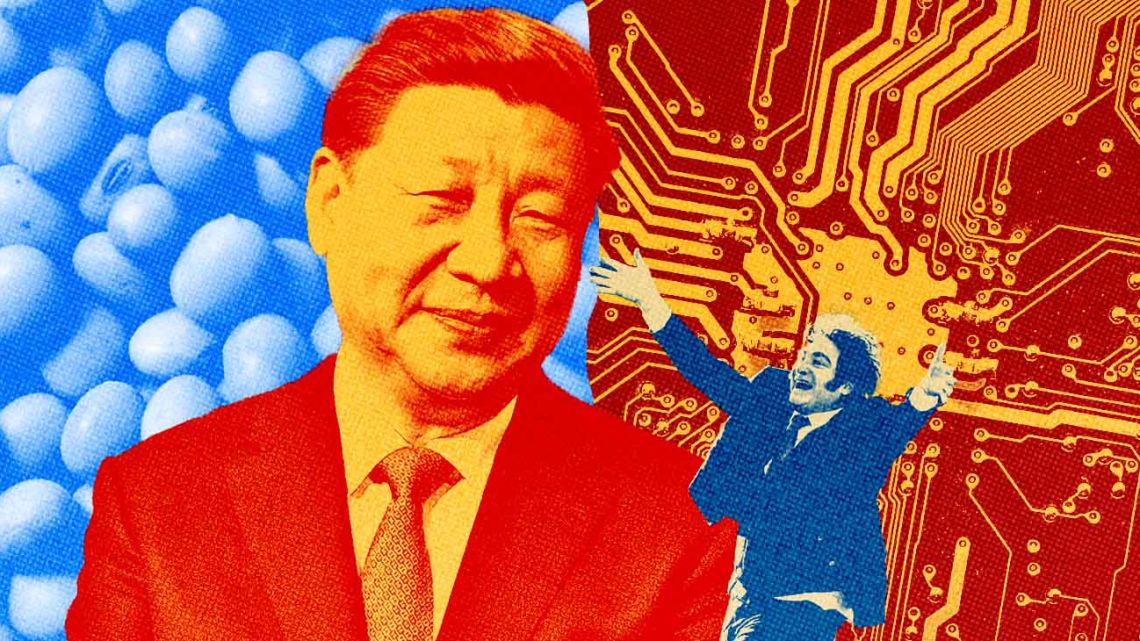
Today is the 115th anniversary of the Wuchang Uprising, the start of the 1911 revolution ending four millennia of Chinese imperial dynasties four months later, so perhaps as good a time as any to talk about China – rarely at the top of the news here but always lurking somewhere.
While the first day of this month is celebrated in mainland China as the anniversary of the 1949 proclamation of the People’s Republic, “Double Ten,” as today is called in Taiwan, remains the national day across the straits on that island – Beijing’s Malvinas, something also making that part of the world topical today, given the centrality of that issue here in the past couple of months. With almost five percent of the mainland’s economic output produced on 0.4 percent of its area by 1.6 percent of the population (closer to being among the world’s top 20 economies than G20 member Argentina) and still recognised as China’s legitimate government by a dozen countries around the world (including our neighbour Paraguay), Taiwan deserves respect but today’s column will focus on the superpower.
So how did China evolve from the ramshackle empire starting to collapse 115 years ago today into sporadically being Argentina’s top trading partner. plus having our long-haired president by the short hairs via a currency swap on a par with Donald Trump’s midterm lifeline last year to beef up the always precarious Central Bank reserves? As it happens, Sino-Argentine links slightly predate Wuchang – in 1909, the dying Manchu empire started to grope towards establishing formal relations with an almost centennial Argentina but ran out of time. A long vacuum follows – the Middle Kingdom is introspective at the best of times and the next three decades were the worst under the thumb of the treaty ports and warlords (until 1928) with Communist subversion as from 1927 and escalating Japanese encroachments as from the invasion of Manchuria in 1931. In those years Argentina might just as well have been Timbuktu.
At the end of May, 1945, with the war in Europe already over, a hitherto Axis-leaning Argentina completed its switch to the winning side by formally recognising Kuomintang China, although the first embassy was in western Chungking (today Chongqing) with Japanese troops still occupying much of the country. This move was quickly wrongfooted by the Communist triumph in 1949. Nevertheless, Taiwan continued to run the Chinese Embassy here for over two decades, enjoying some enthusiastic support from anti-Communist military dictators (especially General Juan Carlos Onganía) but viewed as increasingly irrelevant by almost everybody else.

The world changed with United States President Richard Nixon’s historic visit to Beijing in 1971 as part of Henry Kissinger’s strategy of driving a wedge into the Sino-Soviet bloc, while the United Nations recognised the People’s Republic as the sole Chinese UN representative in the same year. Latin American governments, even the military dictatorships, had no choice but to follow suit and on February 19, 1972, diplomatic relations between Argentina and the People’s Republic were formally established in Romania with Nicolae Ceaușescu as middleman – Argentina has consistently maintained a “One China” policy ever since.
Although then Vice-President Isabel Perón visited China the following year, there was no immediate empathy between the new interlocutors – in the early years Chairman Mao’s biggest fans were not to be found in any Argentine government but in the Ejército Revolucionario del Pueblo (ERP) guerrillas (who never reached the intensity of Peru’s Sendero Luminoso, however). Nevertheless, junta President Jorge Videla, whose anti-Communist principles led him to delete thousands of fellow-Argentines, had no compunction about making an official visit to Beijing in 1980 at the same time he was defying Jimmy Carter’s grain embargo against the Soviet invaders of Afghanistan (although joining the boycott of the Moscow Olympics).
After the return of democracy here in 1983, Raúl Alfonsín was the first president to follow what might be considered a normal relationship with the People’s Republic, neither hot or cold, visiting Beijing in 1985 and 1988. Ditto for Carlos Menem with visits in 1990 and 1995. China played no part in Menem’s privatisations since privatizing to a state-run economy would be a contradiction in terms.

In this century Sino-Argentine ties have moved into a completely new dimension, especially during the four Kirchnerite presidencies. Néstor Kirchner (2003-2007) was only too happy to boast twin fiscal and trade surpluses thanks largely to the commodity price boom from massive Chinese demand for soybeans and other farm produce. In 2004, Kirchner signed a memorandum of understanding with visiting Chinese President Hu Jintao recognizing China as a market economy in return for a then unreal US$20 billion of investments which never transpired. His widow, Cristina Fernández de Kirchner, elevated the alignment to a comprehensive strategic partnership in 2014, translating into such Patagonian ventures as the Santa Cruz hydro-electric dams and the Neuquén satellite station.
The centre-right Mauricio Macri Presidency (2015-2019) made no move to interrupt these commercial ties, making an official visit to China together with Japan in 2017, although steering clear of the Belt and Road Initiative launched by Xi Jinping in 2013. But the Winter Olympics in early 2022 found then-President Alberto Fernández in Beijing signing a memorandum of understanding to officially join that Silk Road revival with Argentina’s top trading partner at that time. Late in his Presidency, Fernández even moved to join BRICS but his far-right successor Javier Milei backed out while maintaining an active interest in merchandise trade and Chinese investment in the mining and lithium sectors (not to mention the currency swap).
Space is lacking for a detailed breakdown of a bilateral trade volume topping US$27 billion last year or an investment portfolio of some US$23 billion. Whether China will continue gaining on the United States, eventually overtaking, or whether such bottlenecks as a rapidly aging population, real estate crisis and slower growth will interrupt this longstanding trend, who will win the artificial intelligence race are all questions for the future – this column has limited itself to trying to look behind the Great Wall of China to see how we arrived where we are today, over a century after the Wuchang Uprising.



Comments