

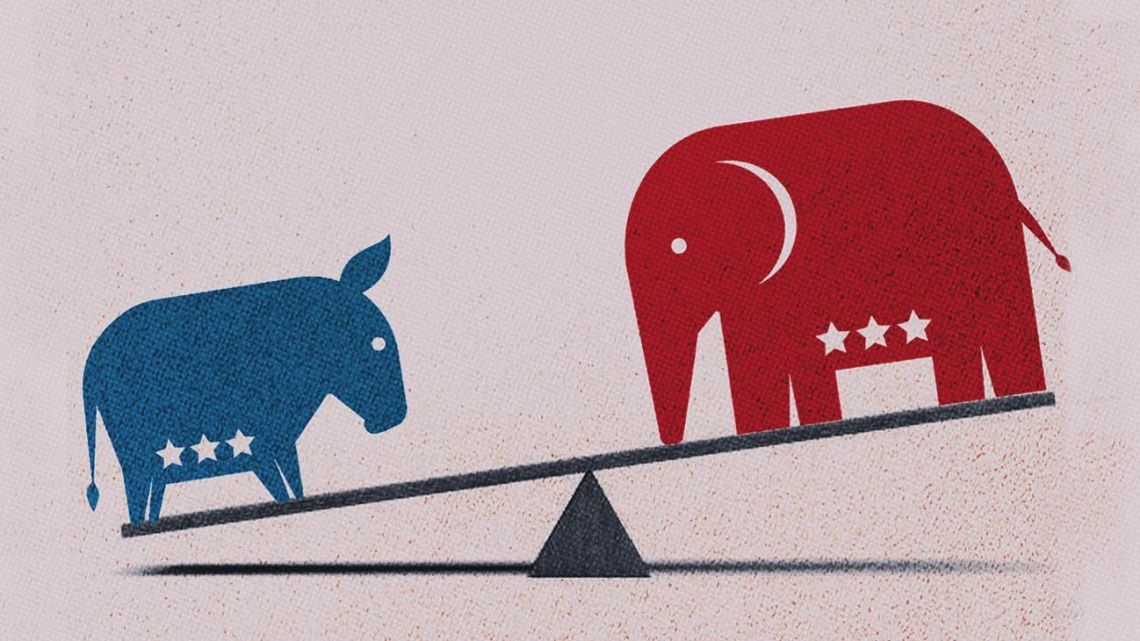
Quite apart from totally contradicting this column’s ‘Beyond the headlines’ slug, last Tuesday’s midterms in the United States were a nightmare for pundits as well as for Republicans for at least two reasons – the dimensions of the “bluenami” landslide turn any account of the verdict into a statement of the obvious making sophisticated analysis redundant while results remaining incomplete for the next week and perhaps month make it harder to look at the nuts and bolts with several missing. Not to mention the forecasts being totally confounded although a President with 38 percent approval ratings within a two-party system might well have made these results the chronicle of a death foretold.
There were over 27,000 electoral contests at federal, state and local level last Tuesday but virtually all the media attention fell on just over 500 – all 435 seats in the House of Representatives, 35 senatorial battles and 36 gubernatorial elections (with the latter generally given short shrift by the major networks). There was voting at more than one level in 45 of the 50 states with only five (Indiana, Missouri, North Dakota, Utah and Washington) limited to renewing their representatives.
At the time this column was written – and probably for a while to come given the lag with postal and absentee ballots, affidavits, etc. even if spared the “hanging chads” of the 2000 election – the overall results were as follows. For the Senate the Democrats bagged 20 of the 35 seats at stake with fragile leads in both the undecided (Alaska and Washington), defending the 13 already held and gaining seven from the Republicans who held onto the other 13. Elsewhere in Congress the Democrats have won 251 of the 435 lower house seats and are running ahead in at least half of the 32 undecided while the Republicans have only clinched 155. The two major parties entered these elections with 18 governors each in the disputed states but the Democrats snatched five (Georgia, Iowa, Nevada, Ohio and Texas) with the Republicans also losing Nebraska to an independent, leaving them controlling just 19 of the 50 states with Alaska and Kansas still up in the air with tiny Democratic leads.
Such are the raw data. Difficult to add to the copious analysis of the reasons behind the 62 percent disapproval of Donald Trump – the Iran war, fuel prices, MAGA (Make America Greedy Again) policies inflating the cost of living, ferocious immigration policies alienating Latinos, etc. – nor to the depth of Democratic penetration into Republican strongholds. Whether the South (Texas for the first time in three decades despite Elon Musk pumping almost quarter a billion dollars into the Republican campaign and both Carolinas) or a reconquered Rust Belt (with the Democrats sweeping both the senatorial and gubernatorial races in the Midwest states of Iowa, Michigan, Minnesota and Ohio as workers fail to see Trump’s protective tariffs reindustrialising anywhere), no region could find dams against the blue wave. Kansas elected its first Democratic senator since the days of FDR in 1932.

Yet that latter triumph (the conservative Methodist pastor Reverend Adam Hamilton) shows that swinging the nation to the left also entailed certain moves to the right from the Democratic Party along with a lot of help from Trump. Alarmist noises came from MAGA Republicans about five candidates standing for Democratic Socialists for America (DSA) entering Congress but they will only be about two percent of the caucus, a fraction of the strength long shown by the Bernie Sanders wing of the party – and also a fraction of the moderate Adam Hamilton prototypes often needed for those dozens of inroads into Republican bastions in the senatorial, gubernatorial and Congress races. The DSA’s Abdul El-Sayed did hold his Democratic seat in Michigan to become the first Muslim US senator but with a couple percent less votes than the Democratic gubernatorial candidate Jocelyn Benson.
Another MAGA excuse for defeat was the country’s changing demography for which they blamed immigration. White males are still a slight majority among the 89 new kids on the block elected last Tuesday but almost half of the 36 gubernatorial elections produced female governors (17) – Georgia, Minnesota, Ohio and Tennessee for the first time (and the first black in the former) while Gina Hinojosa ousting three-term Texas Governor Greg Abbott is the first with origins from the other side of the Río Grande. The 19 male governors elected included four blacks in Florida, Maryland, Nevada and Wisconsin alongside California’s first Latino Governor Xavier Becerra – plenty of diversity beyond El-Sayed.
Turning the number-crunching to the 435-seat House of Representatives entails a multiple field which is also incomplete with 32 vacancies still pending (one of them the 27th District of Florida where President Javier Milei has publicly endorsed the incumbent Republican, María Elvira Salazar – his only direct campaign intervention). Space lacking for further detail but scanning the list shows the Republicans electing a majority of the representatives in only 16 of the 50 states (a number which could rise slightly once all seats have been defined) while the Democrats had a clean sweep in no less than eight states (a number which could also climb).

Plenty of names down to here but one matters more than any other – Donald Trump. Almost a century after the creation of Donald Duck, is The Donald now a lame duck? The wheels were coming off in too many states on Tuesday for him to cry fraud – instead he blamed the candidates whom he had often chosen over less extreme alternatives, insisting that if his name had been on the ballot, “we would have won IN A LANDSLIDE!” It now remains to be seen how he co-exists with this hostile Congress as from January 3 – and how President Milei deals with the fallout for next year’s voting here. Trump might well now choose as his swan song T-Bone Walker’s ‘I got the blues again.’







Comments