

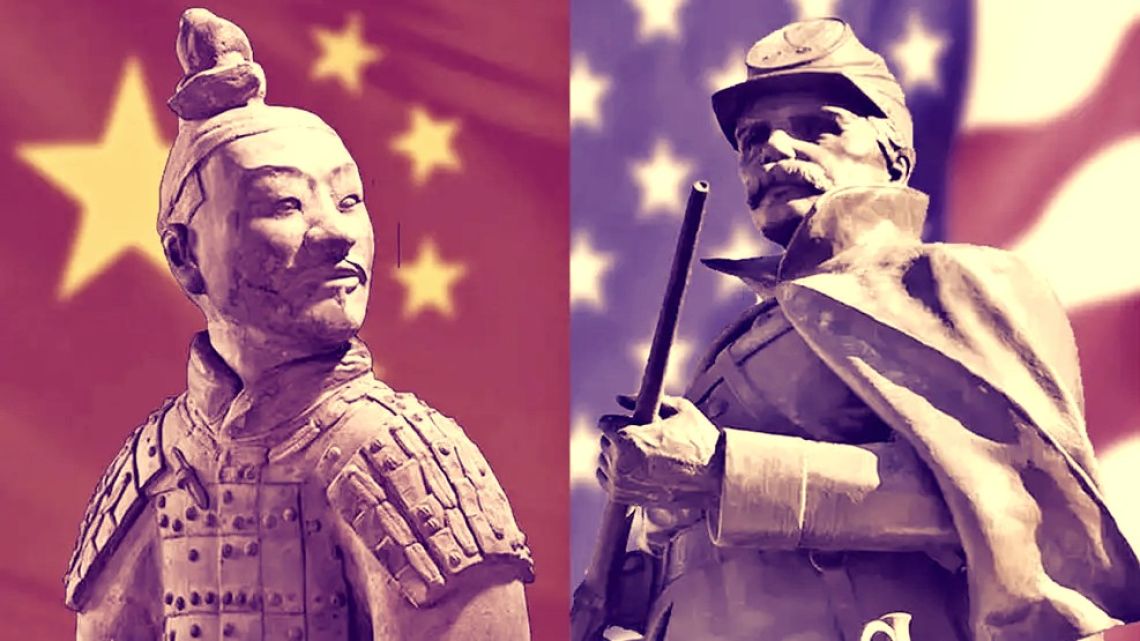
The conflict is global and overt. Nevertheless, Argentina is skating the surface, sailing in subterranean waters. Suddenly, like a geyser out of control, it has emerged in the always fertile field of national controversy.
The United States and China have brought their battle for global technological influence to Argentina in three crucial terrains for its economy: Vaca Muerta, the Hidrovía waterway and Patagonia. Three productive centres churning out hard currency, where the United States is determined to be this country’s major partner and where China has a transitory extension sustained by its digital infrastructure connecting organisations, businesses and users.
Those handling the connections, the digital contacts and their data will also manage an important part of the power. China is present in those data in Vaca Muerta, the Hidrovía and Patagonian centres like Bariloche where Artificial Intelligence projects of US provenance would have to contract Chinese suppliers. For US interests, something unacceptable.
It all blew up when it became known that Huawei would be the supplier of the CALF (Cooperativa de Agua, Luz y Fuerza) electricity supplier, Patagonia’s biggest. The cooperative has for years maintained an alliance with the Chinese company, using their technology in Calfibra, its connectivity unit. Now it is advancing towards Vaca Muerta with a network of fibre optics which it has begun to deploy in Neuquén.

CALF is analysing the incorporation of Huawei technology for a Data Center in the Neuquén Technological Park, modernising its networks via Smart Grid systems. They have also evaluated solutions of video-vigilance, artificial intelligence and remote monitoring, projecting a provincial network of 6,600 kilometres of fibre optics and 3,300 kilometres of ducts.
That leap towards an infrastructure capable of storing, processing and transporting information has set US alarm bells ringing. For Washington, it is not the same as selling telephones or routers to participate in the digital architecture of a region concentrating one of the biggest reserves of unconventional fossil fuels in the world.
The pressure became public when CALF directors received messages from an official of the US Embassy, who posed possible restrictions or visa revocations for anybody moving forward with Huawei. The co-operative denounced the episode to Argentina’s Foreign Ministry.

The conflict gained maximum visibility with US Ambassador Peter Lamelas. At the Energy Forum 2026, organised by AmCham, he affirmed that “the energy security of the data is the national security of both countries” and that investors need guarantees that the information will be protected and circulate via “networks of confidence.”
Lamelas aimed his fire at Beijing: “China requires its companies to give the state all data passing through its technology and artificial intelligence networks, all controlled by the Chinese Communist Party,” while warning: “That’s not on and nor will it help to bring foreign investors to Vaca Muerta.”
Washington maintains that Huawei spies for the Chinese Communist Party without any specific public evidence of espionage in the CALF project. Beijing responded by accusing Washington of “deliberately reviving the theory of the Chinese menace,” while describing its pressures as “grave disrespect towards [Argentine] sovereignty.” Huawei affirmed that it is a private company, present in Argentina since 2001 and operating in accordance with the laws of the countries where they work.

The Hidrovía Paraná-Paraguay waterway is another chapter of the same dispute – the exit point for around 80 percent of Argentina’s exports. Jan De Nul and DEME, both Belgian with the latter associated with US companies, competed in this year’s tender. The Javier Milei government adjudicated the concession for 25 years to Jan De Nul and the Argentine company Servimagnus.
The controversy emerged from denunciations by sectors linked to DEME of the supposed links of Jan De Nul with Chinese capital or suppliers, including Huawei. The issue reached the US Congress – Brian Mast (Republican-Florida) chairing the House Committee on Foreign Affairs alerted Secretary of State Marco Rubio about presumed links between Jan De Nul and Chinese state entities.
Before being adjudicated, Jan De Nul assured that there would be no participation by Chinese companies nor foreign state interference and that it would use the technology of Western suppliers, giving priority to US companies. Huawei remains on stand-by for now.

The same pattern appears in Bariloche, where one or two of the Artificial Intelligence mega-projects which the United States is promising to install in the country could be located. There the CEB (Cooperativa de Electricidad Bariloche), whose top directors travelled last March to Chinese cities in the framework of a Smart Cities programme, operates.
Soon afterwards, the CEB organised an Expo Smart City with 14 Chinese companies, including Huawei, to exhibit solutions of smart lighting, electric networks, sanitation and urban monitoring.
The other alternative for these AI projects is Neuquén with CALF. The dispute exceeds the choice of a technological supplier. The United States promises investments but places conditions: one of them, increasingly visible, is not to depend on China to handle the data of its companies and other strategic projects arriving in Argentina.










Comments