

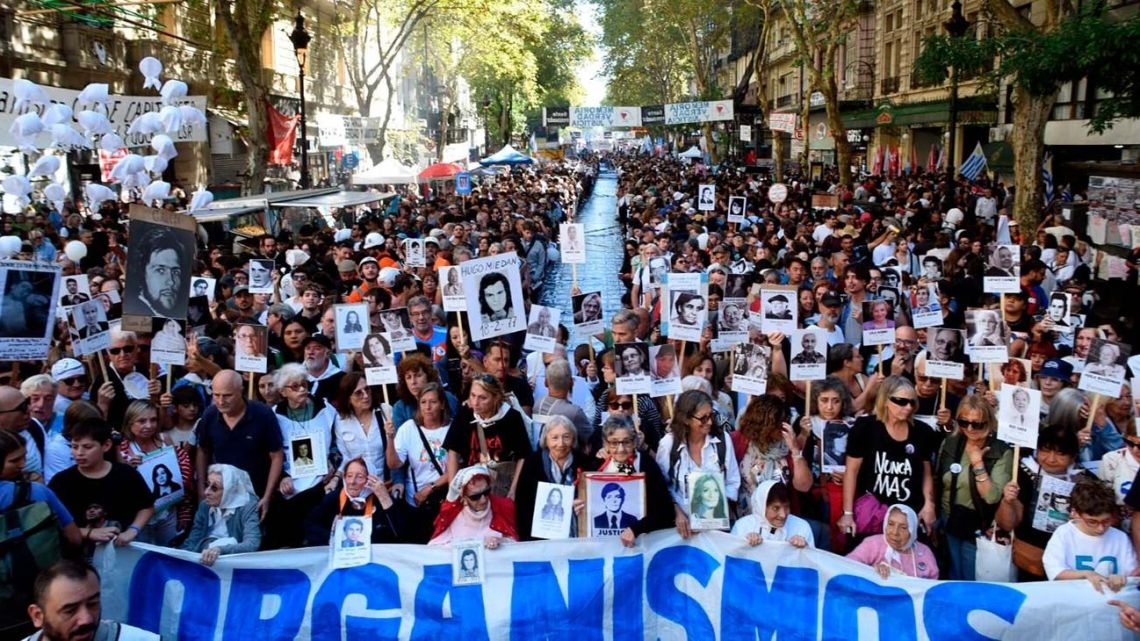
Human rights organisations marked the 50th anniversary of Argentina’s last military coup on Tuesday at the mass rally at Plaza de Mayo, renewing demands for answers over the fate of the disappeared and victims and sharply criticising President Javier Milei’s administration.
“The number is 30,000, tell us where they are,” organisers declared in a central document read before tens of thousands gathered in the historic square, the epicentre of decades-long protests demanding justice for victims of the 1976-1983 dictatorship.
The statement – drafted by Abuelas de Plaza de Mayo and Madres de Plaza de Mayo – reiterated longstanding claims that 30,000 people were forcibly disappeared during the military regime, rejecting efforts to question that figure.
“They were 30,000 and it was a genocide,” the document read, in a direct rebuttal to sectors of the current government that have cast doubt on the death toll.

Argentina’s dictatorship ran a system of state terrorism involving an estimated 800 clandestine detention centres, systematic torture, killings and the appropriation of babies born in captivity – crimes later prosecuted as crimes against humanity, which carry no statute of limitations.
“Forced disappearance is not a thing of the past, but of the present,” said the event organisers.
Rights groups have for decades demanded the full opening and declassification of military and intelligence archives to determine the fate of the disappeared, many of whom remain unaccounted for.

“We do not forget, we do not forgive, and we do not reconcile,” organisers said, linking past repression to present political disputes and warning against what they described as attempts to relativise state terror.
The rally included fierce criticism of Milei and Vice-President Victoria Villarruel, whose discourse on the dictatorship has emphasised violence by guerrilla groups in the 1970s and called for “complete memory” of the conflict, a stance rejected by human rights organisations as equating state terror with insurgent actions.
Demonstrators responded with chants against the government, while the organisers’ text argued that the coup imposed an economic model marked by deindustrialisation and trade liberalisation, alongside repression aimed at dismantling political and labour organisation.
“State terrorism attempted to break up the high level of organisation and social conscience achieved by wide sectors of the people,” the statement said.
The document’s reading was attended by Abuelas President Estela Barnes de Carlotto; the leader of Mothers’ ‘Founding Line’ group Taty Almeida and Peace Nobel Prize winner Adolfo Pérez Esquivel, among others.
“We’re together once again at this historic square and at every main square in the country, deeply convinced that memory is defended by fighting,” the organisers’ document read.
“We do not forget, we do not forget and we do not reconcile. They combatted those who wanted, as today, to turn Argentina into a US colony,” they exclaimed.
There were also references to the disappeared detainees’ activism. “They fought for a society without oppression or exploitation. We come from those traditions, and we recreate the people’s fight against the government of Milei and Villarruel,” it said.
Speaking earlier in the day during a television interview, Carlotto described March 24 as “the reminder of something which must not happen again.”
She warned against any trivialisation of the military junta's crimes. “A dictatorship means violence and an embarrassment for the country,” she said, reaffirming the group’s commitment to democratic institutions restored in 1983.
Carlotto noted that the organisation continues its search for some 300 children stolen during the dictatorship from their mothers in detention centres – many of whom are now adults unaware of their identity. She lamented reduced state support for their work.
“There are only two original grandmothers left, the vice-president [of the organisation] and myself,” she pointed out, in reference to Buscarita Navarro de Roa.
She said that the remaining members of the organisation today “are all grandchildren who were found and [their] siblings,” because “Grandmothers will always continue to find those we’ve been looking for so long ago.”
“You all have to help us… grandchildren may be living in some far-away country because they don’t know who they really are,” she said.
Argentina has been internationally recognised for its human rights trials since the mid-2000s, but tensions over memory policies have resurfaced under Milei’s administration, which has cut funding to memory institutions and questioned aspects of the historical consensus built since the return of democracy.
Carlotto expressed concern over poverty-stricken Argentines who are missing “things such as jobs and a daily meal.” How can there “be hunger in a country where a seed falls on the ground and a plant grows?” she asked.
“All us Argentines can live well in this country, there can’t be children not eating,” she said, appealing for the government to provide extra help for those less fortunate.
– TIMES/NA/PERFIL








Comments