

On a recent Sunday morning, Ecuadorians awoke to find that the front pages of two widely circulated newspapers were blank.
The empty pages of Expreso and Extra were the publisher’s way of drawing attention to the government’s alleged effort to take it over. “Civil liberties in Ecuador are under systematic attack,” media company Gráficos Nacionales SA, or Granasa, warned the next day after several board members were hit with criminal charges amid a government-led dispute over 40 percent of its shares.
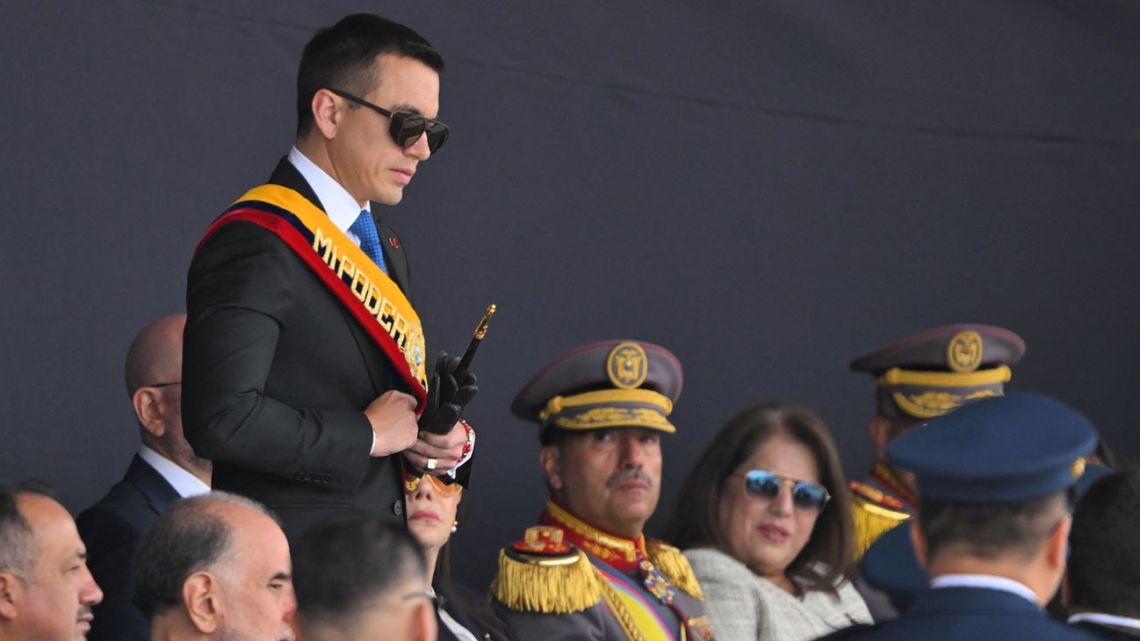
The protest shed light on how the South American country’s US-aligned president, Daniel Noboa, appears to be consolidating power in ways that are causing growing unease in civil society. One week it’s political parties, the next it’s the courts. Now it’s the media.
Government officials “are using institutions like the Internal Revenue Service, the prosecutor’s office, the corporate regulator and the anti-laundering unit to pursue critical voices so that nobody can put the real problems of the country under a magnifying glass,” said Gabriela Panchana, a board member of non-governmental organisation Rumbo Plural, or "Plural Way," which advocates for open democratic debate.

“We could wake up like another Nicaragua,” Panchana said.
In the case of Granasa, the corporate regulator accuses the publisher’s board of governance violations in the transfer of the 40-percent stake. The president’s office referred a request for comment on Granasa to the regulator.
Noboa, the Harvard-educated son of a banana tycoon, said in a recent interview he is deploying “an iron fist with a heart” to combat drug-related crime while introducing economic reforms to boost growth and employment.

As part of his crime-fighting efforts, Noboa is imposing a two-week nighttime curfew covering a wide swathe of the country including Quito, the capital, for two weeks in May, the second such action since March. The curfews are part of a wider crackdown on organised crime that has turned Ecuador into one of the world’s most violent countries.
Bond spreads collapse

Judging by the bond market, foreign investors remain upbeat on Ecuador under Noboa, who was sworn in for a full four-year term in May 2025 after serving out the remainder of his predecessor’s term starting in late 2023. Since then, sovereign bond spreads to comparable US Treasuries have collapsed fivefold to only around 400 basis points, according to a JPMorgan index. Noboa is pledging to hit 350-300 basis points this year and bring them down further in 2027.
“Even if there is some backlash at home, it doesn’t seem to be at least so far spreading to the investment community,” said Eurasia Latin America Director Risa Grais-Targow. She points out that Noboa is delivering on an International Monetary Fund programme and is seeking to open up key sectors for investment.
Still, some local business leaders have said they’re worried about an erosion of rule of law, exemplified by the Granasa case.

“What’s happened to Granasa is another chapter of Ecuadorian democratic weakness,” including attacks on both entrepreneurial freedom and on freedom of expression, threatening the rule of law and private property, said María Paz Jervis, president of the Pichincha Chamber of Industry. “Without democracy, there’s no economic development, no growth.”
Rodrigo Gómez de la Torre, president of the Chamber of Agriculture of north-central Ecuador, echoed the concerns. Freedom of expression and media is non-negotiable and “no government may silence voices, all the more if they’re critical,” he said.
‘Partly free’
In the view of Plural Way, rival populist political organisations, led by the current president on one side and left-wing former president Rafael Correa on the other, are undermining Ecuador’s democracy.
Recent actions against judges and the media are reminiscent of Correa’s decade in office, when he seized control of the courts and sued newspaper El Universo for libel. The newspaper, bought by an Argentine-based consortium in February, has since lost top columnists and its veteran political cartoonist amid censorship allegations.
“There has been democratic backsliding for a while now, and Noboa and his allies may be taking things even a step further than Correa,” said John Polga-Hecimovich, professor of political science at the US Naval Academy.
Since Noboa took office late 2023, Ecuador slipped from “free” back to “partly free” in annual rankings by US democracy advocacy organisation Freedom House, behind Argentina, Bolivia, Brazil and Colombia, though still above El Salvador and Mexico. The group published its 2026 ranking last month.
Ecuador’s decline in the democracy ranking is manifested in other ways. Among vulnerable groups, the Noboa government has been mobilising the state to freeze the bank accounts of dozens of environmental and indigenous rights defenders, including prominent ecologist Belén Páez. Her Pachamama Foundation, which opposes oil drilling in the Amazon rainforest, was persecuted under Correa and is now fending off state pressure under Noboa.
The president’s office didn’t reply to requests for comment on the allegations of democratic backsliding.
‘New Ecuador’
Noboa says he’s battling crime and ushering in a “New Ecuador” that’s boosting private-sector investment, public infrastructure and housing, achievements that he says critics refuse to acknowledge. “There’s no political crisis,” he said in an April 12 local radio interview.
The latest controversy over the court came after a March 27 decision by the National Electoral Council, or CNE, to hold local elections in November – three months early – citing a 62-percent risk of a severe El Niño climate phenomenon, which typically causes heavy flooding, later in the year.
Correa’s left-wing Citizen Revolution, or RC, was previously suspended from participating because of allegations of illegal campaign financing.
“A de-facto ban of the main opposition party is pretty concerning,” said Polga-Hecimovich.
Critics allege that advancing the elections is illegal, adding that the move could make it easier for Noboa’s National Democratic Action party, or ADN, to win control of big cities, including Quito and Guayaquil, that are currently run by RC-allied mayors. Aquiles Alvarez, Guayaquil’s mayor, has been jailed at a new maximum security prison ahead of trial for alleged fuel smuggling. He denies wrongdoing.
Noboa has said his party won’t benefit from the earlier election date, and the head of the electoral board says all parties face the same organisational challenges.
A decision over the legality of the early vote is now in the hands of Ecuador’s Constitutional Court, which refused last year to allow the government to suspend some basic rights via legislation. In recent days the court has urged citizens to remain “vigilant” toward alleged threats to the constitutional order after two of its nine judges came under investigation for holding potential illicit assets.
UN Special Rapporteur on the independence of judges and lawyers, Margaret Satterthwaite, has repeatedly raised red flags over risks to Ecuador’s judicial system.
In its 2026 World Report issued in February, Human Rights Watch said the Noboa administration “has advanced laws and measures that endanger rights, undermine the independence and security of Constitutional Court justices, and threaten constitutional safeguards.” At the same time, structural problems including access to health care and employment “remain largely unaddressed.”
related news
by Stephan Kueffner, Bloomberg








Comments