


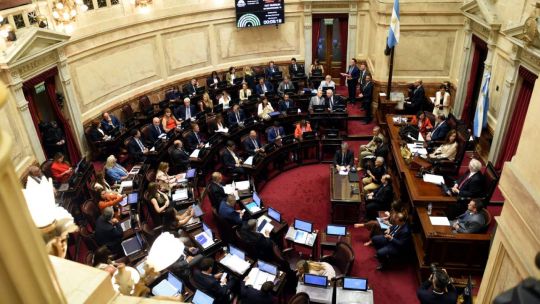
The Javier Milei’s government’s labour reform bill could not have moved through the Senate much faster with its accent perhaps more on speed of passage than depth of content and yet it falls behind the pace of this 21st century – a trait it shares with the week’s other main news item, the year’s first monthly inflation figure based on an antiquated 2004 methodology stubbornly preserved at the expense of sacrificing the INDEC national statistics bureau chief Marco Lavagna resigning at the start of this month. Over and above the methodological debate, the government’s economic team needs to ask how much of the linear relationship between money supply and inflation survives in the modern world of cryptocurrencies since Milton Friedman pioneered monetarism over six decades ago.
Just as French premier Georges Clemenceau famously said that war is too important to be left to the generals, so labour legislation requires a rather broader complement to labour lawyers than politicians (which also raises the question of how far any reforms will go with the current crop of labour judges). What does this bill have to say about the post-pandemic phenomenon of “home office” beyond a passing mention? How does it face the explosively disruptive acceleration of Artificial Intelligence and robots with their challenge to a broad spectrum of jobs and the need for retraining? And should AI not prove to be a neutron bomb, where will the skilled workforce of the future come from with a plunging birth rate and deficient education?
Furthermore, what does it have to say to those who deliver for Rappi or Pedidos Ya, drive for Cabify or Uber and all the informally employed who operate according to the instructions of a digital platform rather than an all too human and usually male boss? A new generation of workers who despise the traditional aspirations of a safe “nine-to-five” job with chances of promotion, a pension and medical coverage along with trade union membership if they come at the expense of a significant gap between gross and net income. This week’s obsolescent debate over a self-styled “labour modernisation” bill in the Congress largely failed to address such questions.
Yet we are only a quarter of the way into this 21st century and the previous century still carries plenty of weight which made itself felt in this week’s debate. Presidential Chief-of-Staff Karina Milei might tell La Libertad Avanza caucuses: “Vote first and read later” in line with her slogan of “Loyalty is not an option, it is a condition,” but this cult of blind obedience will not take the government very far in a Congress where it is a couple of dozen deputies and over a dozen senators short of any overall majority.

The “labour modernisation” bill is thus riddled with concessions to the past century’s corporate interests aka “the caste” which this government is pledged to consign to the past – the price of its comfortable Senate passage. Most visible is the disappearance of the “fiscal chapter” with the not unreasonable excuse that this more properly belongs to a more integral tax reform – the real story is a concession to provincial governors standing to lose up to 400 billion pesos in revenue although this opens up the question of how the FAL (Fondo de Asistencia Laboral) unemployment insurance aiming to replace severance is to be funded. But apart from weeding out much of the Peronist labour legislation of 1975 (the year wages were half the economy), this bill leaves the traditional trade union structures almost intact, partly also with the aim of crowding out the more militant shop stewards potentially moving into a system of company unionism and the far left chucking stones and Molotov cocktails outside Congress last Wednesday – above all revenues with union fees remaining compulsory and continued funding for the union-run obras sociales healthcare schemes with the article to cut their employer contributions from six to five percent removed. Last but not least, there was a concession to traditional banking in the form of maintaining them as the exclusive channel of wage payment by eliminating the originally contemplated option of digital e-wallets although pay may now be in cash or kind.
Yet Rome was not built in a day – this labour reform bill is at least a starting-point towards less labour litigation and a more flexible job market but it is also running behind times which are moving much faster. Progress placing a capacity to manage Congress ahead of any genuine structural reform.












Comments