

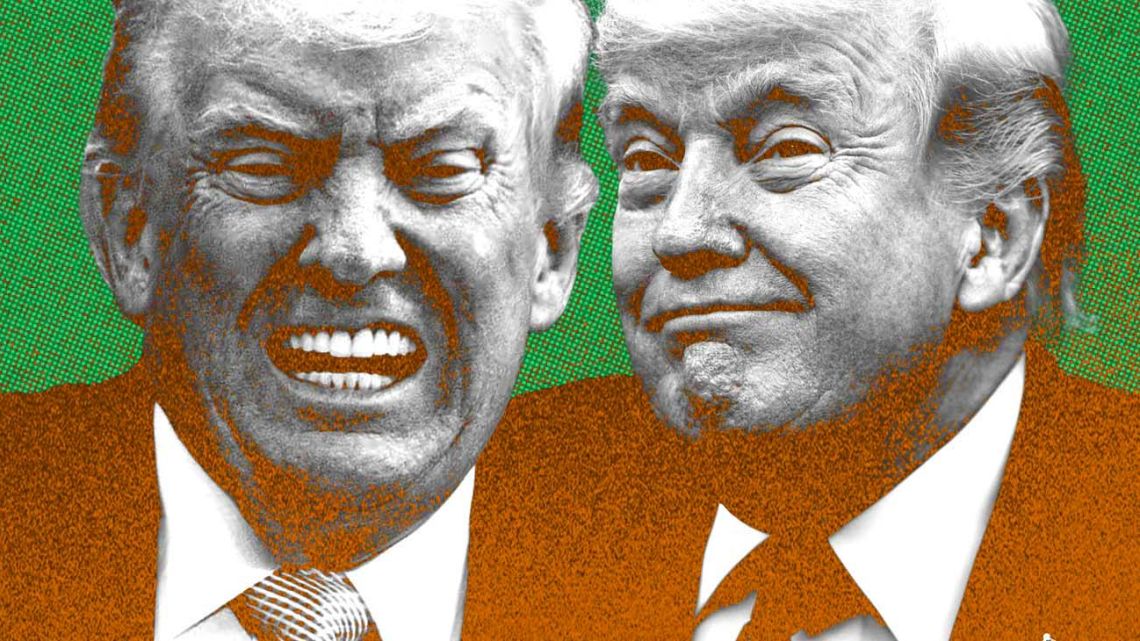
There are two Donald Trumps. One sees himself as a visionary statesman who is vigorously engaged in reshaping the world order in accordance with a grand design that only he understands. The other is a small-town politician who is obsessed with opinion polls and is more worried about the electoral impact of rising petrol prices than the risks posed by a brutal theocratic regime that is determined to wipe a close ally of the United States off the face of the earth and makes no bones about its desire to do the same to the “Great Satan” itself.
The pair take turns in office, with the first Trump telling the Iranian ayatollahs that unless they hand over all the enriched uranium they are hoarding underground, he will rain fire upon them to send them back to the Stone Age where he thinks they belong, and then getting jostled aside by the second one who says he is about to sign a mutually satisfactory deal with what remains of the regime he has been battering that will allow it to carry on much as before.
Many North Americans and most others evidently want the small-town Trump to prevail because they know it would humiliate the world-bestriding version of the US president. As far as they are concerned, attacking Iran with the aim of depriving the ayatollahs and the equally murderous Jihadists of the Revolutionary Guard of their nuclear programme was blatantly “illegal.” Many are unabashedly delighted to see that it did not bring about “regime change.”
The standard view among the more forthright critics of what, for a couple of weeks, Trump had in mind seems to be that the Iranian clerics are fully entitled to arm themselves with nuclear bombs for use against the imperialistic Zionist entity and, for that matter, to charge tolls on oil tankers wanting to pass through the Strait of Hormuz. Some have come very close to congratulating the Iranians for pulling one over on Trump by turning that vital waterway into a strategic asset that enables them to hold the global economy to ransom.

Few show much concern for the Iranian people. Before the war started, Trump did encourage them to rebel against the religious dictatorship oppressing them and promised that “help was on its way,” but of late he has not made many allusions to their plight. The attitude towards them of the many who have taken to gloating over Trump’s discomfort is far less ambiguous; for them, the fate of the large majority of Iranians who would like to see an end to the pious thuggery they have had to put up with for almost half a century is a matter of unconcern. The more progressive are wonderfully empathetic when it comes to the suffering of Palestinians caught up in the wars Israel is waging against Hamas and Hezbollah, but have been left unmoved by what happened to the tens of thousands of Iranians who were recently slaughtered by the regime’s enforcers who, reportedly, were helped by imported Jihadists supplied by Iran’s proxies. There have been no massive demonstrations on their behalf in Western cities.
The religious cult that has long ruled Iran poses a genuine danger not only to democratic countries, beginning with Israel, but also to China and, though Vladimir Putin has other things on his mind, to Russia. Its beliefs, objectives and, on occasion, its methods are not that different from those of the Islamic State which, being a movement rather than an organisation governing specific territories, continues to crop up in Africa, Pakistan, Afghanistan, Iraq and other parts of the Moslem world. Islamists do not believe in sovereign countries and for them the only frontier that matters is the one separating the “house of peace” they own and the “house of war” in which lives the rest of mankind.
The Iranian regime is every bit as explicit about its overall aims as are the Islamic State and its variants. Like them, the ayatollahs and their followers are at war with Western civilisation and are clearly determined to go to any lengths in their efforts to undermine it. With discontent boiling over in so many democratic countries, they have no lack of willing helpers, most of whom would in all probability end up among the first victims of a thoroughgoing religious purge were the radical Islamists to get hold of the political power that they are so strenuously seeking.

Did Trump make a historic blunder when he chose to join Israel in what began as an attempt to overthrow the Iranian dictatorship? For those who refuse to believe that it was on the point of acquiring a nuclear arsenal it would use to annihilate Israel, he clearly did but it can also be argued that previous US administrations, dating back to Jimmy Carter’s, made a far bigger mistake when they decided to tolerate its existence, shrug their shoulders on hearing about the mass “Death to America” rallies it regularly staged, and hope that somehow or other it would turn into a common-and-garden tyranny they could live with.
Their indifference to what was confronting them can be attributed not just to an aversion to performing the arduous and expensive duties of an “international gendarme” in remote places but also to a certain contempt for Islam as such; the idea that its devotees could see it as a viable alternative to the Western way of life struck them as too outlandish to take seriously. If almost all Muslims were ignorant rustics clinging to strange ancestral beliefs, that dismissive approach would have made sense, but it so happens that large numbers of believers are highly intelligent and practically-minded individuals who, after familiarising themselves with Western customs, have found them wanting. Underestimating them, as so many Western intellectuals and, needless to say, politicians are prone to do, could prove fatal.
If Trump ever thought there was a “Venezuelan solution” to the Iranian problem, and that after removing the “supreme leader” a suitable sidekick could be persuaded to play the part of Delcy Rodríguez and do his bidding, he will have realised by now that things were never going to be that easy. In recent days he has been vacillating in public between renewing the military campaign and negotiating with the Islamic Revolutionary Guard Corps, an SS-like outfit that seems determined to fight to the death. If that is so, Trump will have little choice but to put some “boots on the ground” – even if it does cost Republican candidates votes in the fast-approaching mid-term elections. This should have been clear to him from the start but, of course, it was not.






Comments