

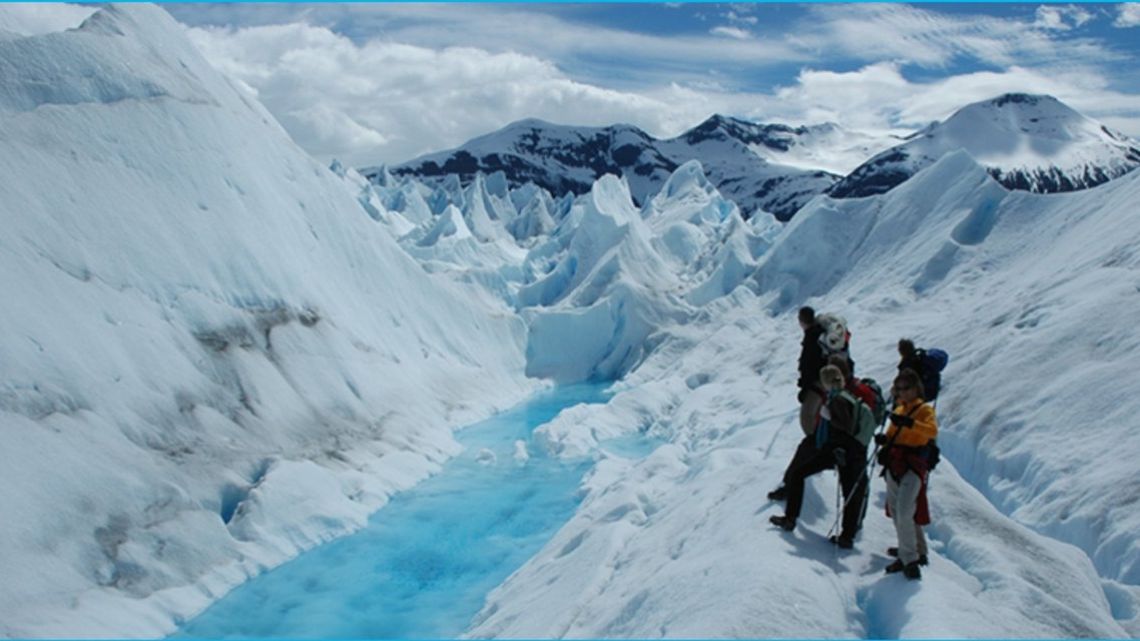
A bid to translate a longstanding yearning of multinational mining majors into reality is being made during Argentina’s summer.
On Monday, the national government presented a bill to amend Law No. 26,639, commonly known as the National Glacier Protection Law, which has already entered the Senate seeking approval in this summer’s extraordinary sessions. The initiative aims at dismantling the minimalist régime which today protects glaciers and the periglacial perimeter – i.e. Argentina’s most important strategic water reserves.
As anticipated and has been the general rule since this government took office, the reform represents an extremely grave and unacceptable regression in the protection of water. It comes in a context of climatic crisis, the accelerated retreat of glaciers and growing hydric stress nationwide.
The government’s bill introduces structural changes which would completely alter the letter and spirit of the current law. Firstly, every glacier could potentially be destroyed. Why could that happen? Because the reform eliminates the automatic protection established today by the existing law, replacing it with a discretionary system. Via a simple declaration of a provincial authority, a glacier may be placed beyond legal protection and cleared for extractive activities.

Secondly, the bill eliminates the express prohibition of mining in periglacial perimeters. The Glaciers Law currently in force recognises that glacial and periglacial terrain form a single system, which is indispensable for the regulation of water. Removing protection from the periglacial surroundings implies, for all intents and purposes, permitting the destruction of the glacier.
The periglacial perimeter not only contains glaciers which we do not see at first sight (rock glaciers), but also frozen soil or permafrost, which are hydric regulators and whose importance is crucial in times of climate change and hydric stress. Intervening in these areas where there is frozen water, whether on the surface or deep down, would mean losing ice which could never be recovered again, altering processes which sustain the volume of the basins. That is why the current law prohibits activities there – the damage would be irreversible. Beyond these zones, Law 26,639 is not the instrument to regulate what activities may be carried out or how.
A total of 12 Argentine provinces have glaciers within their territory: Jujuy, Salta, Tucumán, Catamarca, La Rioja, San Juan, Mendoza, Neuquén, Río Negro, Chubut, Santa Cruz and Tierra del Fuego. According to the National Inventory of Glaciers published in 2018 by IANIGLIA (Instituto Argentino de Nivología, Glaciología y Ciencias Ambientales), the 5,769 square kilometres of Andean glaciers listed in the inventory (i.e. excluding the South Georgias and the Sandwich islands) represent 0.21 percent of Argentina’s total mainland territory. To that should be added the huge surface area of the periglacial perimeter corresponding to the definition of the Law, and which includes not only the moraines of glaciers but also the permafrost (frozen soil).

The ambition of the big mining companies is not to permit any kind of limits to their voracious activities, seeking to reach the minerals below these geoforms without caring about the devastating and irreversible consequences for the population and the ecosystems.
The law to protect glaciers approved in 2010 aims at protecting the hydric basins, which present an ecological and functional unit between provinces and thus they do not belong any one provincial jurisdiction. Invoking “federalism” is therefore an error which could be very costly. The waters are born in one province, cross their territory and continue their course through one or more provinces, irrigating fields, watering cities and supplying different populations. Via the basins between provinces, it behoves the nation state to guarantee their unity, since any action or legal determination in water management affects the entire territory of the different provinces through which they run.
The aim is thus to obtain the best instrument for the efficient and sustainable use of a scarce and vulnerable resource, guaranteeing solidarity between the different provinces within the concept of national territory. This means that the provinces may not dispose of the hydric resources between jurisdictions in exclusive and discretionary fashion since the hydric basins overflow exclusive provincial powers and thus correspond to the entire nation and the Argentine people.

In 2025, the International Year of Glaciers’ Preservation, the national government seeks to amend the National Glacier Law, authorising each province to make further amendments to their taste, following the directives of the mining lobby. It seeks to undermine the prevailing legal framework, appealing to a false federalism, to expand the zone of mining exploitation.
Amending the Glaciers Law in this sense is environmentally risky, as well as illegal. The bill violates the principle of environmental irreversibility, recognised by the National Constitution and by the Escazú Agreement (Law 27,566), which forbids any diminution in the levels of protection already achieved. Instead of reinforcing the protection of water in the face of the climatic crisis, the government seeks to weaken the only clear limit on the advance of mega-mining in the headwaters of rivers.
Once a glacier has been destroyed, there is no possibility of recovering it – its destruction is forever. More than ever, we need to appeal to a basic principle that goes beyond voting and political identity: to protect the glaciers and the periglacial perimeter is to protect the water, the basins and the future of the entire nation – indeed to protect life itself.

We appeal to the citizenry, the social organisations, the communities, the press and legislative representatives to defend the Glaciers Law just as it is without amendments and to prevent any regression in the protection of Argentina’s strategic water reserves.
by Maristella Svampa & Enrique Viale












Comments