

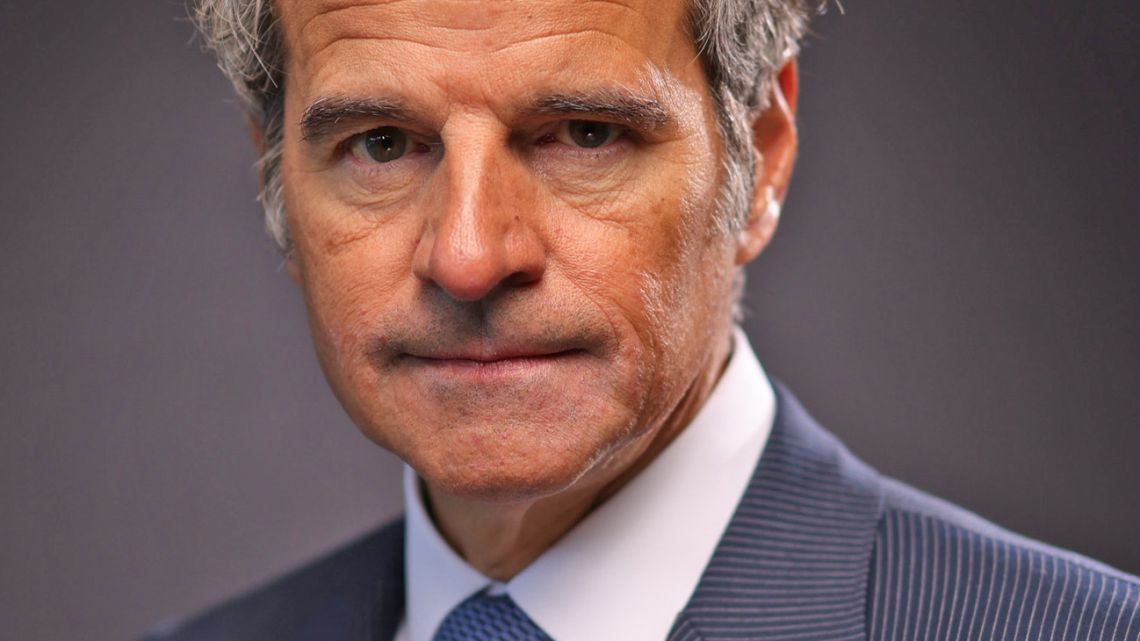
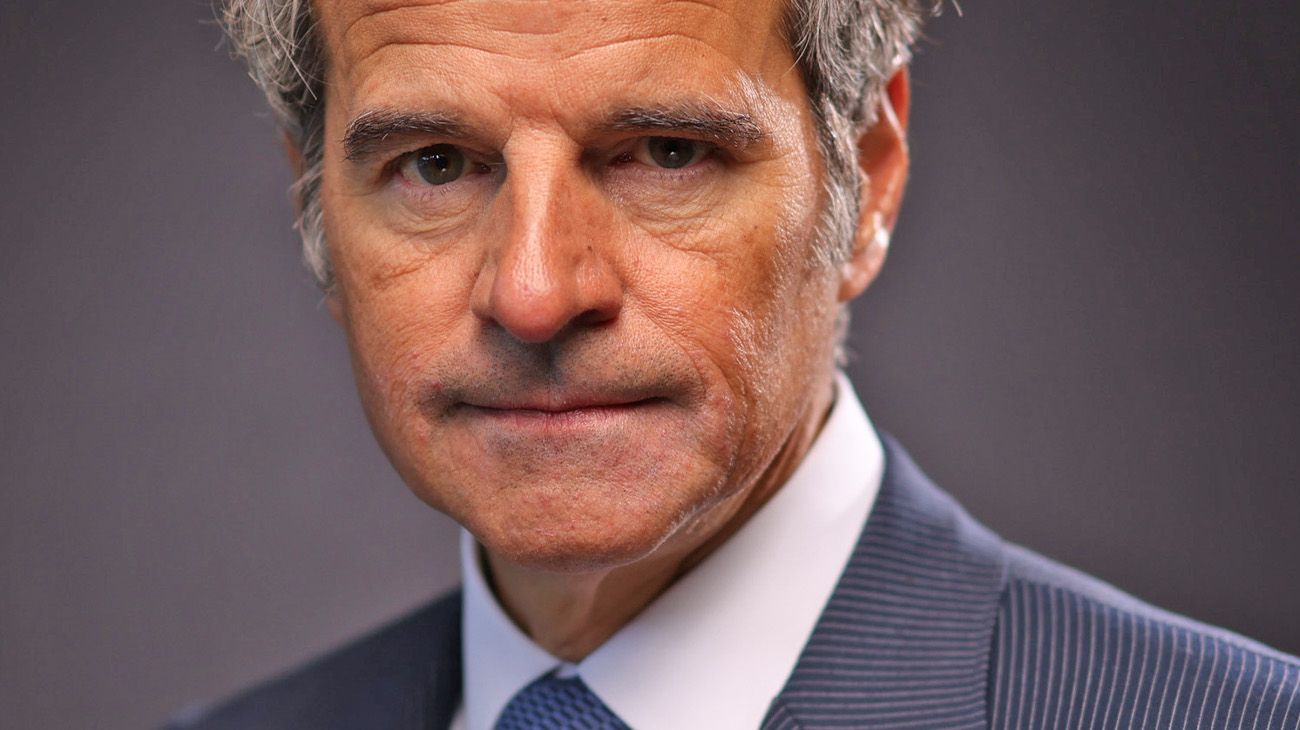
Rafael Mariano Grossi is a career diplomat whose professional life, in recent years, has been defined by his work on nuclear non-proliferation, disarmament and international security, placing him at the forefront of geopolitical tensions.
Grossi, 64, joined Argentina’s foreign service in the 1980s, specialising in nuclear issues, and held a series of posts in the diplomatic corps before moving into multilateralism, taking on key posts in Vienna and The Hague.
He served as chief-of-staff at the OPCW, the Organisation for the Prohibition of Chemical Weapons, and held senior roles at the International Atomic Energy Agency (IAEA), the UN’s nuclear watchdog. In 2013, he was appointed Argentina’s ambassador to Austria, also becoming its representative to the IAEA and other UN organisations.
In December 2019 Grossi entered the frontline of multilateralism, when he was elected as the sixth director general of the IAEA. He is the first Latin American to hold that post and was re-appointed for a second term in 2023.

Grossi has since been at the centre of some of the most complex diplomatic disputes involving nuclear safety and compliance. He has won plaudits for his energetic, front-footed approach to diplomacy, one that has seen him meet key actors in global disputes (including Vladimir Putin, Volodymyr Zelenskyy and authorities in Tehran), visit Iranian facilities and cross into active conflict zones in the Ukraine war, during which he has come under gunfire. He has also been actively threatened by leaders in Tehran, who have promised to “deal” with Grossi when the time is right.
Grossi’s service, experience and energetic approach to diplomacy has seen him installed as a leading contender to replace UN Secretary-General António Guterres, when the current UN chief’s term in office ends in December 2026.
In an exclusive interview with the Times, conducted in the days days after his candidacy was officially launched by Argentina’s government and the CARI think tank in Buenos Aires and prior to US President Donald Trump’s ouster of Venezuela’s Nicolás Maduro, Grossi discusses the United Nations, his approach to diplomacy and his career to date.
I enjoyed seeing you speak at CARI. The first thing that I wanted to ask about is this phrase you returned to: “Active diplomacy.”
Yes...
The UN has this reputation, or it has had historically, about having leaders that take their time, whereas your approach seems to be a bit more energetic.
I would say active diplomacy because it’s what, in my opinion, it’s badly needed at the moment. And I think you have to think about your approach to what is happening.
Of course, you have to think, you have to avoid being rash and things like this. This is the golden rule of everything, in particular diplomacy, and not to be hectic, not to be impromptu. But it is clear that you have to move [forward].
You spoke a little bit [in your speech] about the UN not quite following through on its founding principles. Do you think those principles are still relevant today or do they need adapting for the modern time?
I think they are relevant. Of course, you reflect or enact those principles according to the times you’re living in.
I’ve used this analogy before: Mozart is Mozart, but you play it differently. It’s the same music but you’ll play differently. You might have different forms of words in English today to express what the UN Charter says, but in reality, when you talk about the centrality of peace and security, development or the humanitarian action, I don’t think you could come up with a better formulation of basic tenets for any international endeavour of this type.
It’s about addressing the needs and the deficit – which is a deficit of the UN as a relevant actor in the solution of a number of problems, [for example] wars, conflict, etc.
For you, has it strayed from that brief considerably then?
Yes, it has… it’s moving into irrelevance.
How so?
By inaction, omission, impossibility, frustration, passivity, cynicism, or simply the wrong agendas. I think when you have all these conflicts in the world today, the UN is nowhere to be seen. It is so clear.
How do you implement those changes, practically? I think it’s fair to say that there’s quite a lot of the global community that would agree with that criticism. But reducing that level of bureaucratic inertia, how do you actively tackle that? Is it about being there on the ground?
Well, of course, it’s about being there on the ground and knowing what to do when we are on the ground and knowing how to prepare your presence on the ground.
I've been doing business [i.e. negotiations] in a war zone. And, you know – knock on wood – so far, relatively good! In the Middle East, in Iran and in China, Japan – very different, difficult places.
I know how I’ve done that. And I think that this could be done equally as efficiently as I have been doing it, on a bigger scale. And even better, I would say, because you would have a bigger structure supporting that effort and hopefully the support of many, many countries.
The work that you’ve done today obviously stands on its own. But the UN is a different organisation…
Yes.
I think it’s fair to say in your current role, your technical profile suits the IAEA so well. And that technical knowledge provides benefits, right? But with the UN, you’re covering so many different streams – you’re also on human rights, climate change, things like this. Some of these are not so fashionable in the current climate today. How do you plan to bring all those things together?
What you say has been said to me before. People say ‘You’re good at what you do in the IAEA. Why go there? Why go to that place?’ Well, because that place [the UN] continues to be indispensable. And I think that the skills that I have, which are perhaps perfectly suited to the IAEA, can also be extrapolated. And I have other skills, perhaps, that I’m not showing so much while I’m at the head of the IAEA. They could also be put to good use – of course, one doesn’t want to be obnoxious! [Laughs]
Basically, it’s about being a good diplomat. If you have a good approach, an important comprehension of historical processes, a good understanding of energy, technology and so on, that helps a lot. I think at the end of the day, it boils down to being a person who can tackle things, solve them efficiently. It’s not completely spontaneous, it comes with years of exercising the profession. And I think I know how to do it.
It’s the experience, what I have been doing has led me to believe that it is possible. The UN needn’t be where it is now – and I have this conviction in me.
Would you agree that the UN has lost credibility today?
Well, I think it has, to a certain extent, lost credibility. The principles have not, the mission has not…
What does credibility as a concept stem from? It comes from the ability to do the stuff you are supposed to be doing. You are credible when you are – for example – a good journalist or a good DG [director-general]. And then you start losing it when people cease to see that productivity, that effectiveness in you.
I think it’s fair to say, hard as it may sound, that we don’t see how the UN is adding value [right now]. It adds value in some areas and I think that needs to be recognised, which is sometimes lost in translation...
Or lost in the headlines…
In the humanitarian area, you know, we have 10 million displaced people. The UNHCR [UN Refugee Agency], what a great job they do. There’s a lot of good that can be said about the UN, but I think it has left vacant its central purpose. And it has gone into certain areas in a way which is divisive. When you start reflecting the views of some, again that affects the credibility of the exercise.
Regarding Mr Milei’s speech that he gave at the UN last year. He was talking about this idea, about imposition on other cultures, the imposition of ideas or certain characteristics. Would you agree with those criticisms?
Well, it’s a good question for Mr Milei. But I think he reflects a current of thought, which is larger and wider than him. Expressed by some countries.
You heard me refer the other day to the people, the people in the street, normal people. This is the impression. And many governments, some of which are not going to express it in such a clear way – President Milei is very eloquent, very clear in expressing his thoughts. I think that it reflects quite a growing, perhaps, perception of the UN.
A lot of his criticism is related to this kind of cultural stuff, the ‘anti-woke’ stuff. Would that be something that you would look to tackle?
Well, one thing which I believe is important is to look at the approach of the UN in the globality of the effort. Some ideas, some concepts, have a lot of importance in some Western countries, but when I go to other parts of the world, less so.
I’m talking about very simple things, not strange things about dominance or about the role of women in society, for example. Certain things that must reflect and respect the plurality of world society.
There are obviously two selection criteria for the SG post. There’s this talk about a Latin American representative, even though regional rotation has not always been followed. And the main point against you is that you’re not female, a woman. Could you explain to me why you think you are the best candidate?
Yes, because I believe when it comes to elected positions, gender must never be a criterion. You are there to elect the best person for a job. This is said with due respect – I don’t think it’s serious to say for the UN to say ‘I need a woman.’
I’ve done lots on the equality of men and women at the IAEA – I took an organisation that had 28 percent of women professionals. We are at 53 percent now and they are not clerks! [They are] Directors of nuclear safety, nuclear security, nuclear power, inspectors, etc. I’ve created fellowships for young women in nuclear sciences.
For now, I am the only [official] candidate, but let’s assume there are a few distinguished female candidates. I don’t think they would like to believe – and I speak as the father of seven women – that they are there because they are women, but rather because they are the best.
And Latin America?
I would be perhaps a bit unorthodox here... frankly, let candidates from all regions compete, if they so wish. Yes, it is true that there are is a historical factor – four Europeans, two Africans, two Asians, one Latin American [secretary general in the past]… OK, you can say, well, it’s our moment. But I personally wouldn’t be in disagreement [with candidates from outside the region running]. I want and I’m keen to compete with anybody who feels that he or she has a platform, a vision statement, that they want to present.
As an Argentine and as a Latin American, what would it mean for you, if you were successful in winning the post? How important do you think that is for Latin America as a whole?
It would be important for Latin America, absolutely. Despite all the tensions, differences and critical issues we have at the moment in our region, there is an underlying basic idea of Latin America as a region of peace. Of course, if you go to history, you will find conflicts that existed. But in general, if you look at them, these conflicts never lasted for long. And immediately the region came together as one [afterwards]. Take the Chaco War, take the Peru-Ecuadorian War, etc. There was always this idea that it would be fratricidal. This you don’t see so much in other parts of the world. So I think there is this idea of an underlying sentiment of peace, cooperation, solidarity, [which] has sometimes been abused as a concept or misrepresented as a concept, but I don’t think it is irrelevant.
I also think this continent represents the idea of a mix. In this day and age, migration is a big problem and we have dealt with that – I’m the son of Italians, you know. Argentina, you know, it’s a place where anybody can come. It’s constitutional. It’s a concept that came from our founding fathers, from [Juan Bautista] Alberdi.
And I must say that in general, when you go and deal with conflicts in Africa, in Asia, in other places, like being a Latin American, sort of helps. You have less baggage. And you have other elements to help, [like] Messi and Maradona!
At the IAEA, you’ve crossed into war zones to visit nuclear plants, going to Iran, meeting [Vladimir] Putin etc. Why is that approach so important to you?
I think it boils down to leadership. You have to do it, you have to play the part, act the part, believe in the part. And the general has to be on the battlefield and has to be the first.
You know, as I said to my inspectors when we were crossing [through war zones], I would never go to a place I have not been myself first. And when we came to that grey zone and they were shooting at us, I told everybody, ‘Go home. I go first, then you come if you want. There’s no problem. But I will go.’ My team was incredible, and they were with me, and we crossed. And I believe in that. I just believe in that.
This is what, well, you mentioned that earlier, the ‘C’ word: Credibility. That is political capital that you bring to the negotiating table because you can talk to the leaders and say, ‘I know, I’ve been there, I know what needs to be done.’ It incurs risks, of course, death threats and all of that, which is a cost you pay.
How do they affect you? How does it change your day-to-day life? My guess is you travel with a lot more security?
Yeah, it changes my day-to-day, it affects my family to a certain extent and then you can feel guilty about that, but I feel supported. It’s something I’ve discussed with my children, for example, why I do it, why I believe in that. And again, I think in one’s personal life, our children will take examples from what we do, not what we say.
You're talking about setting examples to your kids and showing them what you do, but that's also relevant for the rest of the world.
I think it is. Because leadership is... what is leadership? Leadership is also a reflection of a role, of someone who says, ‘Well, this is the way and I'm telling you that this is the way because of this, this, this, this and that. I've been there and I'm ready to assume the risks of what this entails.’
In a sense, [with] this kind of a job... you know, your private life disappears. The concept of free time disappears. And of course, you must go there because such and such is going to be there. And of course, take that other call, even if it's 2am in the morning or be there, even if it's your son's birthday, because it's a unique opportunity and you have to be there and you have to do the job. You're putting your life at the service of something.
And you're ready to do that.
I am doing it already.
You are the only declared public candidate to date, but it would be remiss of me not to ask about support. You already have three countries, including Argentina, with Italy and Paraguay.
I value that enormously. I'm so moved by that, especially Italy. You know, I'm half-Italian. For me, Italy is my country as well. I'm one of those Argentines very close to his Italian family. I have family, I see them all the time. The little town my family came from made me an honorary citizen. It’s a very strong feeling.
We know that we’re talking about the P5 [the five permanent members of the UN Security Council: China, France, Russia, United Kingdom, United States] here, right? This is really what we’re talking about. Do you feel like you have support of those powers?
I feel confident.
What did your early years in Argentina’s Foreign Service teach you here?
My beginning in the Foreign Service of Argentina coincided with the return of democracy in Argentina. And that was, for many Argentines, after the war in the South Atlantic and then democracy coming. And in my area in particular, don't forget Argentina had announced uranium enrichment and a secret enrichment plant in the Patagonian desert – the stuff of a Netflix film, all right?
The government was struggling with understanding the extent of this nuclear programme. And I began as a diplomat there. They were creating a unit for nuclear affairs. And I said, ‘I want to go there.’ Nobody wanted to, of course! You want to go to the North American Department, so you get a posting to Washington or to London and you go to the Western European Department or whatever.
I had a boss who was a visionary, who said to me, ‘Well, you know, Rafael, you want to do this, you have to understand this stuff.’ And so instead of, you know, wearing a nice suit and being a diplomat, you're going to go there. And I spent almost a year touring all the nuclear facilities in Argentina being trained. I got a certificate in the end from the CNEA, the National Commission of Atomic Energy. Of course, I was not dreaming that I would be the Director General of the IAEA one day, though it came handy, I must say!
I think that marked my process, joining the Foreign Service there, feeling that this was a very important area for my country, one where Argentina needed to play by the book. Argentina was not signing the Treaty on Non-Proliferation of Nuclear Weapons. And then a few years later, what we did with Brazil, that was a life-changing experience, where a generation of young diplomats from both sides got together and we decided that it was folly to have a nuclear arms race in this region. And we changed that. We really did, with the creation of the ABACC [Agencia Brasileño-Argentina de Contabilidad y Control de Materiales Nucleares]. I saw that, I worked on it. We did something that is, still today, studied as an example of how you can change a reality.
These early and extreme examples of active diplomacy, that really changed reality, marked me for life.
Say you do win the race. Let’s just forward five, 10 years. What changes do you hope to have introduced?
I think we need to, we must, we need to be able to say, together, that we have addressed the UN and put it back to where it should be.
One more question if I may: I was talking to my seven-year-old son yesterday and – after explaining to him what the United Nations was and what it does – he told me to ask a question. It was: “How do you do peace?”
(Laughs) You “do peace” by always trying, by never stopping, by not believing that you’re not going to be able because it’s too difficult, that it’s not within your reach. It’s a matter of trying and trying and trying.
Something else, does he like football?
Sure.
I follow a team – which he could consider following too – Estudiantes de la Plata, recent champions. We are a team that never gives up. We were almost defeated in a final recently and we came back. It is a team that makes it by hard work – its fans chant about working! Thousands of people talking about hard work! At Estudiantes, we work. This is how I feel – you can "do peace" by never giving up. And when you win, you win big.
related news


Image Gallery





Comments