
A ceremony in Salta this month paid tribute to Dr Joseph Redhead (1767–1844), a physician, scientist and contemporary of the independence wars whose legacy lives on, more than two centuries after his arrival in the Río de la Plata.
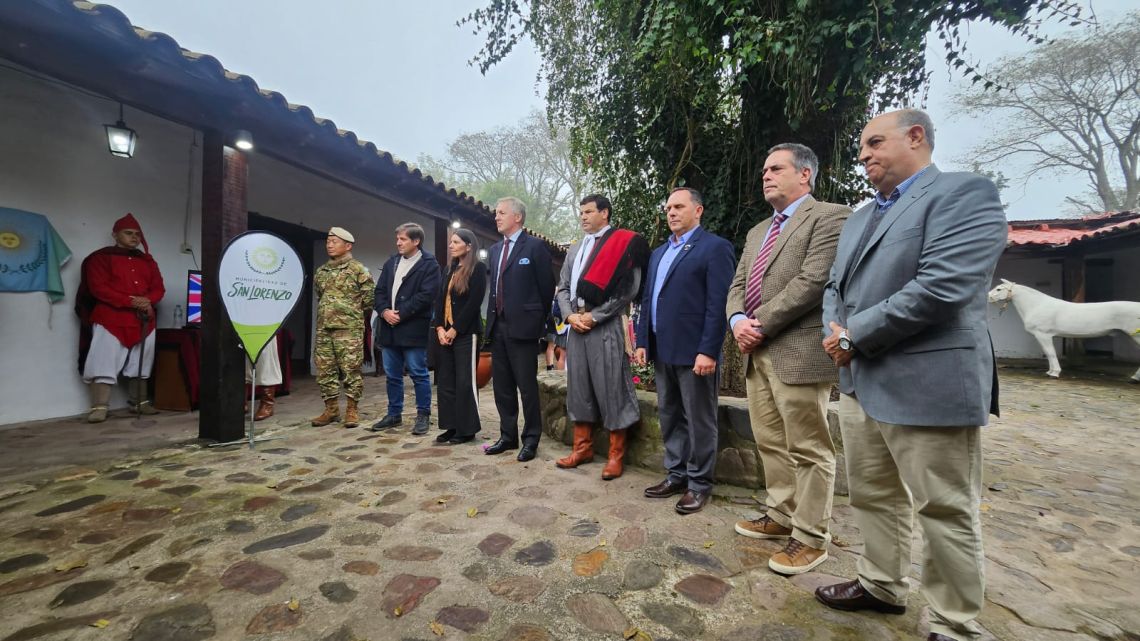
On 4 June, the Museo de la Gesta Güemesiana, together with the Colegio Sagrado Corazón Luz y Guía, organised a ceremony honouring Dr Redhead, physician to Generals Martín Miguel de Güemes and Manuel Belgrano and widely regarded as colonial Salta’s foremost scientist.
Among those attending were authorities from the Municipalidad de San Lorenzo, UK Ambassador to Argentina David Cairns, Army Commander of the 5th Mountain Brigade Colonel Hernán Aoki, gaucho associations, historian Dr Ricardo Alonso and representatives of the British community in Salta.
Dr Alonso, who has written extensively on Redhead and is regarded as the authoritative scholar on the physician, provided historical context to enrich the tribute.

A commemorative plaque was unveiled during the ceremony, symbolising the enduring recognition of Redhead’s contributions to both science and Argentina’s struggle for independence.
Born in Antigua in 1767, Redhead graduated in medicine from the University of Edinburgh. After arriving in Buenos Aires in 1803, he concealed his British origins by claiming to be from Connecticut in the United States. Before settling in the Río de la Plata, he had also studied at the University of Göttingen and travelled extensively through Italy, Russia and France.
He settled in Salta in 1809, where he undertook extensive studies of the region’s vegetation and carried out pioneering research into typhus and malaria in Rosario de Lerma. By 1812 he was in Tucumán, serving as physician to General Belgrano, whom he accompanied in victory at the Battle of Salta in 1813 and in defeat at Vilcapugio and Ayohuma. He was Belgrano’s attending physician at his deathbed in 1820.

Redhead’s contributions to science earned recognition well beyond the region. In his monumental Buenos Aires and the Provinces of the Río de la Plata (London, 1852), Woodbine Parish repeatedly cited Redhead as a correspondent, acknowledging his geological and barometric observations, including reports on the Chaco meteorite. Parish also noted Redhead’s theories on the origin of native iron, which were shared by Alexander von Humboldt, and even mentioned a walking stick fashioned from meteorite iron.
Redhead’s barometric measurements were pioneering, calculating the altitude of Salta at 3,973 feet and recording elevations across the Quebrada de Humahuaca, La Quiaca, Tupiza, Potosí, and Chorolque. He was one of the first scientific mountaineers to measure Andean summits in the Southern Cone.
His published works included Memoria sobre la dilatación del aire atmosférico (1819), an unusually rigorous experimental study for its era. Unpublished notes written in English on the influence of the sun and atmosphere on plants and animals are preserved in the library of Luis Güemes.

By honouring Dr Redhead at the Museo de la Gesta Güemesiana, with the collaboration of the Colegio Sagrado Corazón Luz y Guía, Salta reaffirms its dedication to preserving the intertwined heritage of science, medicine, and independence.
The new plaque places him firmly within the historical narrative of Güemes’ patriotic struggle and helps ensure his contributions remain part of Argentina’s collective memory.










Comments