

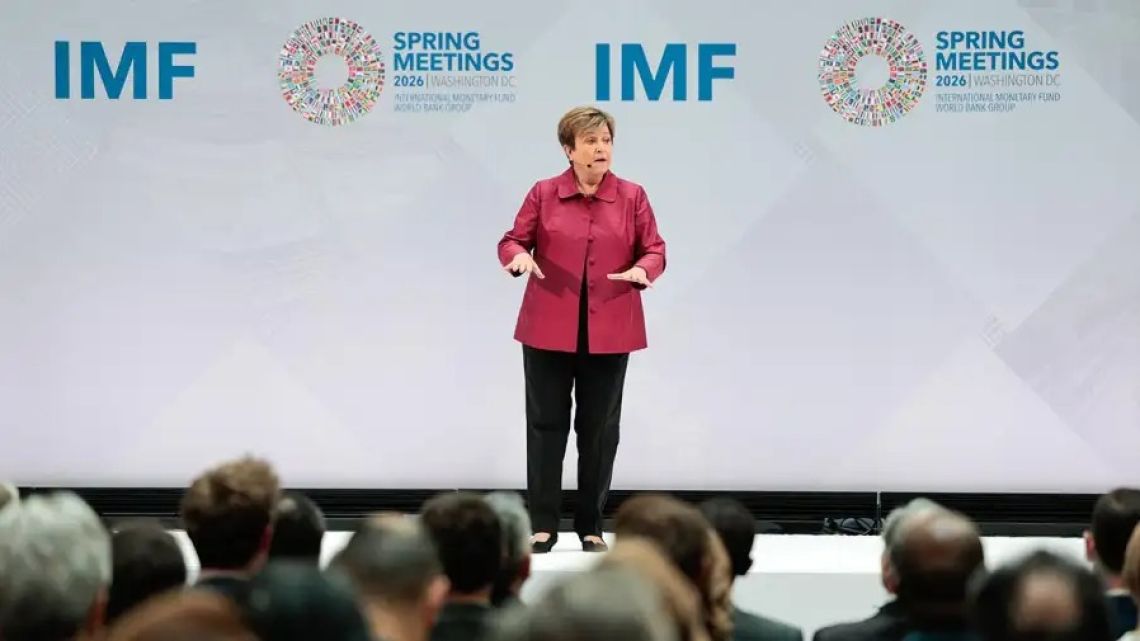
The conclusion of Argentina’s staff-level agreement with the International Monetary Fund (IMF) came with a coded message at the 11th hour, reflecting the pressures facing President Javier Mlei’s government – the institution must respond to a global crisis and the outcome of US elections, which could stress-test the financial backing Argentina has received.
During the IMF’s Spring Meetings in Washington, the Fund’s staff finalised Argentina’s numbers but inserted a condition: that the economic team must implement additional measures before any funds are disbursed.
In the closing lines of the IMF’s official statement, the institution led by Kristalina Georgieva noted the following: “IMF staff welcomes the strong and constructive engagement with the authorities and their continued commitment to the programme, including through the implementation of corrective measures to address earlier setbacks. Upon completion of pending measures, the review will be submitted to the IMF Executive Board for consideration.”
Among analysts in Washington, the reading is that it is “highly unusual” for IMF staff to announce a staff-level agreement while, in the same breath, making it clear that escalation to the Executive Board depends on additional steps. Sources with direct knowledge of the institution’s working suggest that the ‘asterisk’ in the statement could be linked to a specific move on capital controls, although they ruled out any potential demand for a sharp devaluation.

The Fund’s wording implies that corrective actions are in their final stages and that, once the last operational milestone is met, the final green light for disbursement will be granted.
Tug-of-war

Behind this bureaucratic delay lies a high-stakes tug-of-war; IMF staff are feeling political pressure from the White House. One insider told Perfil that the technical team is effectively “kicking” the decision upstairs to the Board, where the final battle will be fought.
Washington’s backing for Milei’s government is unequivocal, but driven by short-term electoral logic: US President Donald Trump needs foreign policy wins as he faces mounting fatigue on the domestic front.
The run-up to the November 2026 midterms in the United States is shaping the approval ratings of Trump, who is reeling from a string of six consecutive local electoral defeats. In this context, economic support for Argentina has become firm and largely unquestioned at the US Treasury.

Remarks by US Treasury Secretary Scott Bessent at the Institute of International Finance hinted at the role Washington's economic figureheads are playing in shaping pressure on the IMF. “Argentina has been a fantastic success. They are building reserves every day,” said Bessent. “Tens of millions of people have been lifted out of poverty and it is very interesting to see that the poorest and the youngest voted for the government of Javier Milei. There is optimism there."
For IMF staff, however, US optimism clashes with the cold reality of the data. In its latest World Economic Outlook report, the Fund revised Argentina’s growth prospects for 2026 downwards. It now forecasts GDP will improve 3.5 percent this year – half a percentage point lower than predicted six months ago – with annual inflation of 30.4 percent, nearly double the previous estimate. The Fund attributes the overheating to a “negative supply shock” stemming from the war in Iran, which has driven up global logistics costs.
Parameters
To safeguard the programme’s sustainability, the IMF-Argentina staff-level agreement sets out strict parameters across five key fronts, with a particular warning regarding the monetary framework overseen by Central Bank Governor Santiago Bausili:
-
Monetary policy: The main point of friction – the Fund has called for strengthened operations through “upfront measures to contain interest rate volatility and improve monetary policy transmission and credit allocation.” Monetary is to remain “appropriately tight,” with the ultimate goal of widening exchange-rate bands to enhance flexibility in the face of external shocks.
-
Fiscal policy: Argentina’s zero-deficit target is reaffirmed as a non-negotiable anchor, consistent with a primary surplus of 1.4 percent of GDP this year, underpinned by spending restraint but with “sufficient space for targeted social assistance”.
-
External position: The aim is to increase net international reserves by at least US$8 billion in 2026, requiring Central Bank purchases of no less than US$10 billion over the year.
-
Financing: A multi-pronged strategy will be deployed to roll over foreign-currency obligations, including local-law debt issuance, asset sales and external borrowing, potentially backed by multilateral lenders.
-
Structural reforms: Measures will focus on boosting formal employment and productivity in strategic sectors such as energy, mining and the knowledge economy.
Timeline
Notably, the IMF’s staff made no mention of any request for a waiver from the Board to overlook Argentina’s repeated failure to meet its reserve accumulation targets, which it has now missed for a second consecutive time.
The deadline for the Executive Board to consider Argentina’s case is May, when US$805 million falls due to the Fund itself. To avoid placing further strain on its reserves, the Board would need to convene and approve the disbursement before that date.
Yet political timing appears to be at odds with the urgency of the financing needs. The interval between staff-level agreement sign up and the Board’s formal meetings has getting bigger. Historical patterns suggest that the Fund’s bureaucracy slows as Argentina’s programme becomes more fragile.
related news
Milei vows to stay course, tackles ‘bad’ inflation data head-on in AmCham Summit speech

Argentina's inflation picked up more than expected on energy shock
Diego Maradona's birthplace repurposed as soup kitchen for hungry











Comments